
Argentina's Wheat Cut Is Smaller Than You Read. The Next Four Weeks Decide the Rest.
The Bolsa de Cereales de Buenos Aires now puts the 2026/27 crop at 23.4 million tonnes, 16% below last year's record, and most of that gap is last season's exceptional yield rather than this season's weather; what remains open is roughly 1.9 million tonnes of yield, which the belt settles between now and early November.

October 8, 2026
3 min read
The Bolsa de Cereales de Buenos Aires now puts the 2026/27 crop at 23.4 million tonnes, 16% below last year's record, and most of that gap is last season's exceptional yield rather than this season's weather; what remains open is roughly 1.9 million tonnes of yield, which the belt settles between now and early November.
By João Pedro Rodrigues Morciani · Senior Analyst, Helios AI
The Yield Is Being Decided Now, From North to South.
Argentina's wheat is entering the weeks that set its yield, one region at a time. On 1 October the Bolsa de Comercio de Rosario (BCR) had the core region, northern Buenos Aires, southern Santa Fe and south-east Córdoba, at 3% flowering, 17% heading and 25% in boot. The Bolsa de Cereales de Buenos Aires (BAGE) counted 34% of the national crop from heading onward the same day.
The south has not started. INTA, Argentina's national agricultural research institute, places the optimum heading date at its Barrow station in south-east Buenos Aires between 25 October and 5 November, and its Anguil station puts La Pampa's optimum flowering at 27 to 31 October. Northern Buenos Aires heads in the first fortnight of October and Entre Ríos in September and early October, on INTA's and the national trial network's calendars. The belt crosses its most sensitive phase over about five weeks, and the north starts harvesting from late November.
That calendar is a Brazilian miller's exposure when booking December to February cover.
Most of the Cut Is Last Year's Record, Not This Year's Weather.
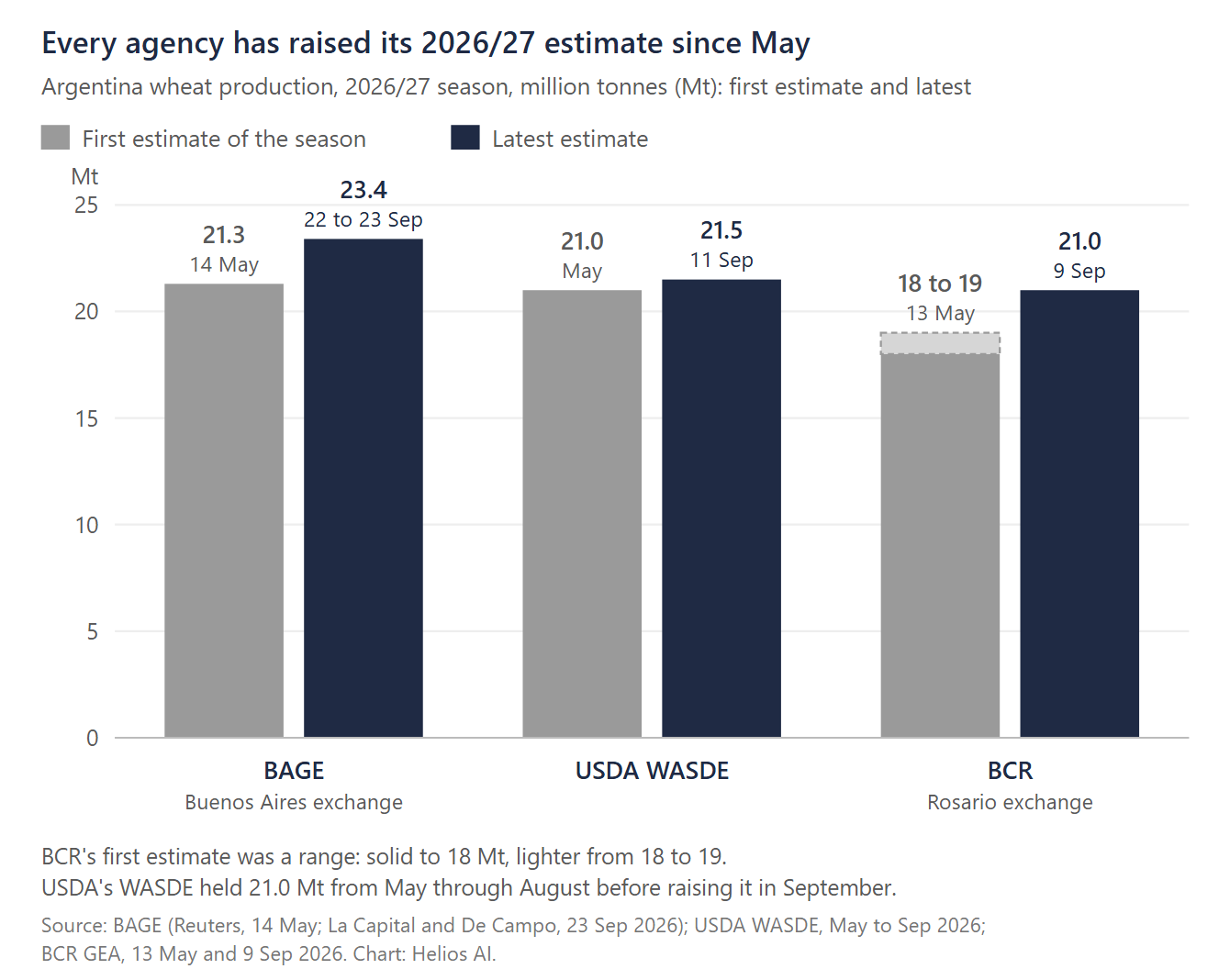
The official number has been rising since May. BAGE opened on 14 May at 21.3 million tonnes, 23% below the record. At its campaign launch on 22 and 23 September it raised that to 23.4 million tonnes on 6.55 million hectares, 15.8% below the 27.8 million tonnes of 2025/26. BCR (21.0 million tonnes, 9 September), the US Department of Agriculture's Foreign Agricultural Service (USDA FAS; 21.6 million in its 23 July Grain and Feed Update) and USDA's September World Agricultural Supply and Demand Estimates (WASDE; 21.5 million) have also moved up since May.
Little of the cut is area. BAGE's 6.55 million hectares compares with about 6.7 million last season, a 2% change worth roughly 0.6 million tonnes on the record base: about two of the sixteen points. BCR and USDA put the area decision on fertilizer prices.
The other fourteen points are arithmetic on last year's yield. The 2025/26 crop yielded a record 43.5 quintals a hectare by BAGE's final count. USDA's 3.27 tonnes a hectare for 2026/27 is a trend yield, in USDA's words: "This decline is largely explained by the exceptional yields achieved in MY 2025/26." Area is not climate. A base effect is not climate.
What is undecided is the gap between trend and BAGE. A trend yield gives USDA's and WASDE's 21.5 to 21.6 million tonnes; BAGE's 23.4 million assumes an above-trend 3.57 tonnes a hectare. The difference, about 1.9 million tonnes or 8% of the crop, is what October and early November decide.
The Crop Took Its Stress Early, at Tillering.
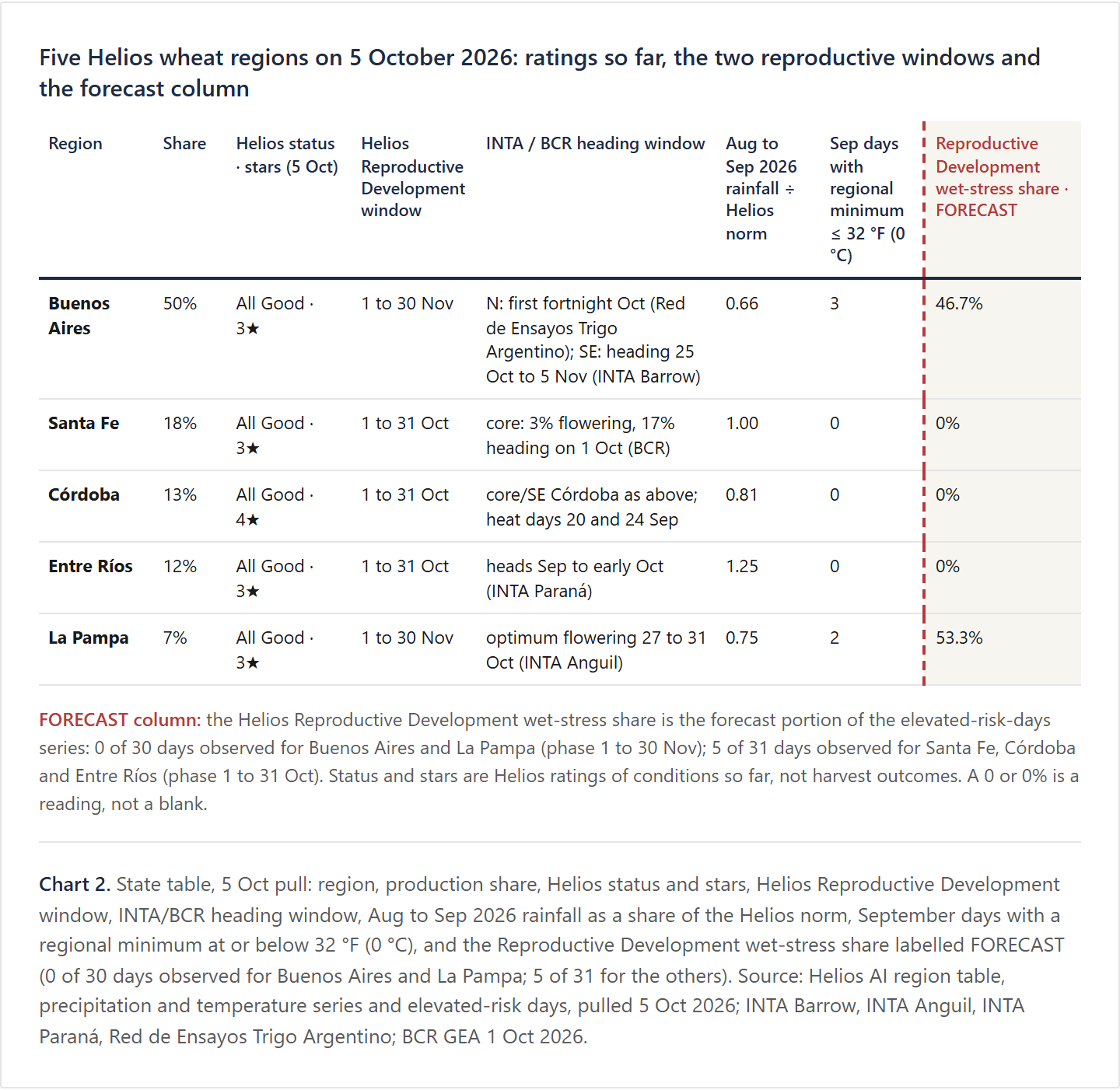
September brought Buenos Aires and La Pampa more freezing days than any earlier September in the Helios series. In the Helios temperature series, pulled 5 October, Buenos Aires had three days with a regional-average minimum at or below freezing and La Pampa two; the four prior Septembers held one such day between them. First-half minima ran 4.4 °F (2.4 °C) below the Helios norm in Buenos Aires and 5.1 °F (2.8 °C) below in La Pampa.
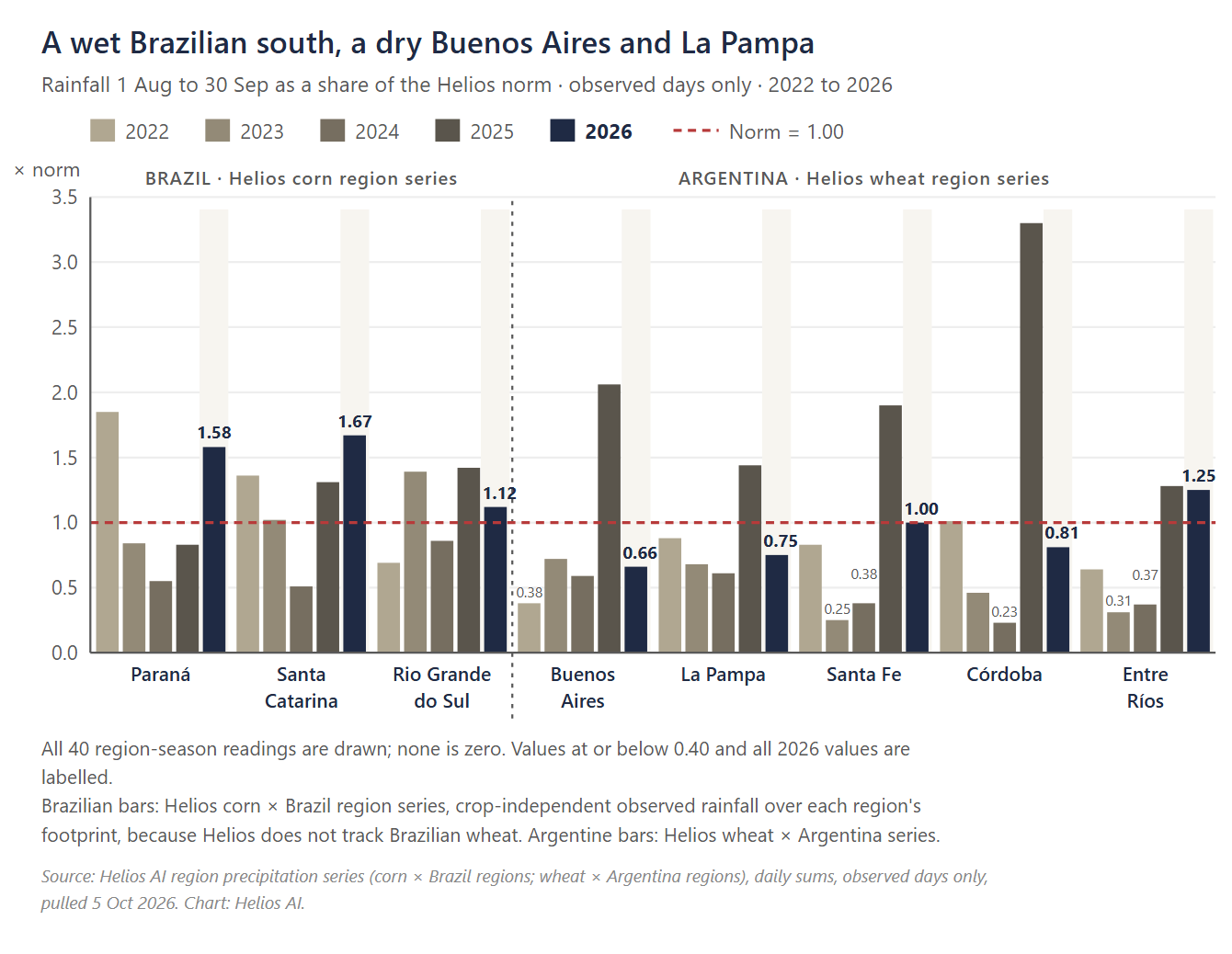
It was dry as well. Helios observed rainfall for August and September, pulled 5 October, ran at 0.66 of the norm in Buenos Aires and 0.75 in La Pampa. BCR's core-region network measured 31.5 mm in September against a normal near 50 mm and had 250,000 hectares in regular condition on 28 September, cut to 120,000 by 1 October after 25 mm fell.
Both exchanges read the damage as limited. With most of the core region at tillering, Cristian Russo, BCR's head of crop estimates, said on 7 September that wheat "should not suffer a critical impact beyond some localised leaf damage" (our translation), and BAGE's 24 September report expected no damage of magnitude. All five Helios regions read All Good on 5 October. That is a rating of conditions so far, not a harvest.
What Can Still Go Wrong, and Where.
Published agronomy names three hazards between heading and grain fill. INTA says heading and anthesis should fall just after a region's last frost. The University of Buenos Aires cereals chair puts heat damage above 32 °C. A wet spring feeds disease, and BCR already reports rust in southern Santa Fe.
The Helios forward read names one of them. The only risk the Helios forecast series flags, pulled 5 October, is wet stress in Reproductive Development, which Helios dates to November for Buenos Aires and La Pampa. For Buenos Aires the forecast puts November rainfall at 1.4 times the norm and flags wet stress on 47% of the phase's days, every one of them a forecast day. The province rows are averages; that November window fits the south-east and opens after the north has headed.
A Strong El Niño Usually Brings a Wetter Spring.
The counter-argument is official and dated. The US National Oceanic and Atmospheric Administration's Climate Prediction Center had an El Niño Advisory in place on 10 September, and on 30 September Argentina's Servicio Meteorológico Nacional (SMN) forecast above-normal October to December rain over the Litoral, western Santa Fe, Córdoba, La Pampa and western Buenos Aires. USDA wrote both sides in July: improved rainfall "is expected to benefit crop development and support higher yields. However, excessive moisture during the grain-filling stage and harvest could adversely affect both yields and grain quality."
The Rosario Curve Peaked in August and Gave It Back in September.
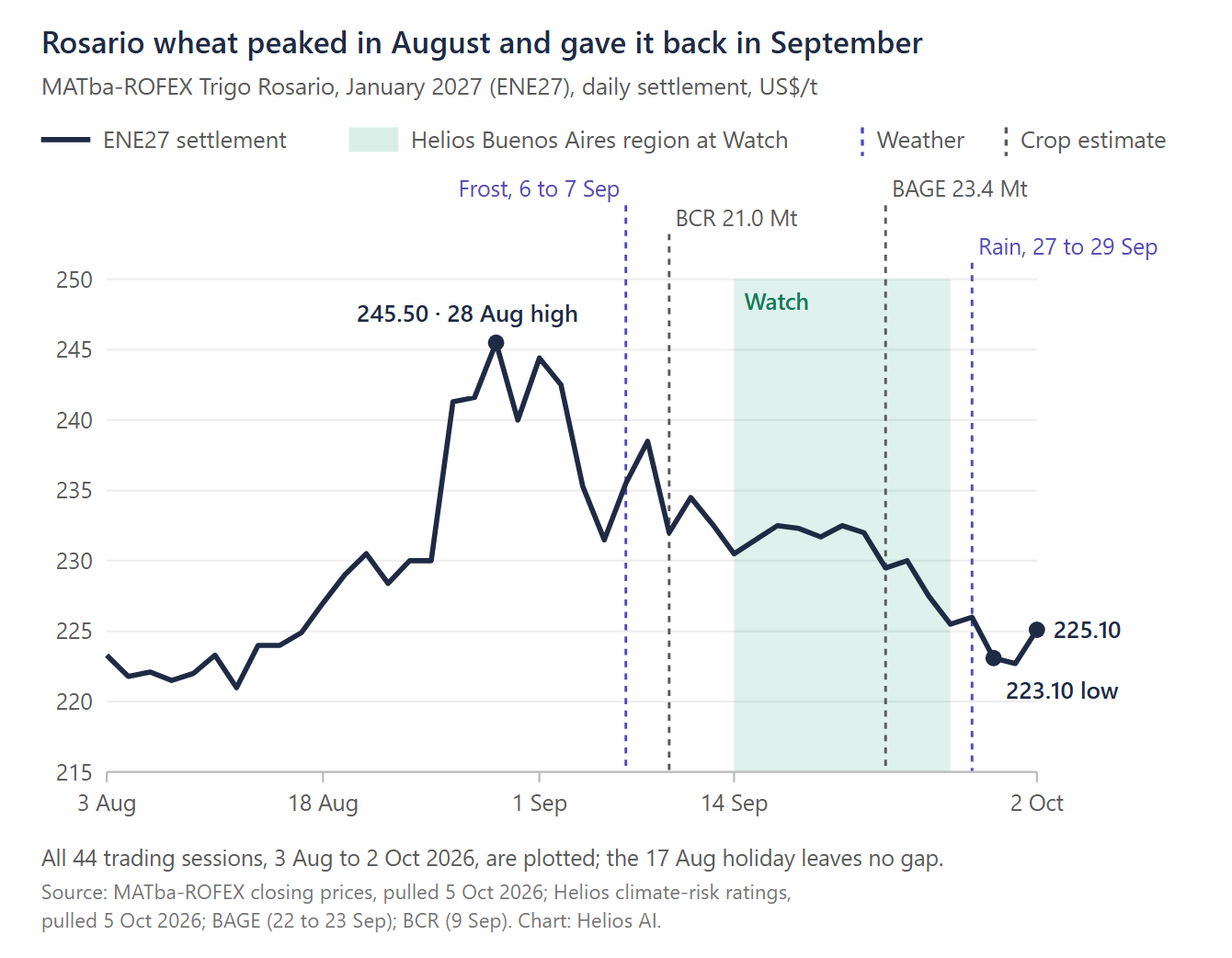
The new-crop price already sits under the old-crop price. On BCR's 1 October quotations, wheat free on board (FOB) at Up River ports was bid at US$251 and offered at US$252 a tonne for spot, against US$248 and US$250 for December shipment. On MATba-ROFEX, Argentina's futures exchange, Trigo Rosario settled on 2 October at US$221.00 a tonne for December 2026, US$225.10 for January 2027 and US$231.00 for March 2027. For a December to February buyer that curve is flat to slightly upward.
The move came in September. The January 2027 contract peaked at US$245.50 on 28 August and bottomed at US$223.10 on 30 September; from 1 September to 2 October it fell 7.9%. The chart draws no causal line.
Brazil's Own Crop Is Short, Wet and Testing Below Type.
Brazil is harvesting a short, wet crop of its own. CONAB, Brazil's Companhia Nacional de Abastecimento, put the 2026 wheat crop at 5.74 million tonnes on 15 September, 27.1% below 2025. Deral, Paraná's state agriculture department, cut its estimate to 2.13 million tonnes from 2.37 on 24 September, with 62% harvested by 28 September.
The quality prints are the problem. Early southern lots test at 70 to 76 kilograms per hectolitre (kg/hl), with falling numbers, the sprout-damage test, down to 200 seconds (TF Agroeconômica, 24 September; Cepea, at the University of São Paulo, 29 September). Brazil's grading rule puts the top grade, Tipo 1, at 78 kg/hl and bread-grade wheat at 220 seconds, so these lots are Tipo 2 to 3 with a tail below type. Abitrigo, the millers' association, raised its import estimate to 9 million tonnes from 7.5 on 24 September, where BAGE's Gabriel Gavarrino said: "El Niño in Argentina is not harmful. It is beneficial, unlike what happens in Brazil" (our translation).
The rain is the part Helios can show. Observed August and September rainfall, pulled 5 October, ran at 1.58 of the norm across the Helios Paraná footprint, the second-wettest of five seasons, and 1.67 across Santa Catarina, the wettest. Rio Grande do Sul, 1% harvested on 1 October, was at 1.12 and near normal in September; its damage came in bursts, frosts on 7 and 8 September at flowering, hail and up to 259 mm of rain in one week, and the extension service Emater reports head blight, giberela, "significant in part of the fields" (our translation). Helios does not track Brazilian wheat, and, as we wrote in August, it does not measure protein.
What This Means for a Brazilian Miller.
The volume question is Argentina's window. Abitrigo expects about 9 million tonnes of imports this season, and Argentina supplied about 76% of Brazil's 6.87 million tonnes of imports in 2025, on CNN Brasil's figures, duty-free inside Mercosur. The roughly 1.9 million tonnes still undecided in the Pampas is small against Argentina's crop and large against Brazil's import need, and it is decided before the first December cargo loads.
The quality question is older than this season. Brazilian mills normally use Argentine wheat to lift the quality of domestic lots, as Safras & Mercado's Élcio Bento described in July, and last season's Argentine crop made that harder: USDA FAS reported protein levels generally lower than normal. With Paraná's lots already testing below type, a mill needs the December arrivals to do the blending work the 2025 crop did not. Helios does not measure protein or test weight; that answer comes from the first new-crop certificates.
The timing question is the El Niño spring. The same wet pattern that is harvesting Brazil's crop is forecast to arrive in the Pampas during grain fill and harvest, which in south-east Buenos Aires and La Pampa means late November and December, the first shipment months. USDA's own caveat names that window. Meanwhile the price signal points the other way: CEPEA's Paraná wheat indicator rose from R$1,453.63 to R$1,553.71 a tonne between 2 September and 2 October, 6.9%, and Rio Grande do Sul's from R$1,355.88 to R$1,454.52, 7.3%, while Argentine December shipment sat US$2 to 3 a tonne under spot at Up River. A mill is paying more for less at home while the new crop it depends on is priced as normal. That is a description of the market, not a recommendation.
The Bottom Line.
The headline cut is not the open question. Argentina's 2026/27 crop is 23.4 million tonnes on BAGE's count, and most of the gap to last year is last year's record yield. A December to February buyer's remaining exposure is roughly 1.9 million tonnes of yield: in the core region now, in northern Buenos Aires this fortnight, in south-east Buenos Aires and La Pampa from 25 October to 5 November. The crop arrived there All Good in every Helios region on 5 October.
Brazil is the reason that window matters more than usual. Its own crop is 5.74 million tonnes, 27.1% smaller, its early lots test below type, and Abitrigo expects about 9 million tonnes of imports, three quarters of which have come from Argentina. For a Brazilian mill the exposure is two numbers: the tonnes the Pampas deliver from this window, and the test weight and protein of what docks from December. BAGE's and BCR's Thursday reports settle the first; the first new-crop certificates settle the second.
Most of the cut is last year. The rest is the next four weeks, and the quality of what crosses the border after them.
Frequently asked questions
How big is Argentina's 2026/27 wheat crop expected to be?
The Bolsa de Cereales de Buenos Aires projected 23.4 million tonnes on 6.55 million hectares at its campaign launch on 22 and 23 September 2026, 15.8% below the 27.8 million tonne record of 2025/26, and described it as on course to be the second-largest Argentine wheat crop on record. The Bolsa de Comercio de Rosario had 21.0 million tonnes on 9 September, USDA FAS 21.6 million in its 23 July Grain and Feed Update, and the September WASDE 21.5 million. All four have raised their numbers since May.
Why is it smaller than last year?
Two reasons, and neither is this season's weather. Planted area fell about 2% to 6.55 million hectares, which BCR and USDA attribute to the fertilizer-to-wheat price ratio in April and some rotation to barley. The rest is the return from last season's record yield of 43.5 quintals a hectare to a trend yield; USDA's 3.27 tonnes a hectare for 2026/27 is "slightly above the average of recent years, excluding the exceptional MY 2025/26 crop".
When is Argentina's wheat reproductive window and what weather hurts it?
It runs from north to south over about five weeks. Entre Ríos heads in September and early October; the core region was 17% headed and 3% in flower on 1 October (BCR); northern Buenos Aires heads in the first fortnight of October; INTA puts the optimum heading date in south-east Buenos Aires at 25 October to 5 November and optimum flowering in La Pampa at 27 to 31 October. Published agronomy names frost at heading and anthesis, temperatures above 32 °C during flowering and grain fill, and excess rain during grain fill and harvest, which feeds disease and lowers quality.
Does a strong El Niño help or hurt Argentine wheat?
Both, depending on timing. NOAA's Climate Prediction Center had an El Niño Advisory in place on 10 September 2026, and Argentina's national weather service (SMN) expects above-normal October to December rainfall over the Litoral, western Santa Fe, Córdoba, La Pampa and western Buenos Aires. USDA's July update says improved rainfall should support yields while "excessive moisture during the grain-filling stage and harvest could adversely affect both yields and grain quality". The Helios forecast series, pulled 5 October, flags wet stress on 47% of the days in Buenos Aires's November reproductive phase, all of them forecast days.
What does Argentina's crop mean for Brazilian wheat importers?
Brazil's own crop is short and its quality is in question. CONAB put the 2026 harvest at 5.74 million tonnes on 15 September, down 27.1%, and early southern lots are testing at 70 to 76 kg/hl with falling numbers down to 200 seconds (TF Agroeconômica, 24 September; Cepea, 29 September), against the 78 kg/hl Tipo 1 and 220-second bread-grade thresholds of Normative Instruction 38 of 2010. Abitrigo expects imports of about 9 million tonnes this season. Argentina supplied about 76% of Brazil's wheat imports in 2025 and about 71% in the first half of 2026, on CNN Brasil's figures, and mills normally blend in Argentine wheat to lift the quality of domestic lots (Safras & Mercado, July). BAGE describes its 23.4 million tonnes as on course for the second-largest Argentine crop on record, so the open questions for a Brazilian miller are the yield decided in the next four weeks and the test weight and protein of what arrives from December. Helios does not measure protein or milling quality.
When does the Argentine harvest start and when does the new crop reach Brazil?
BAGE reported the first harvest tests, in Salta in the far north, on 1 October, with results above the historical average; the harvest runs from late November in the northern belt and through December and January in Buenos Aires and La Pampa, where Helios places peak harvest in December. New-crop shipments reach Brazil from December, and USDA notes the strong pace of Argentine shipments in the December to March period of previous marketing years. FOB Up River December shipment was quoted at US$248 to 250 a tonne by BCR on 1 October, against US$251 to 252 for spot.


.png)

Personalized commodity intelligence for the teams that feed the world.
