
August is the National Peach Month, and the Global Peach Supply Is Telling Two Different Stories
The timing lands mid-harvest for one of the most closely watched stone fruit seasons in years. On the surface, 2026 looks like a recovery story. Underneath,…

August 11, 2026
5 min read
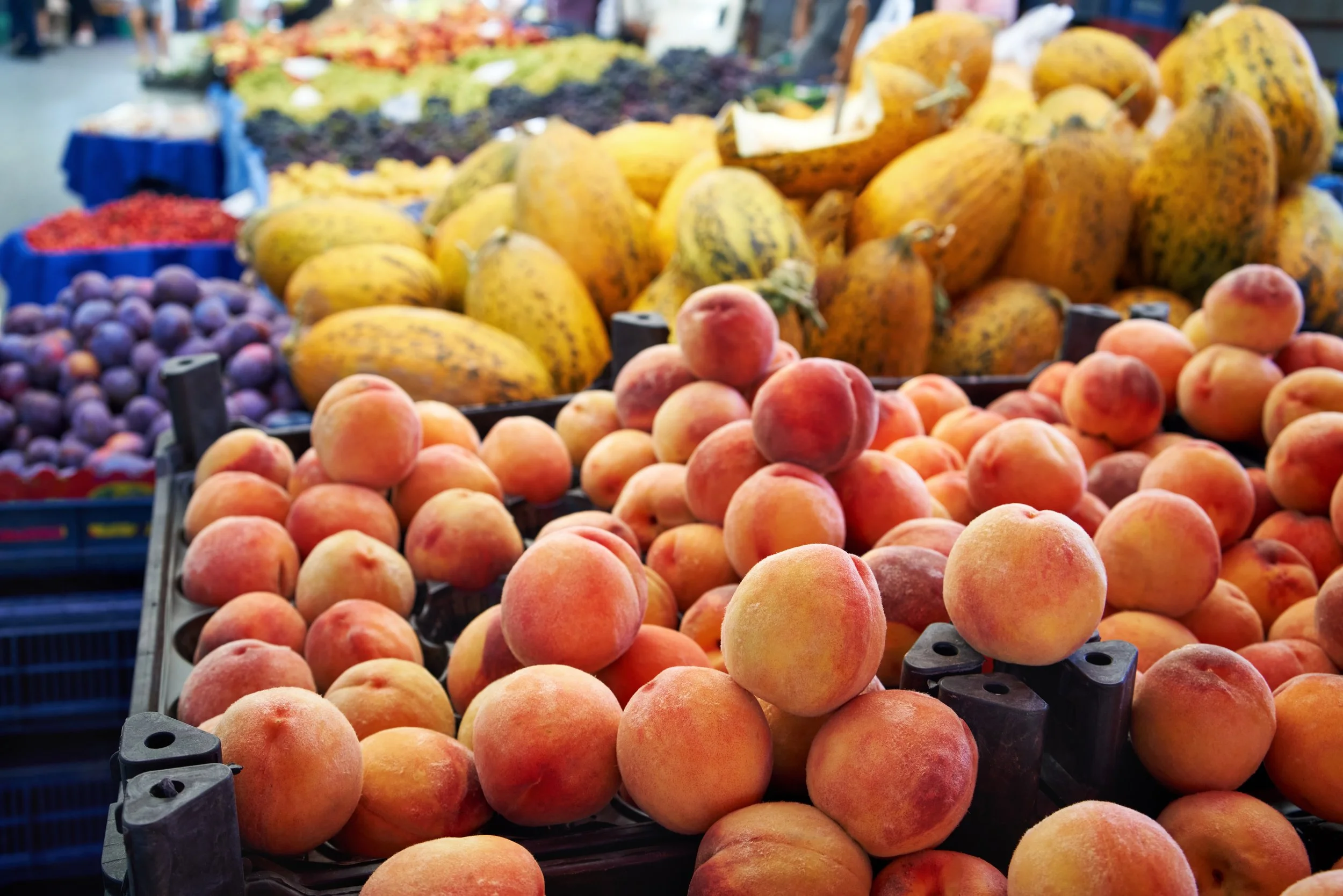
The timing lands mid-harvest for one of the most closely watched stone fruit seasons in years. On the surface, 2026 looks like a recovery story. Underneath, Helios Horizon data shows one of the world's top peach origins in confirmed crisis, a major European origin quietly underperforming its forecast, and US wholesale prices that have not yet priced in either.
For procurement and supply chain teams, that gap between the headline and the ground truth is the story worth reading this week.
What did the industry expect from the 2026 peach season?
Optimism. At the Interprunus forum in May, European forecasters projected a 2026 peach and nectarine crop of roughly 3.41 million tonnes, up 9% on 2025 and 11% above the recent five-year average. Spain, Europe's largest producer, was forecast at 1.51 million tonnes, up 6% year on year. Turkey's national statistics agency projected total fruit production rebounding nearly 58% after a 2025 season wrecked by the worst winter frost in a decade.
The consensus in May: a season without major weather incidents, with only "some uncertainties" noted in Catalonia and Aragón.
Three months later, the picture at origin level looks very different.
What happened to Turkey's peach crop in 2026?
Turkey's peach season moved from Warning to Take Action in Helios Horizon on June 14, and the season climate risk rating dropped from Poor to Terrible. That was weeks after national forecasts projected a rebound.
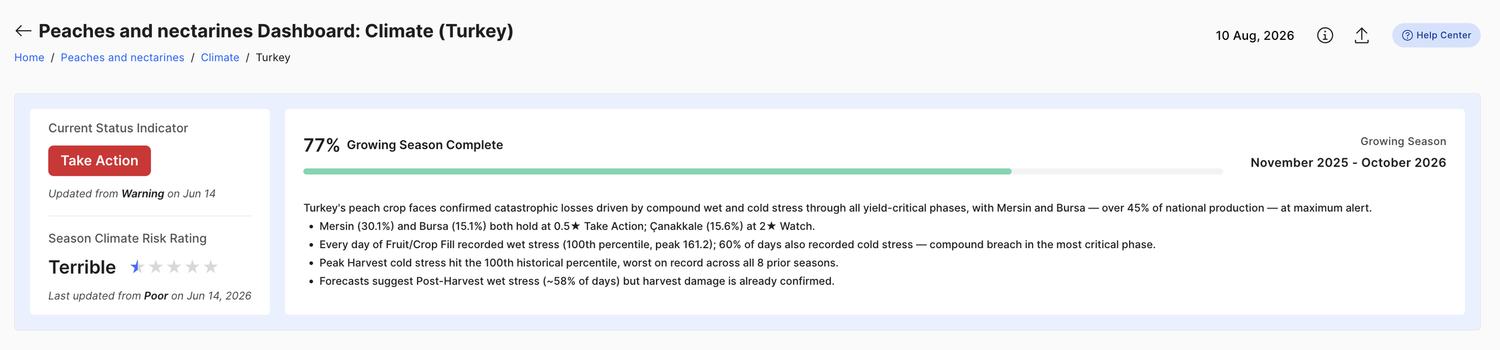
Helios Horizon escalated Turkey's peach season to Take Action on June 14, with Mersin and Bursa, over 45% of national production, at maximum alert.
The driver is compound wet and cold stress running through every yield-critical phase. In Mersin, which alone accounts for 30.1% of Turkish peach production, Reproductive Development, Fruit/Crop Fill, and Peak Harvest all recorded 100th-percentile wet stress. During Fruit/Crop Fill, every single day breached the wet stress threshold. Peak Harvest cold stress also hit the 100th historical percentile, the worst on record across all eight prior seasons in our data. Cumulative precipitation in parts of Mersin is running 62% above the historical average.
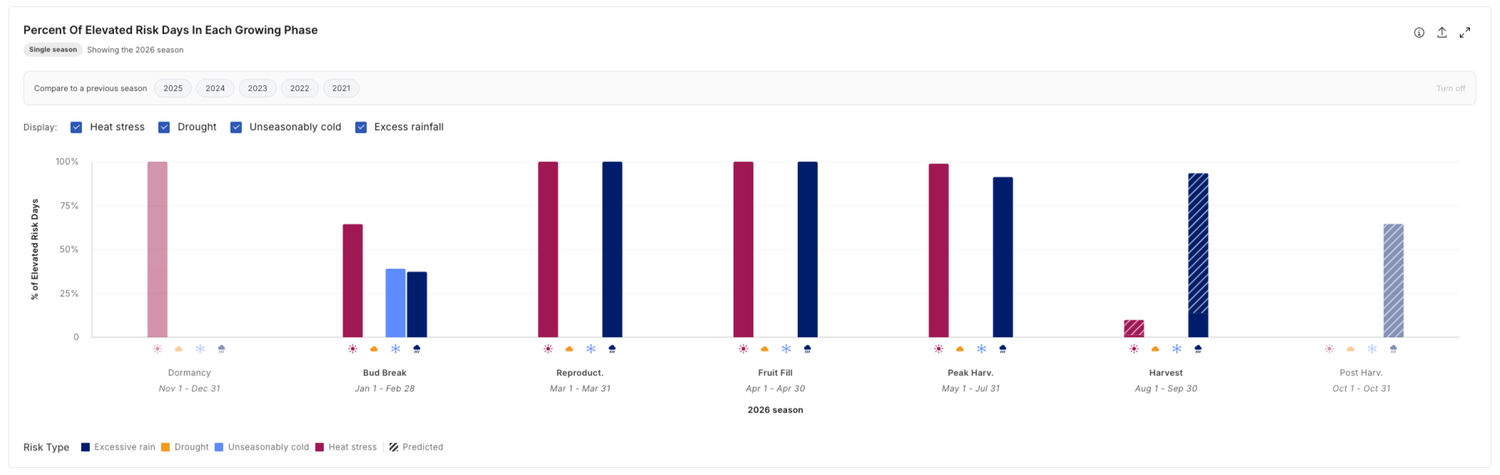
Together, Mersin and Bursa represent over 45% of national production, and both hold 0.5-star ratings. No historical season in the eight-year record approaches this compound wet signature across three consecutive critical periods. The losses are no longer a forecast. They are confirmed.
Is Spain's record forecast as safe as it looks?
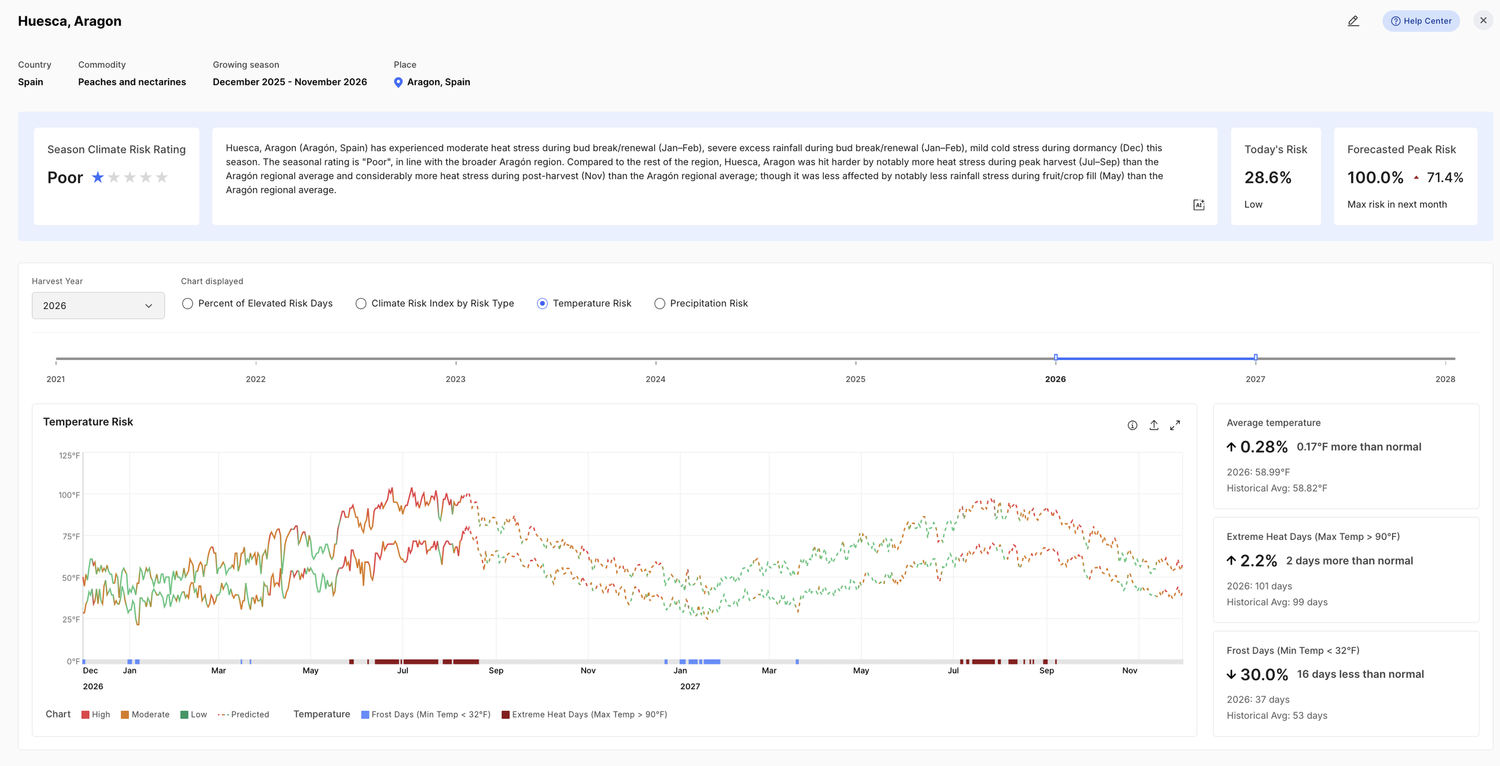
Huesca opened the season with excess rainfall at bud break and is closing it with above-average heat stress at peak harvest.
Spain will still have a large crop. But the regional detail matters, and Aragón, one of the country's biggest peach and nectarine regions at roughly 290,000 forecast tonnes, is the region to watch.
Helios Horizon rates the current Huesca, Aragón growing season as Poor. The season opened with severe excess rainfall during bud break, and cumulative precipitation is running 34% above the historical average. Now the stress has flipped: Huesca has logged notably more heat stress during peak harvest (July through September) than the regional average, with 101 extreme heat days this season against a norm of 99, and forecasted peak risk in the next month at 100%.
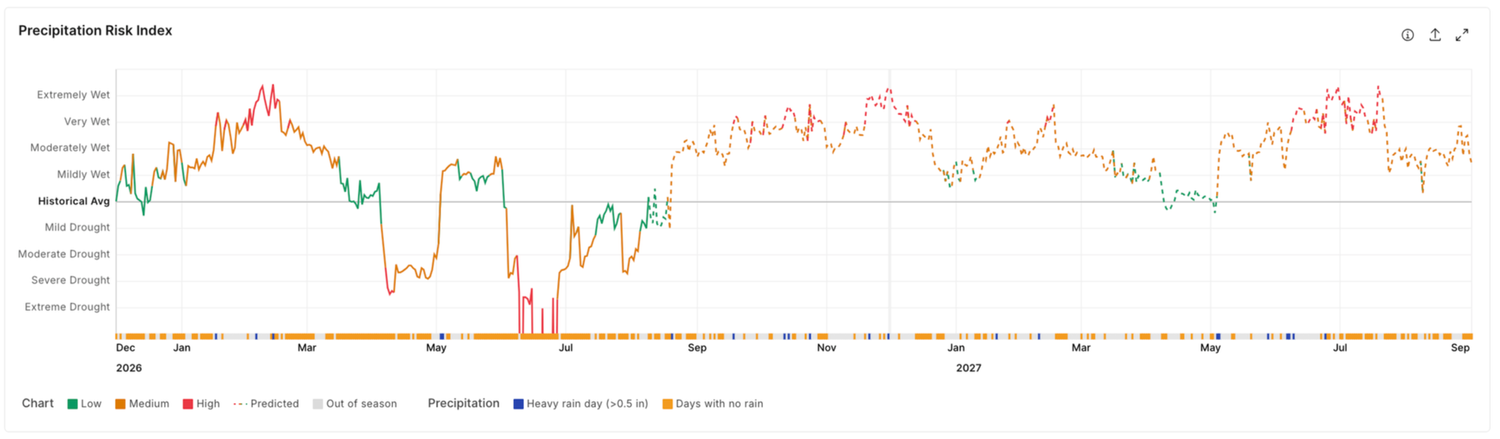
None of this erases Spain's national recovery. It does mean quality, sizing, and late-season availability from specific Aragón zones carry more risk than the headline forecast suggests. Buyers sourcing at the regional level, not the national one, will feel that difference first.
Why are US peach prices still stable if supply is under stress?
Because market pricing lags physical stress. That lag is the window.
The average US wholesale price for peaches and nectarines sits at $2.36 per kg as of early August, actually down 6% over the past 30 days, with Helios forecasting a modest climb to $2.48 over the next three to six months. Our one-month price forecasts for this market have run at 91.78% historical accuracy.
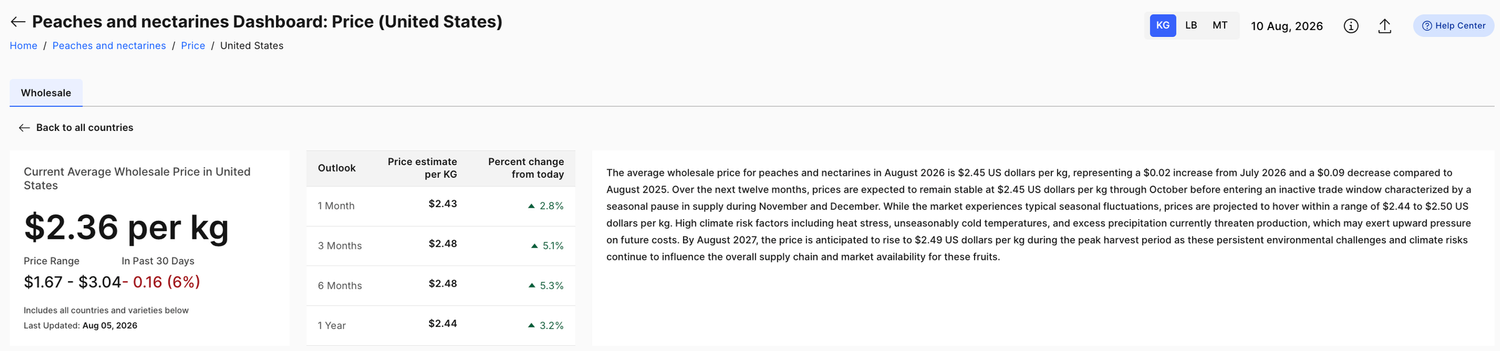
US wholesale prices remain stable at $2.36 per kg, with Helios forecasting a modest climb to $2.48 over the next six months.
But underneath the stable average, stress is already visible. Texas growers lost most of their crop this year to a warm winter that starved trees of chill hours, followed by a late spring freeze. Michigan orchards took frost damage in April. And within the US wholesale data, yellow flesh varieties are already forecast to move from $2.21 to $2.58 per kg, a 16.7% jump, across every outlook horizon. The average looks calm. The variety-level and origin-level detail does not.
What pattern connects Turkey, Spain, and the US this season?
Same fruit, three different failure modes, one common thread: the damage concentrated in yield-critical phenological windows, not across the season as a whole.
Turkey's crop was hit by compound wet and cold stress during fruit fill and peak harvest. Aragón took excess rainfall at bud break and heat stress at peak harvest. Texas lost its crop to missing chill hours in dormancy and frost at bloom. In each case, seasonal averages looked survivable. Phase-level exposure did not.
That is why Helios tracks elevated risk days by growing phase rather than by calendar month. A week of extreme weather during fruit fill can do more damage than a month of it during dormancy. It is also why headline production forecasts published in May, built before those critical phases resolved, diverged so sharply from the outcome in Turkey.
What should peach and stone fruit buyers do before prices move?
The Turkey signal escalated on June 14. US wholesale prices are still within their normal range in August. That distance between confirmed physical loss and market repricing is where procurement teams have room to act: locking coverage on exposed varieties, stress-testing supplier concentration in Mersin and Bursa, and validating alternative origins while Spanish and US fruit is still flowing.
Helios delivers these signals three to six months before disruptions register in market pricing, at the region, commodity, and growing-phase level. If peaches, nectarines, or any climate-exposed commodity sit in your portfolio, this is what the platform is built for.
Want to see the peach and nectarine dashboard for your sourcing regions?
Request a Demo


.png)

Personalized commodity intelligence for the teams that feed the world.
