
Brazil Planted Its Soybeans on Time. El Niño's Split Arrived a Month Early.
Mato Grosso was 96% planted by 6 November, clearing the date that decides Brazil's second corn crop; El Niño's split then arrived early, with heat in the centre-north and, in the south, the least sunlight in 26 years; and the dollar rose 9% against the real after the 25 October runoff while the soybean at Paranaguá held near its August price.

November 12, 2026
3 min read
The Date That Decides the Second Crop Has Passed.
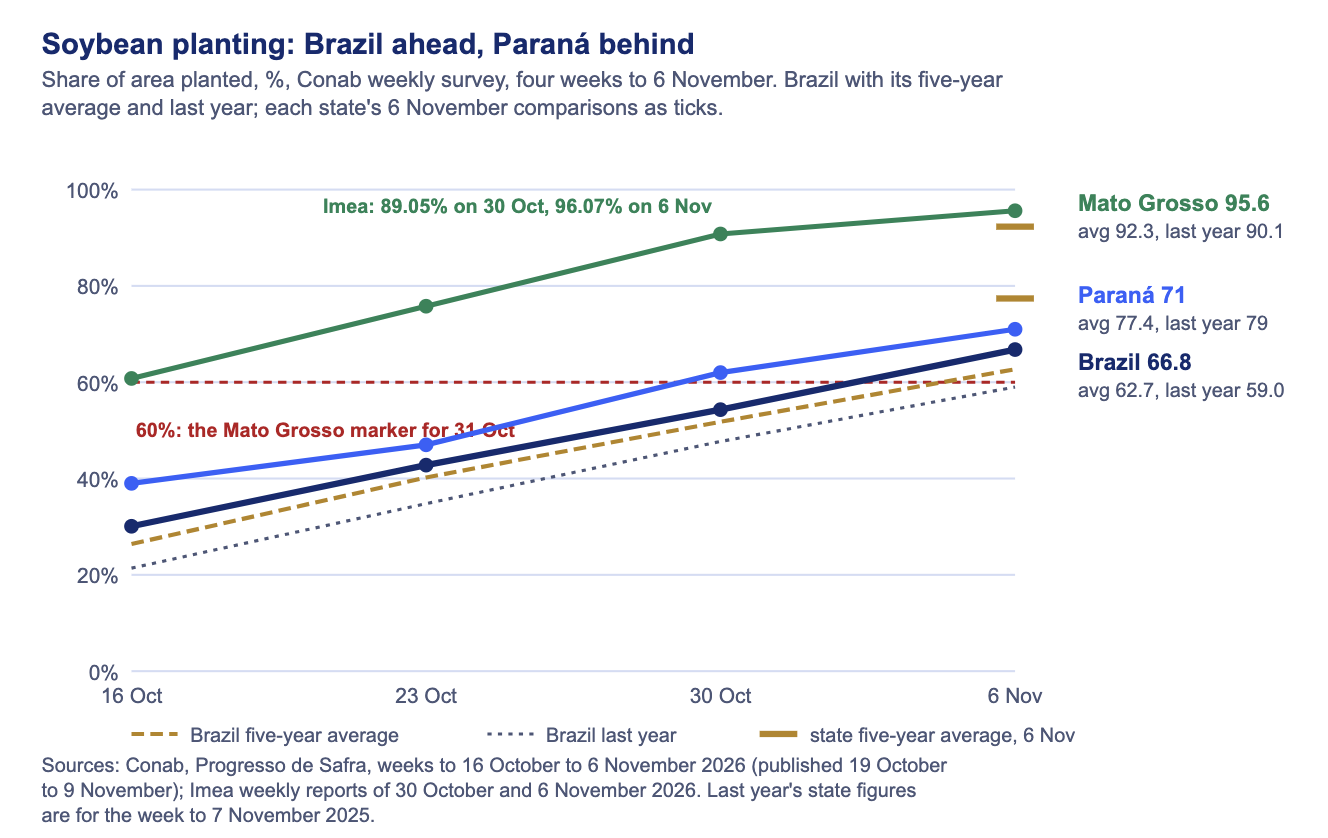
In October we hung Brazil's second corn crop on one date: Mato Grosso 60% planted by 31 October. The state passed it at 89% on 30 October, and the 6 November report of Imea, the Mato Grosso institute of agricultural economics, has it at 96.1%, against a five-year average of 90.4%. Brazil as a whole reached 66.8% on 6 November in the weekly survey of Conab, the national supply agency, against a 62.7% average and 59.0% a year ago.
The date matters because of what it starts. The second crop is about 80% of Brazil's corn and the crop the world imports. In 2015/16, the last very strong El Niño, a late soybean planting pushed almost half of it past the ideal sowing window; the national yield finished 28% below trend and Brazil's corn exports fell by more than half. That chain has not started this year.
The Weather Arrived on the Side El Niño Predicted.
The 8 October discussion of the US National Oceanic and Atmospheric Administration (NOAA), due for an update on 12 November, called this El Niño likely the strongest since 1950, with a greater than 83% chance of a strong-to-very-strong event through January to March 2027. In Brazil its textbook split, a dry, hot centre-north and a wet south, has arrived a month early.
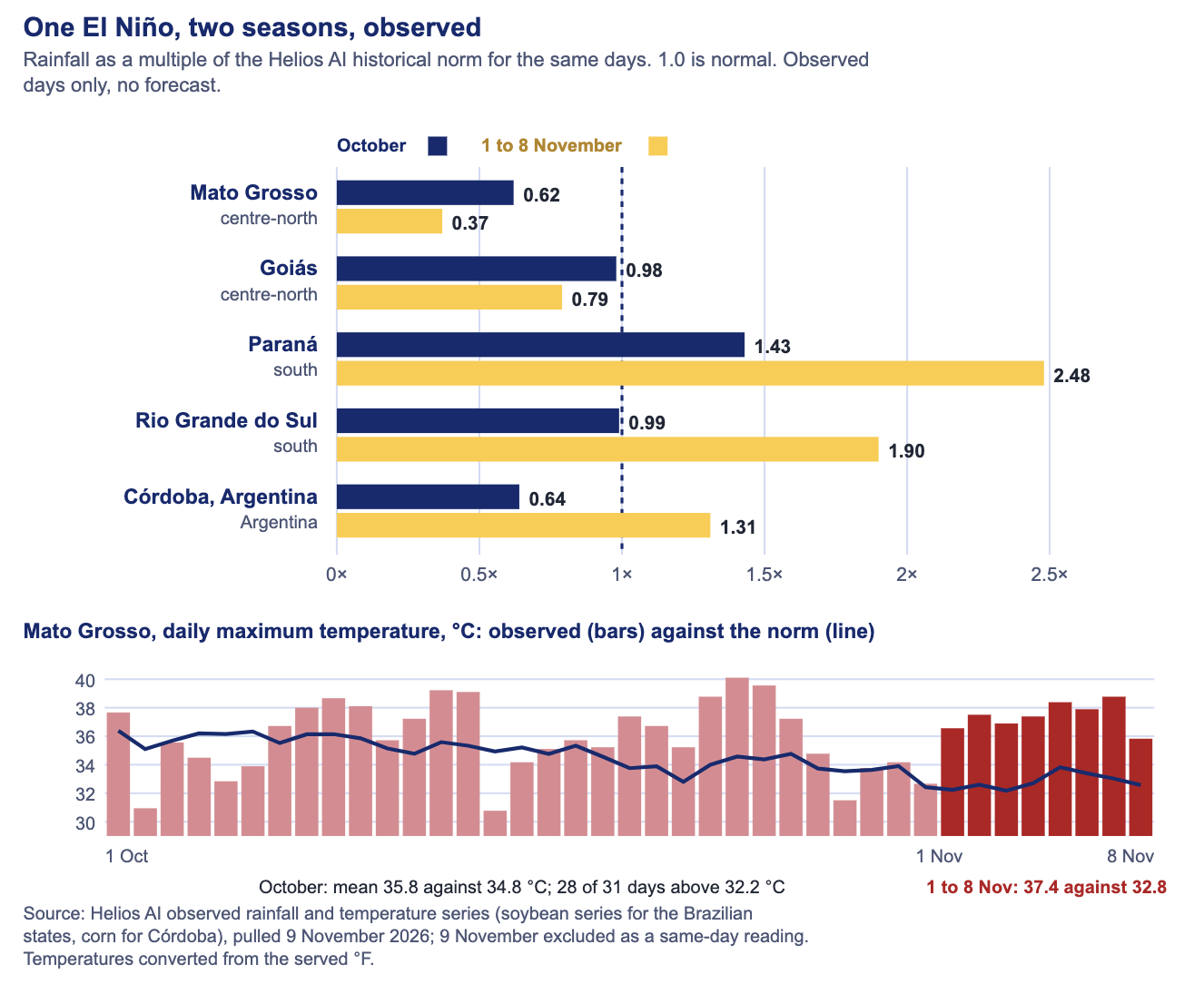
Mato Grosso had 62% of its normal October rain, and 37% in the first eight days of November. Its afternoons ran about 1 °C above normal in October and 4.6 °C above in early November, every day above 32 °C, while nights stayed near normal. Paraná had the opposite: 43% more rain than normal in October and almost two and a half times normal in the first eight days of November.
This is stress in the vegetative stage, not yet a yield loss. Mato Grosso's soybeans went in early, neither Imea nor AgRural reports replanting of any size, and the yield is set at pod fill in December and January.
The South Has Had Its Least Sunlight in 26 Years.
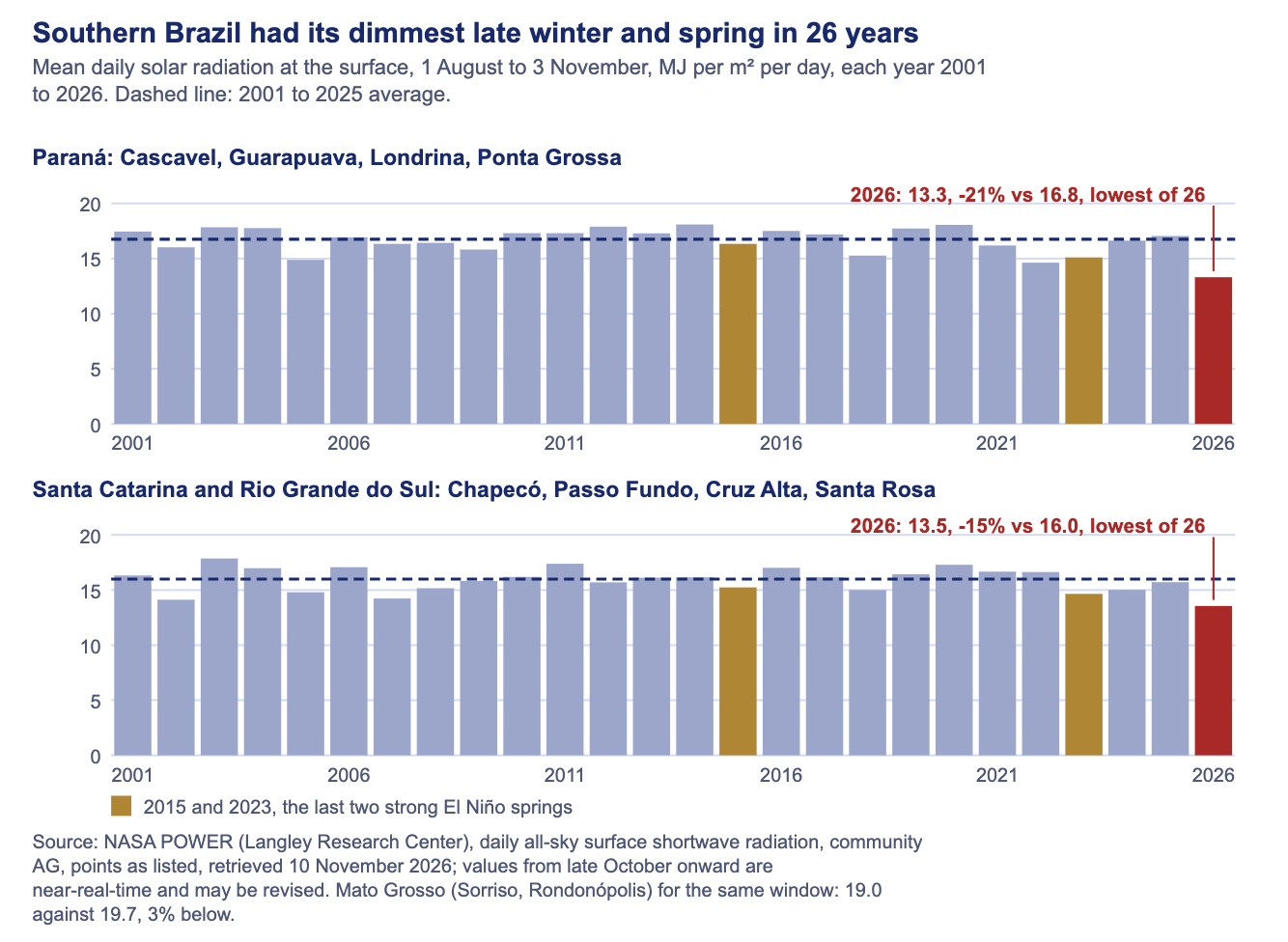
The wet south has also been a dark one. In NASA's satellite-derived POWER series, four soybean locations in Paraná averaged 13.3 megajoules of solar radiation per square metre a day from 1 August to 3 November, 21% below their 2001 to 2025 average and the lowest of the 26 years on file. Four locations in Santa Catarina and Rio Grande do Sul were 15% below, also the lowest. October alone was 25% below in Paraná, and neither 2015 nor 2023, the last two strong El Niño springs, was as dim. Mato Grosso, over the same weeks, was 3% below its average. In the Helios series Paraná had 2.3 times its normal September rain and 1.8 times normal from 1 September to 8 November, and its October afternoons averaged 3.3 °C below normal, with 26 of 31 days below, while nights were only 1.4 °C below, the pattern of overcast days.
The field reports say the same. Deral, Paraná's agricultural department, cites excess rain, low light and below-normal temperatures, and the consultancy AgRural said on 9 November that in the south the concern is the lack of sunlight. Paraná was 71% planted on 6 November against a 77% average, behind each of its last three seasons, and Conab reports waterlogging, erosion and corn replanted in Paraná and Santa Catarina.
What low light does to a soybean plant depends on when it comes. Early, it costs growth. Shade at emergence and in early vegetative growth gives taller plants with less biomass, and in one trial the stem changes persisted after the shade was lifted (Wu and colleagues, Plant Production Science, 2016). Plants make up most of that ground if the light returns: in a shade-net trial, soybeans shaded for their first 60 days yielded 36% more than plants given the same shade in the following 60 (Yuan and colleagues, Legume Research, 2022).
Later, it costs yield. Seed number, the main yield component, is largely set from R3 to R6, from pod set to seed fill (Kantolic, Peralta and Slafer, European Journal of Agronomy, 2013), which in Paraná falls in January and February. In that window, 14 days at 60% shade ending near R3 cut seed number by 16%, and plants did not recover from shade lasting 14 days or more (Egli, Crop Science, 2010). In a greenhouse, continuous 60% shade from first flower left 27% fewer mature pods (Egli and Bruening, Crop Science, 2005). Shade nets block far more light than this spring's cloud, so those figures are an upper bound.
The yield risk in the south is therefore a cloudy January and February: fewer pods and fewer seeds per plant. The nearer cost is the calendar. In Kantolic's trials shade barely changed the pace of development, which makes the cool temperatures the likelier reason the soybean cycle is lengthening, and Deral warns that a longer cycle could push back Paraná's corn sowing in January.
The Estimates Have Not Moved. They Already Disagree.
Conab's first survey carries 181.6 Mt of Brazilian soybeans, and its second is due on 13 November. Private estimates published since mid October run from Rabobank's 178 Mt to StoneX's 185 Mt, and the 10 November report of the US Department of Agriculture (USDA) left Brazil at 186.0 Mt, above the top of that range. The national total will again tell little, because the south's surplus and the centre's deficit offset each other.
For the second crop, Imea's November balance carries Mato Grosso's 2027 harvest at 53.7 Mt, 7.5% below this year's, on area slightly up and yield down 8%; Conab's first national figure, 113.3 Mt, is flat on the year. The United States is the backstop: USDA cut its corn yield to 179.6 bu/ac but still carries ending stocks at 10.8% of use, enough to supply corn in the second half of 2027, when Brazil normally ships a fifth of world trade.
In Argentina the Buenos Aires grain exchange had corn 50.5% sown on 5 November and soybeans 4.7%, about three points ahead of last year. It and the Rosario exchange are almost 6 Mt apart on soybeans, at 53.6 Mt and 47.8 Mt; USDA has 50.0 Mt and raised its Argentine corn by 2 Mt to 57.0 Mt on above-average planting progress.
The Election Moved the Currency More Than the Soybean.
Margins were thin before the election. Imea puts Mato Grosso's 2026/27 soybean cost up 16.7% and its revenue below total cost, and Conab named margins as the reason soybean area grows by only 1.4% this year, the smallest rise in twenty years.
The runoff of 25 October changed the currency in one session. The central bank's PTAX reference rate went from 5.04 reais per dollar on Friday 23 October to 5.50 on Monday 26 October, a 9% move, and reached 5.51 on 9 November, the highest of the year. Against the July and August averages, when growers were closing their soybean input purchases, the real is about 7% to 8% weaker. The Cepea/Esalq indicator at Paranaguá was R$ 158.62 per 60 kg sack on 9 November, spot, against R$ 159.44 on 31 August. From 23 October it rose 4.1% in reais and fell 5.8% in dollars, as Chicago and export premiums gave back most of what the currency added.
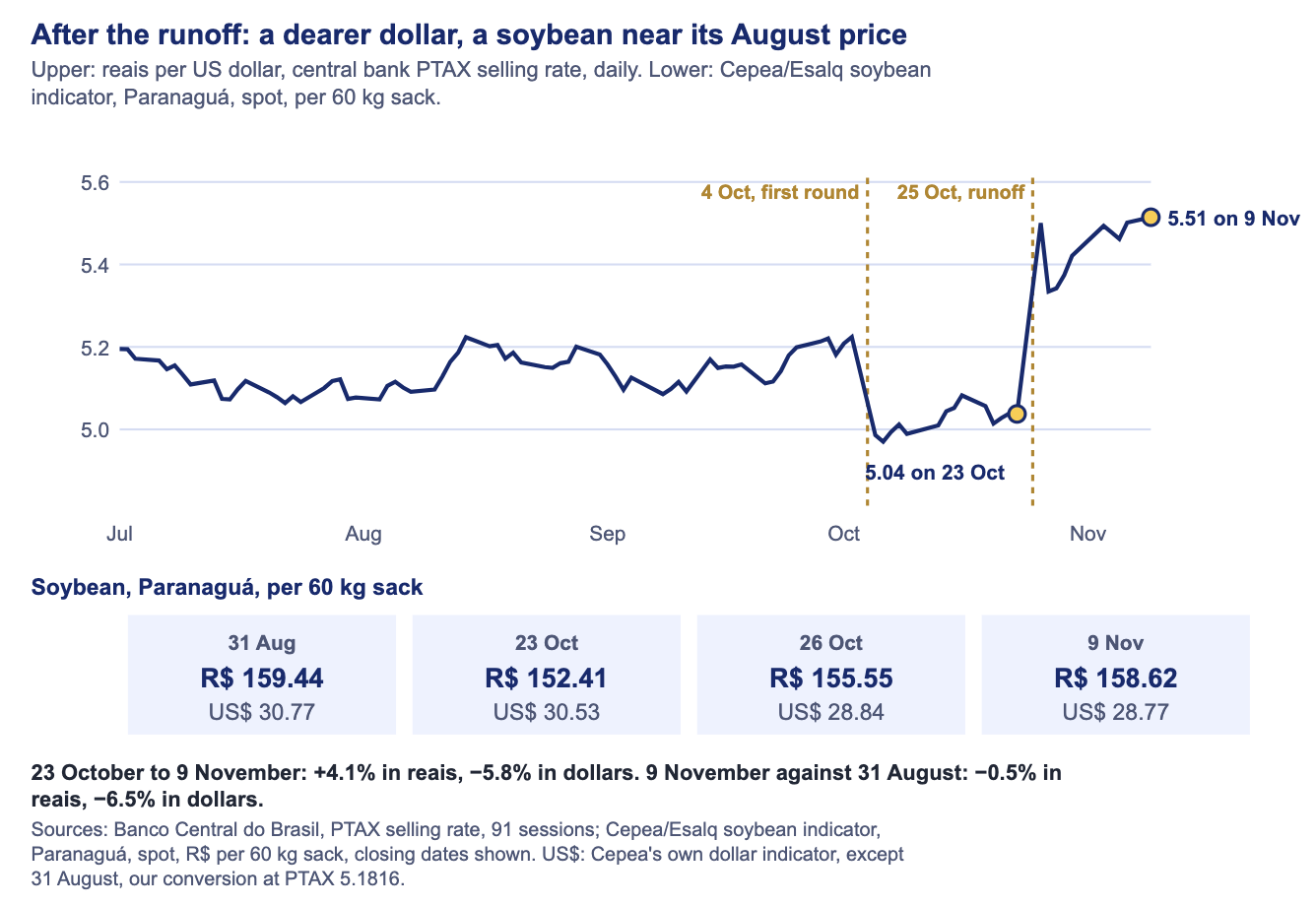
So the weaker real is an option, and it belongs to the unsold half of the crop. Mato Grosso's growers had sold 48% of the 2026/27 soybean crop by the end of October, eleven points above their average pace, most of it before the currency moved. The unsold half can now be priced at more reais per dollar if Chicago holds. On the cost side the move runs the other way: by early October about 90% of the soybean fertilizer had been bought, but only about 45% of the second crop's, and the rest is priced in dollars. For a buyer the question is whether the weaker real brings Brazilian selling forward. Cepea reported in the first week of November that growers showed less interest in forward contracts for 2027 shipment, so the answer so far is no.
The Bottom Line.
The calendar risk we called the world story in October has been retired at its first gate. What remains is weather, and it is arriving in the shape El Niño predicted: dry and hot in the centre-north; wet, cool and the dimmest in 26 years in the south; with Argentina adding soil moisture and sowing ahead of last year. Three things now move the view: Mato Grosso's rain at pod fill in December and January, whether the southern cloud lifts before Paraná's pod set in January, and Paraná's soybean harvest pace against its January corn window. The weather will set the size of the crop. The currency works on how fast it is sold, and a buyer feels that first.
Frequently asked questions
Is Brazil's 2026/27 soybean planting ahead or behind?
Ahead nationally. Conab had 66.8% of the area planted on 6 November 2026, against a five-year average of 62.7% and 59.0% a year earlier; AgRural counted 64% on 5 November. Imea had Mato Grosso at 96.1% on 6 November, against 90.4% for its five-year average. Paraná is the exception, at 71% against an average of 77%, slowed by rain, waterlogging and erosion, and planting in Piauí has largely stopped for lack of soil moisture.
How big will Brazil's 2026/27 soybean crop be?
Conab's first survey of 15 October carries 181.6 Mt, with a second survey due on 13 November. Private estimates published since mid October run from 178 Mt (Rabobank) to 185 Mt (StoneX), and USDA's report of 10 November keeps Brazil at 186.0 Mt. At state level, Imea has Mato Grosso at 48.9 Mt, 5% below last year, and Deral has Paraná at 22.75 Mt, 4% above. These are pre-season estimates; yields are set at pod fill in December and January.
How is El Niño affecting Brazil's crops in 2026?
In the observed Helios series, Mato Grosso had 62% of its normal October rain and 37% in 1 to 8 November, with every afternoon of early November above 32 °C; Paraná had 1.43 times its normal October rain and 2.48 times in early November. That is the split El Niño typically brings, a dry centre-north and a wet south, arriving earlier than the November window. In Mato Grosso it is stress in the vegetative stage, not yet a yield loss. NOAA's 8 October discussion gave a greater than 83% chance of a strong-to-very-strong El Niño through January to March 2027; its next update is on 12 November.
Does the cloudy, rainy weather in southern Brazil hurt the soybean crop?
It has slowed and weakened early growth; it has not yet cost yield. From 1 August to 3 November, solar radiation at four soybean locations in Paraná was 21% below its 2001 to 2025 average and the lowest in 26 years, in NASA's POWER series, and Santa Catarina and Rio Grande do Sul were 15% below. Deral cites low light, excess rain and cool temperatures, and Conab reports waterlogging and replanting. In trials, soybeans largely recover from shade in vegetative growth (Yuan and colleagues, 2022); yield is set from R3 to R6 (Kantolic and colleagues, 2013), January and February in Paraná, where 14 days of 60% shade cut seed number by 16% (Egli, 2010). The risks to watch are cloud persisting into January and a longer cycle delaying Paraná's corn sowing.
What does Brazil's second corn crop depend on this season?
First on the soybean calendar, and that gate has passed: Mato Grosso was 89% planted on 30 October against the 60% line it missed in 2015/16, when almost half the second crop was sown late and the national yield finished 28% below trend. Next come the soybean harvest pace in Mato Grosso around 20 February, Paraná's harvest pace against its January corn sowing, and rain at corn flowering in April. Imea carries Mato Grosso's 2027 second crop at 53.7 Mt, 7.5% below this year's; Conab's first national figure is 113.3 Mt.
How did Brazil's 2026 election move the real and soybean prices?
The central bank's PTAX rate went from 5.04 reais per dollar on 23 October to 5.50 on 26 October, the first session after the 25 October runoff, and reached 5.51 on 9 November, the year's high. The Cepea/Esalq soybean indicator at Paranaguá, spot, was R$ 158.62 per 60 kg sack on 9 November against R$ 159.44 on 31 August; since 23 October it rose 4.1% in reais and fell 5.8% in dollars, as Chicago and export premiums fell. Mato Grosso growers had sold 48% of the crop by the end of October, so the weaker real mainly helps the unsold half, and it raises the cost of the second crop's fertilizer still to be bought.




Personalized commodity intelligence for the teams that feed the world.
