
Chile's Cherry Crop Was Forecast to Be the Largest Ever. October Rained on It Twice.
USDA projected a record 727,000 tonnes on 76,000 harvested hectares in August, on the condition of regular weather; the observed Helios rainfall series then recorded two fronts, 6 to 8 and 20 to 24 October, at seven to eight times the window norm in O'Higgins and Maule, the two regions holding more than 80% of the cherry area, and the growers' own bodies have since cut their box counts while the Cherry Committee has yet to print.

November 4, 2026
3 min read
The Record Is on Hectares, and It Was Written in August.
The record forecast was written in August, before the rain. The United States Department of Agriculture (USDA) projected, from its Santiago post, 2026/27 production at 727,000 tonnes, 16% above 2025/26, with exports of 667,000 tonnes, in its Stone Fruit Annual of 27 August 2026. The growth comes from orchards planted four to five years ago reaching bearing age, on 80,000 planted and 76,000 harvested hectares, and the report states its own condition: the figure holds "assuming regular climatic conditions". Maule carries 32,801 hectares and O'Higgins 29,935, together more than 80% of the country's cherry area. The Frutas de Chile Cherry Committee's preliminary figure, from its workshop of the same 27 August, was 132.9 million 5-kilogram cartons, with an update promised for mid-October that has not arrived.
The Bloom Was Clean. Fruit Set Was Not.
September, the flowering month in O'Higgins and Maule, ran at 0.9 times its rainfall norm in both regions, with no regional-average night below freezing. Then the fronts came. From 6 to 8 October the observed series recorded 7.8 times the window norm in O'Higgins and 8.1 times in Maule, most of it on 6 October alone, a day at ten times its norm in both regions. The Curicó station had logged 46.2 mm by 8 October against a 26.3 mm mean for the whole month (Dirección Meteorológica de Chile, the national weather service, via VLN Radio, 8 October). From 20 to 24 October a second front delivered 7.2 times the window norm in O'Higgins and 7.8 times in Maule; Rancagua measured 28.7 mm on 20 October (regional balance of SENAPRED, the disaster-response agency, via El Rancagüino, 21 October). Both fronts were cold, with 6 October maxima 12 to 13 °F (6 to 7 °C) below norm. The week of 26 October to 1 November brought one wet day, four dry days and two light ones. There was no third front.

October 2026 Is the Wettest of Five on File.
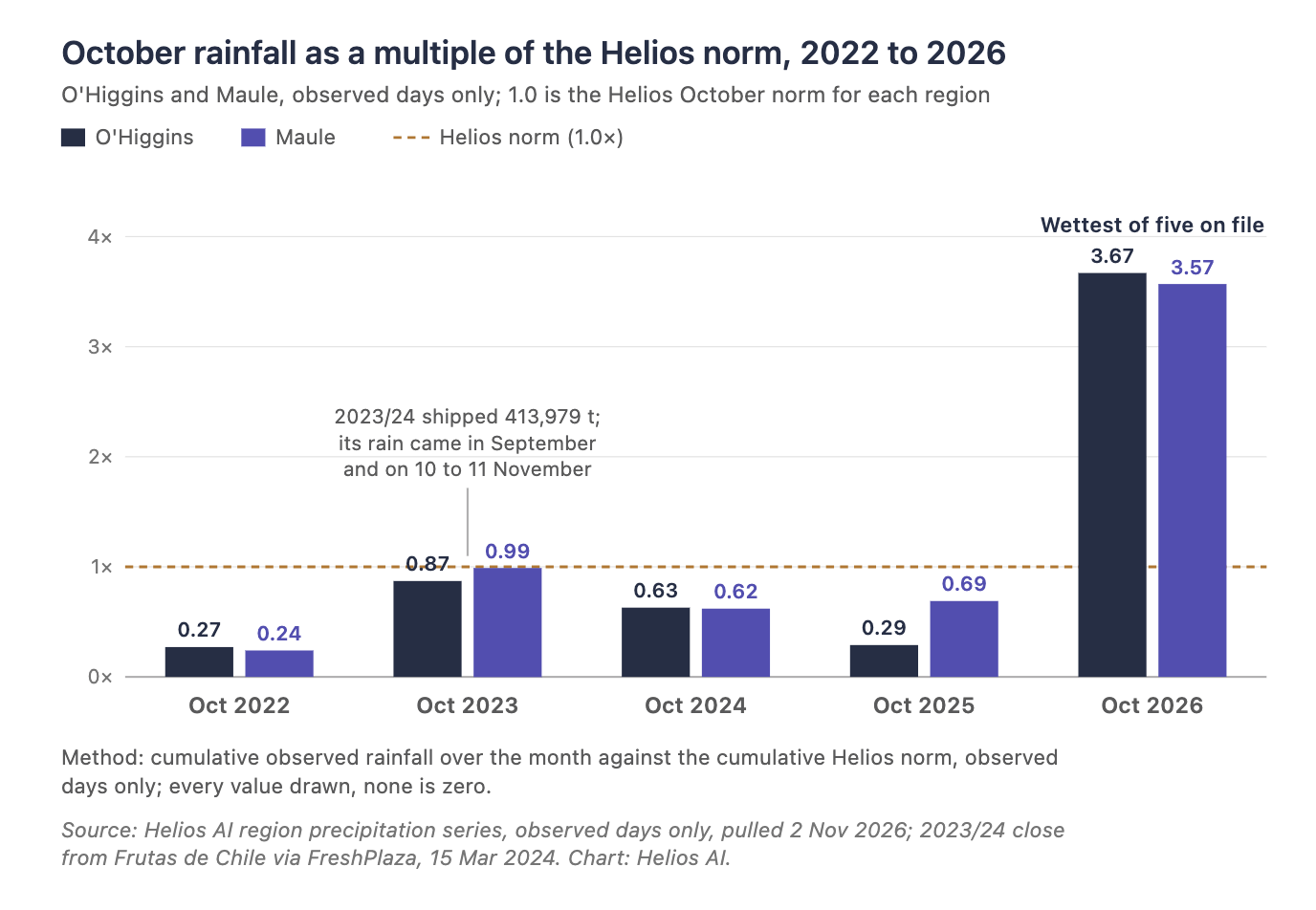
October 2026 closed at 3.7 times its norm in O'Higgins and 3.6 times in Maule. Our daily history for these regions covers five Octobers, 2022 to 2026, and no earlier one reached its norm; the next wettest, 2023, came closest and still fell short. This October carried 4.2 times the rain of that year in O'Higgins and 3.6 times in Maule, with rain on 25 of 31 days in O'Higgins and 23 in Maule. The comparison matters because of the dates. In 2023/24 the rain fell in September, at bloom, and in the second week of November, at harvest. Its October was ordinary.
Rain Cracks Cherries. Ripe Ones Crack More.
For Santina and Lapins in O'Higgins and Maule, October is fruit set and early fruit growth; in the Limarí valley of Coquimbo, to the north, the earliest varieties were already being picked from mid-October. The agronomy is published. Washington State University's crop protection guide describes rain-induced cracking as direct osmotic water absorption through the fruit cuticle and skin, with susceptibility rising as the fruit matures and differing by cultivar. Oregon State University (OSU) extension bulletin EM 9227 (Kaiser, Long and Brewer, 2019) adds a second cause, the tree's internal water relations when soils sit near field capacity. It also states the commercial threshold: "Historically, a cracking rate as low as 20–25 percent would render a crop unmarketable." Its susceptibility table puts Bing, Brooks and Santina in the high column, Lapins high-to-moderate and Regina moderate. USDA's report notes that plastic roofs have become standard in many central Chilean orchards because rain cuts fruit quality and exportability; OSU adds that runoff from covers can saturate the root zone. Helios measures the rain by region and by day. It does not measure cracking, exportable share, hail or arrival condition; the packers, the exporters and their association ASOEX do, and their counts settle this season.
The North Split First. The Belt Decides the Count.
Every quantified loss so far is in the uncovered north, which carries 1.5% of Chile's cherry output in our regional weighting. In the Limarí, adviser and grower Jorge Astudillo put definitive damage in early Brooks and Nimba at 70 to 80% after the 12 October rain (Diario Frutícola, 14 October); Teno Pack's Ovalle plant had expected its zone to come in 60 to 70% below initial estimates before the first front, on earlier causes (Portal Frutícola, 5 October). The covered belt reported differently, and later. On 9 October consultant Walter Masman called the productive impact in O'Higgins practically marginal; on 15 October adviser Carlos Tapia saw no splitting risk at that stage in O'Higgins and Maule (both Portal Frutícola). By 28 October, after the second front, Masman called it probably the most complicated season to date and said each weather front lowers a set potential of close to 130 million boxes (Portal Frutícola). On 2 November Víctor Catán, president of the fruit growers' federation Fedefruta, located the damage from the southern Metropolitana to Ñuble, concentrated in O'Higgins and Maule, with hail at Peumo. His words: "There are fields with a lot of damage, and others a kilometre away where nothing happened" (our translation; El Mercurio via the Grupo de Diarios América, GDA). None of the belt statements carries a percentage.
The Grower Bodies Have Cut on Boxes. The Committee Has Not Printed.
Every public cut so far is on boxes, a packed count, not a count of fruit on the trees. On 16 October Antonio Walker, president of the Sociedad Nacional de Agricultura (SNA), the national farmers' society, still called the 140 million box winter figure very high and allowed a possible 4% loss (BioBioChile); on 28 October, after the second front, he said the season would land closer to 115 million boxes, about 18% below (Pauta). On 2 November Catán put production at around 100 million boxes, on the condition that the rain stops (El Mercurio via GDA). Neither body is the Committee, neither gives a method, and the 140 million is the SNA's reference rather than the Committee's 132.9 million, so we do not net them. The Committee's own number is due in November, at least a week later than its 29 October print last year. Last year's 131 million October estimate closed at 113.8 million, 13% lower, after an October below norm. In 2023/24, rain on 11 and 12 November cut the Committee's estimate by 14.6% on 21 November, and the season closed flat at 413,979 tonnes.

The Early Weeks Are Air. The Volume Comes by Sea.
The first fruit landed in Shanghai on 17 and 18 October, by air from Coquimbo and Colchagua, and the importer Haojiu described clean skins and bright colours (Produce Report, 18 October). JD Fresh's first batch slipped to about 23 October because rain slowed ripening (ChinaFruitPortal via FreshFruitPortal, 16 October). On the week-44 prints, air-freight Santina of 2J size traded at about ¥700 (US$105) per 2.5-kilogram box, wholesale, in a Chinese market the report does not name, 10 to 15% below the opening prints, with buyers holding back (FreshPlaza, 2 November); the Helios Chile wholesale series carries no 2026/27 print, so we quote no Helios price. The volume comes by sea. The first Cherry Express sailing, the direct service of Ocean Network Express (ONE), leaves Valparaíso on 13 November and reaches Hong Kong on 6 December, with weekly sailings to 8 January whose fruit lands on 31 January, six days before Lunar New Year on 6 February 2027 (ONE schedule via MundoMarítimo, 27 October).
The Bottom Line.
The record was forecast on hectares, and no body has revised the hectares. The rain fell on the fruit. Two fronts at seven to eight times norm, in the two regions holding more than 80% of the cherry area, in the month the fruit set, made October 2026 the wettest of five on file. What that did to the packed share has no official count yet. The first dated check is the Cherry Committee's November report. The second is weeks 46 to 50, when the first sea fruit sails and lands and the shipping pace and arrival rejections can be read against last season's. The first of those sailings leaves Valparaíso on 13 November.
See observed and forecast rainfall and temperature by region for the origins you buy from, with the pull date on every reading:
Frequently asked questions
How big is Chile's 2026/27 cherry crop expected to be?
USDA's Stone Fruit Annual for Chile (Global Agricultural Information Network report CI2026-0009, 27 August 2026) projects a record 727,000 tonnes, 16% above 2025/26, and exports of 667,000 tonnes, on 76,000 harvested hectares, "assuming regular climatic conditions". The Frutas de Chile Cherry Committee's preliminary estimate of the same day was 132.9 million 5-kilogram cartons; its official estimate, due in mid-October, is now expected in November. Since the October rain, the SNA's Antonio Walker has said about 115 million boxes (Pauta, 28 October) and Fedefruta's Víctor Catán around 100 million, conditional on the rain stopping (El Mercurio via GDA, 2 November). Last season closed at 113.8 million boxes and 569,492 tonnes of November to May exports.
Did the October rain damage Chile's cherry crop?
The quantified damage so far is in the early, uncovered orchards of the north: 70 to 80% definitive damage in Brooks and Nimba in the Limarí (Jorge Astudillo, Diario Frutícola, 14 October), and an Ovalle zone 60 to 70% below initial estimates (Teno Pack, Portal Frutícola, 5 October). In O'Higgins and Maule, which hold more than 80% of the cherry area, the dated statements moved from practically marginal on 9 October to probably the most complicated season to date on 28 October (Walter Masman, Portal Frutícola), and on 2 November Fedefruta located hail and rain damage concentrated in those two regions without a percentage. In the Helios observed series, October 2026 was 3.7 times norm in O'Higgins and 3.6 times in Maule, the wettest of the five Octobers on file (2022 to 2026).
Why does rain crack cherries, and which varieties are most at risk?
Water enters the fruit by direct osmotic absorption through the cuticle and skin, and through the tree's vascular system when soils are saturated (Washington State University crop protection guide; Oregon State University EM 9227, 2019). Susceptibility rises as the fruit matures and depends on the cultivar's skin: OSU's table lists Bing, Brooks, Rainier and Santina as highly susceptible, Lapins and Sweetheart high-to-moderate, Regina moderate, and Black Pearl low. OSU records that a cracking rate of 20 to 25% has historically rendered a crop unmarketable. Plastic covers are standard in many central Chilean orchards for this reason (USDA, 27 August 2026); the early orchards of the north lack them (Walter Masman, Portal Frutícola, 9 October).
When do Chilean cherries arrive in China for Lunar New Year 2027?
Air shipments began landing in Shanghai on 17 and 18 October 2026 (Produce Report). The first Cherry Express sailing, ONE's direct Valparaíso to Hong Kong service, departs 13 November and arrives 6 December, with weekly sailings through 8 January whose fruit lands 31 January (MundoMarítimo, 27 October). Peak arrivals in China are expected from mid-December to mid or late January (FreshPlaza, 20 October). Lunar New Year falls on 6 February 2027, eleven days earlier than in 2026. China took 87% of Chile's 2025/26 exports (USDA Table 3: 494,322 of 569,492 tonnes, November to May).
What are Chilean cherry prices in China now?
On the week-44 report of 2 November 2026 (FreshPlaza), air-freight Santina 2J traded at about ¥700 (US$105) per 2.5-kilogram box and Santina 3J at about ¥800 (US$120) in a Chinese wholesale market the report does not name, 10 to 15% below the first arrivals, with slow sales. Last season's first batches, 17 to 19 October 2025, sold at 1,400 to 2,400 yuan per 5-kilogram carton by size at Shanghai Huizhan (Guojiguoshu, 20 October 2025); the varieties, packages and markets differ, so the two are not a like-for-like comparison. The Helios Chile wholesale series holds no 2026/27 print and we publish no price forecast.
What happened the last time rain hit the Chilean cherry harvest, in 2023/24?
Two bouts of rain fell over two weeks, including 11 and 12 November 2023: Rancagua 35 mm, Curicó 25 mm, Talca 28 mm, with up to 20% damage in early Santina and Royal Dawn (FreshPlaza, 17 November 2023). The Cherry Committee cut its estimate by 14.6% to 81.5 million boxes on 21 November 2023, and the season closed at 413,979 tonnes, almost unchanged on the year, with China a record 377,000 tonnes (FreshPlaza, 15 March 2024). In the Helios series, that season's rain came at bloom (September 2023 at 2.2 times norm) and at harvest; its October was below norm. This season's bloom was dry and its October was the wettest on file.




Personalized commodity intelligence for the teams that feed the world.
