
Ecuador's Banana Year Has Been Quiet. The Last Fortnight Was Not.
Ecuador's banana exports are 8.3% ahead of last year, but dry-season rain has reached Guayas and Los Ríos for only the second time in eleven seasons, and that cost sits in spray programmes and the 2027 contract rather than in the box count.

September 24, 2026
3 min read
Ecuador's banana exports are 8.3% ahead of last year, but dry-season rain has reached Guayas and Los Ríos for only the second time in eleven seasons, and that cost sits in spray programmes and the 2027 contract rather than in the box count.
By João Pedro Rodrigues Morciani · Senior Analyst, Helios AI
All Helios figures pulled 21 September 2026; the observed window runs to 20 September. Rainfall is expressed throughout as a multiple of each province's own historical norm for the same window.
The Export Line Is Up 8.3%. Start There.
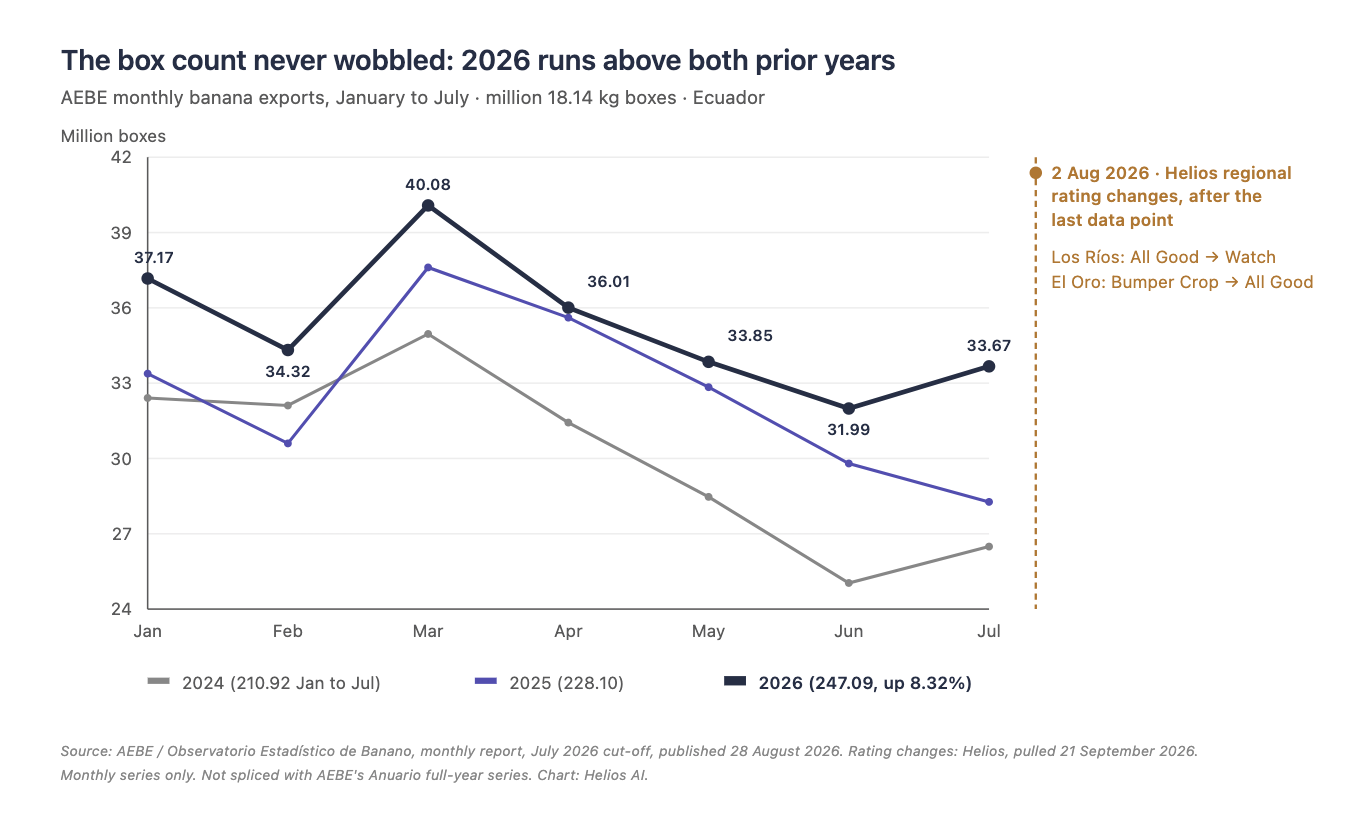
Ecuador has had a good export year, and the exporters' own association publishes the number. AEBE's Observatorio Estadístico de Banano reports 247.09 million boxes shipped from January to July 2026 against 228.10 million a year earlier, up 8.32%. July alone ran 33.67 million, 19.10% above July 2025. The unit is the 18.14 kg export carton, and the source is AEBE's monthly report with a July cut-off, published 28 August 2026.
The forward indicator agrees with it. AEBE's weekly national enfunde, the bagging count that runs ten to twelve weeks ahead of harvest, averaged 43.90 bunches per hectare across July weeks 27 to 31 against 36.18 a year earlier, 21.34% higher. Nothing here claims Ecuador ships fewer boxes.
The Dry Season Got Rain. That Has Happened Once Before.
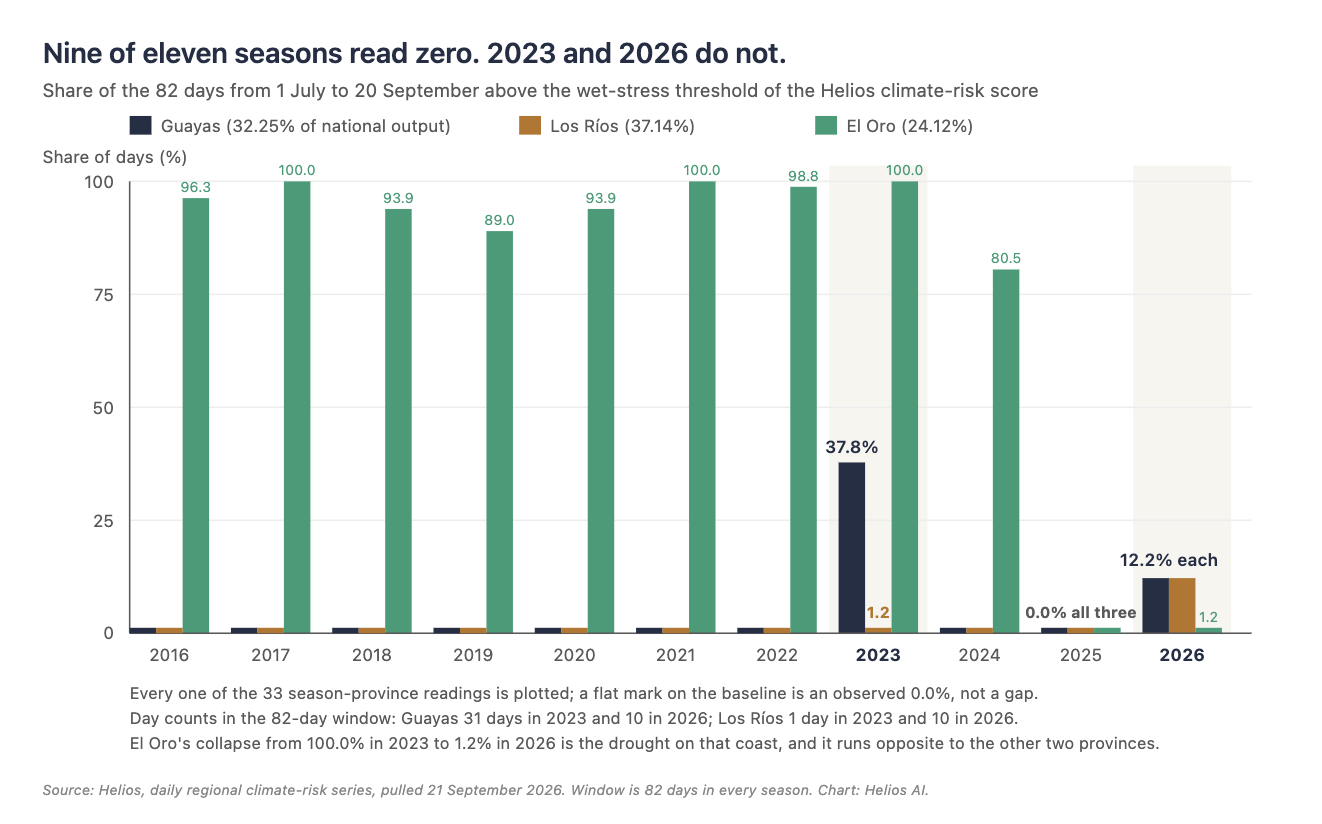
Guayas and Los Ríos are supposed to be dry from July to September, and this year they were not. Our daily regional series carries eleven banana seasons back to 2016. Measure the share of days from 1 July to 20 September on which the wet-stress component of the Helios climate-risk score sits above the ratings' own threshold, and nine of those eleven seasons read exactly zero in both provinces. Two do not: 2023 and 2026.
2026 is the second such year, and the two provinces have not behaved the same way. Guayas ran 10 of its 82 dry-season days above the threshold, 12.2%, against 31 days and 37.8% in 2023. On that province the El Niño year was the bigger event. Los Ríos went the other way: 10 days this year against a single day in 2023. Intensity says the same thing. The average wet-stress reading across the Los Ríos window is 22.3 in 2026 against 13.6 in 2023, and the daily reading has risen without a break since 10 September, from 32 to 68 by the 21st. Los Ríos is the largest of the three provinces in our regional coverage, at 37.1% of national output.
The rainfall series says the same. Los Ríos took 1.77 times its historical norm from 1 July to 20 September, ahead of 2023's 1.38, and Guayas 2.97 times against 2023's 2.61. September itself turned sharp: through the 20th, Guayas ran at 5.5 times its norm for those days and Los Ríos at 2.9, every day observed. El Oro, the third major producing province, has run dry rather than wet this year, at a quarter of its normal dry-season rainfall, and is not part of this story.
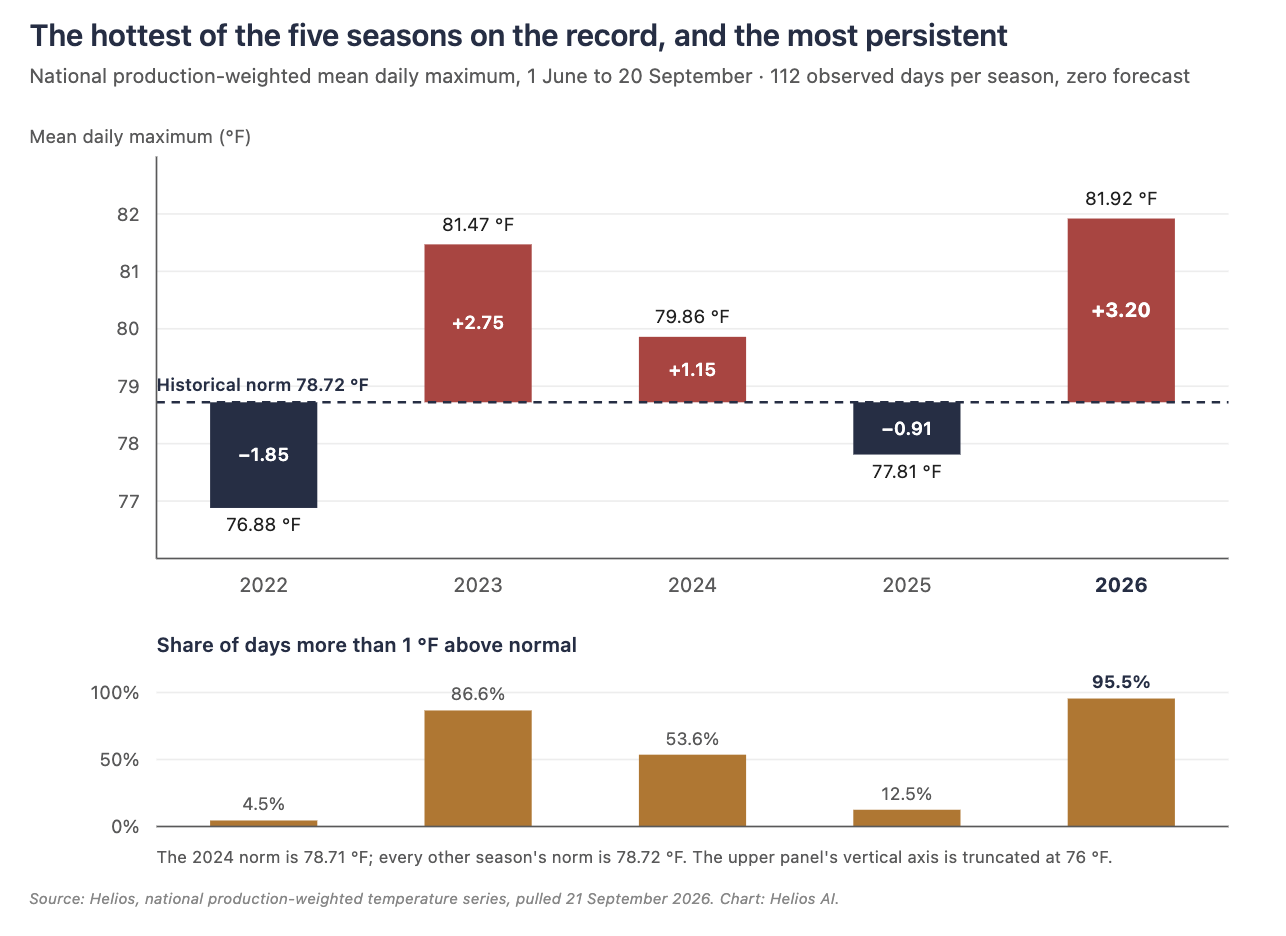
The season has also been the hottest of the five the temperature series covers. The national production-weighted mean daily maximum from 1 June to 20 September was 81.92 °F against a 78.72 norm, an anomaly of +3.20 °F across 112 observed days. 95.5% of them ran more than a degree above normal, against 86.6% in 2023. Night-time minimums run warmer still, at +3.26 °F.
Wet Leaves and Warm Nights Are a Spray Problem.
The mechanism here is published agronomy, not a Helios output. The University of Hawaiʻi at Mānoa's extension publication PD-50, "Black Leaf Streak of Banana", September 2008, states the condition plainly: "Infection requires either a film of water on the leaf surface or relative humidity greater than 91%." And the line that matters most here: "Good water drainage in fields will reduce disease levels greatly by minimizing the relative humidity in the canopy and the leaf wetness duration."
The same document puts the first visible symptoms 15 to 20 days after infection. A leaf wet in mid-September is a lesion at the start of October, which makes this fortnight an October decision.
"Good water drainage in fields will reduce disease levels greatly by minimizing the relative humidity in the canopy and the leaf wetness duration."University of Hawaiʻi at Mānoa, PD-50, "Black Leaf Streak of Banana", September 2008
Drainage is the thin part, on AEBE's own survey work. Its April 2025 survey found no pumping stations among the Guayas farms covered, and 80% of them clearing drainage channels once a year. That is 2025 work about the provinces, not a reading of this month.
2023 Cost Cycles, Not Boxes.
The only comparable dry season is 2023, the El Niño year, and its cost is on the record by name. Franklin Torres, president of the Federación Nacional de Productores de Banano del Ecuador, told Expreso in August 2023 that the previous full year had run 21 to 22 spray cycles, that growers were already at 24 by that July, and that the annual spend was "3.000 dólares por hectáreas". René Medina of FrutaDeli said in the same piece that Quevedo's 25-year average was "entre 20 y 22" cycles and that some companies were projecting 45 to 50. Quevedo is in Los Ríos.
Then look at what that season shipped. Ecuador exported 359.10 million boxes in 2023 and 364.19 million in 2024, on AEBE's Anuario Estadístico published 2 July 2026. The disease year did not take the fruit. It took margin, one spray cycle at a time.
The Bill Arrives in the 2027 Contract.
Ecuador's fruit is priced against a floor, and the floor is set by decree. The minimum support price in force for 2026 is USD 7.50 per 22XU box of 43.0 lb, which is 19.50 kg, paid to the producer al pie del barco, at ship's side, with a referential minimum free on board (FOB) price of USD 9.75. It sits in Acuerdo Ministerial 107, signed 16 September 2025 for the calendar year 2026. The agriculture ministry's own site was unreachable throughout this research, so both figures come from the reporting at signature and from President Daniel Noboa's statement of them on 17 September 2025.
That box is not the box in the export figures above. AEBE counts 18.14 kg cartons, the European import standard; the priced box is the 19.50 kg 22XU. Both units are real and neither converts into the other.
The 2026 number was imposed rather than agreed. The negotiating tables of 12 and 15 September 2025 failed, with producers asking USD 8.80 and exporters offering USD 7.40, so the ministry set the price itself, on national average production cost plus a reasonable margin. There is precedent for farm biosecurity costs entering that number: José Antonio Hidalgo, executive director of AEBE, told El Universo on 30 July 2026 that "se adaptó desde ese año los costos de bioseguridad en el precio oficial".
There is no banana futures contract anywhere, and no published Ecuadorian spot box price for 2026 survived verification here. So a cost increase in this crop does not appear on a price screen. It appears in a negotiation. The 2027 number comes off that same annual cycle and that same cost base: a ministerial resolution signed before the year it applies to.
What Would Prove This Wrong.
Publishing on 23 September means publishing inside the event. The Helios national daily climate-risk score crossed above its historical average on 19 September, at 30.6 against a 29.9 norm, and reached 39.6 against 28.3 on 21 September, the last observed day. Ecuador's national status indicator reads Warning. After that everything is forecast, and the forecast is steep: the curve runs above 90 through the turn of the month and peaks at 99.5 on 2 October. A forecast is not an observation.
The falsifier has a date, and it is 30 September 2026. If Guayas and Los Ríos stop adding wet-stress days before the end of the month, the fortnight was weather rather than a season, and the leaf-wetness argument shrinks with it. Half of that test has now run, and it split. Between 15 and 20 September Guayas added no new day above the threshold, while Los Ríos added six, one for every day of the six. Guayas then crossed back above on the 21st. The province with the worse rating paused and the larger producer did not, which narrows the case rather than settling it. The second test is external: AEBE's October and November monthlies.
The Bottom Line.
An importer's exposure this quarter sits in the contract rather than the container. Nothing here supports pulling Q4 volume away from Ecuador, and the July bagging count argues hard against it. What it supports is treating the 2027 minimum price as a live and contested number, and asking Ecuadorian suppliers now for their July-to-October spray cycle counts against their own five-year average.
The trigger to revisit is specific. If the Los Ríos wet-stress count keeps climbing through the last week of September while the temperature anomaly holds near +3 °F, the October spray bill is being written now, and the producers' side of the 2027 table gets a stronger case.
A quiet box count is not a quiet crop.
Frequently asked questions
How much banana does Ecuador export?
AEBE's Observatorio Estadístico de Banano reports 247.09 million boxes for January to July 2026 against 228.10 million in the same period of 2025, a rise of 8.32%, in its monthly report with a July cut-off published 28 August 2026. Full-year 2025 came to 378.41 million boxes, 3.90% above 2024, on AEBE's Anuario Estadístico published 2 July 2026, worth USD 4,077.45 million FOB on a figure the Anuario sources to Banco Central del Ecuador. The unit throughout is the 18.14 kg export carton. The largest destination so far in 2026 is the European Union at 81.01 million boxes, up 14.68%, while the United States is down 5.62% at 28.30 million. There was still no August 2026 figure as of 21 September.
Are Ecuador's 2026 rains reducing banana supply?
Not on any measured series. Exports through July are 8.32% ahead of 2025, and AEBE's own July bagging count, which leads harvest by ten to twelve weeks, ran 21.34% above last year. The anomaly this year is regional and seasonal rather than national: Guayas and Los Ríos took dry-season rain that nine of the last eleven seasons did not bring. The exposure that follows is disease pressure and the cost of controlling it, not a volume shortfall.
What is Black Sigatoka and why does rain make it worse?
Black Sigatoka is a leaf-spot disease of banana caused by the fungus Pseudocercospora fijiensis. The University of Hawaiʻi extension publication PD-50, September 2008, states that "infection requires either a film of water on the leaf surface or relative humidity greater than 91%", that spores are dispersed by rain-wash, rainsplash and wind-driven rain, and that the first symptoms appear about 15 to 20 days after infection. The same publication ties control back to the field itself: "Good water drainage in fields will reduce disease levels greatly by minimizing the relative humidity in the canopy and the leaf wetness duration." That latency is why rain in mid-September is an October problem.
What is Ecuador's official minimum banana price for 2026?
USD 7.50 per 22XU box of 43.0 lb, or 19.50 kg, paid to the producer al pie del barco, at ship's side, with a referential minimum FOB of USD 9.75. The 41.5 lb box type is priced at USD 7.25. The instrument is Acuerdo Ministerial 107, signed 16 September 2025 and applying from 1 January to 31 December 2026. The ministry set it unilaterally, on national average production cost plus a reasonable margin, after the negotiating tables of 12 and 15 September 2025 failed, with producers asking USD 8.80 and exporters offering USD 7.40. Ecuador's agriculture ministry website was unreachable during this research, so these figures come from the reporting at signature and from President Daniel Noboa's own statement of both box prices on 17 September 2025, rather than from the signed text.
Which Ecuadorian provinces grow the most banana?
Helios's regional coverage attributes 37.14% of national banana production to Los Ríos, 32.25% to Guayas and 24.12% to El Oro, with the remaining 6.49% unallocated to a rated region. Los Ríos and Guayas are also where 2026 diverged: both took dry-season rain for only the second time in eleven seasons.
Will Ecuadorian banana contract prices rise for 2027?
That is a negotiation rather than a forecast, and the 2027 number has not been set. What can be said is that the 2026 price was imposed after the tables failed, that the gap between the two sides was USD 1.40 a box, and that farm biosecurity costs have entered the official price before: AEBE's executive director José Antonio Hidalgo told El Universo on 30 July 2026 that "se adaptó desde ese año los costos de bioseguridad en el precio oficial". A dry season that forces extra spray cycles in the two largest producing provinces is the kind of cost the producers' side brings to that table, and there is no published Ecuadorian cost-of-production study for either side to argue from.
Helios AI provides climate-risk intelligence for institutional buyers of agricultural commodities: seasonal climate-risk ratings, disruption alerts and region-level monitoring across major producing origins, scored phase by phase against historical seasons. Helios analysis is scenario-based and does not constitute trading advice.

.png)

Personalized commodity intelligence for the teams that feed the world.
