
El Niño and Asia's rice supply: what the 2026 season looks like from the field
Rice Month, September 2026. Data: Helios Horizon rice climate and export price dashboards, 4 September 2026 print. El Niño is no longer a forecast. NOAA has had an El Niño…

September 8, 2026
6 min read
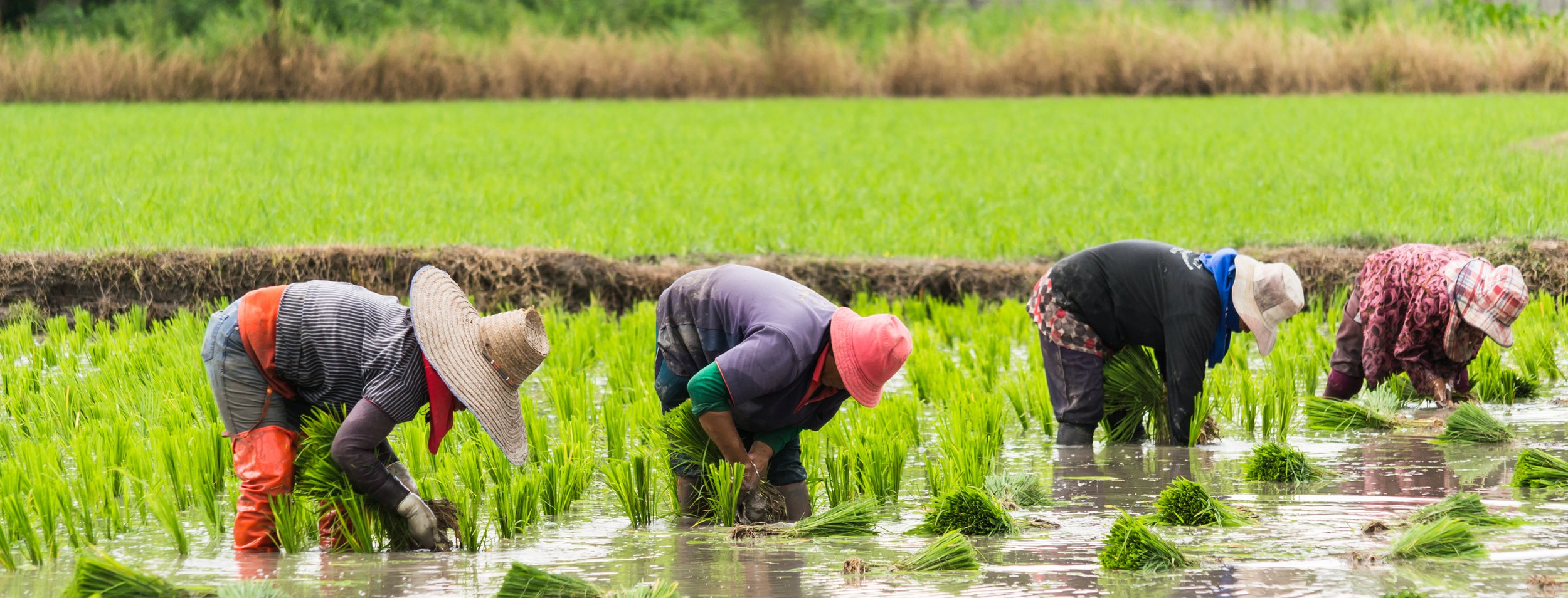
Rice Month, September 2026. Data: Helios Horizon rice climate and export price dashboards, 4 September 2026 print.
El Niño is no longer a forecast. NOAA has had an El Niño Advisory in place since June, with conditions expected to strengthen into the Northern Hemisphere winter. For rice, that matters more than for almost any other crop. Nine of the ten largest exporters are in Asia, and the last strong El Niño episode ended with the world's biggest shipper restricting exports.
This year's version is arriving unevenly. Some origins have already taken record drought through planting. Others look clean at the national level and stressed underneath. And in a few cases the price forecast is pointing the opposite way from the climate signal. Here is where things stand across the origins Helios tracks, with the Q4 2026 to Q1 2027 window in mind.
Where is El Niño already showing up in Asia's rice fields?
Planting. Both Vietnam and Thailand recorded their worst planting-period drought on record this season.
In Vietnam, planting drought hit the 100th historical percentile. The Mekong Delta, which grows 48% of the country's rice, and the Red River Delta are both at two stars; Cần Thơ sits at one star on Warning. The national status has since eased from Warning to Watch, and Vegetative Growth dry stress is running at the 75th percentile, below the downgrade threshold. The damage is in the establishment window, not the current one.
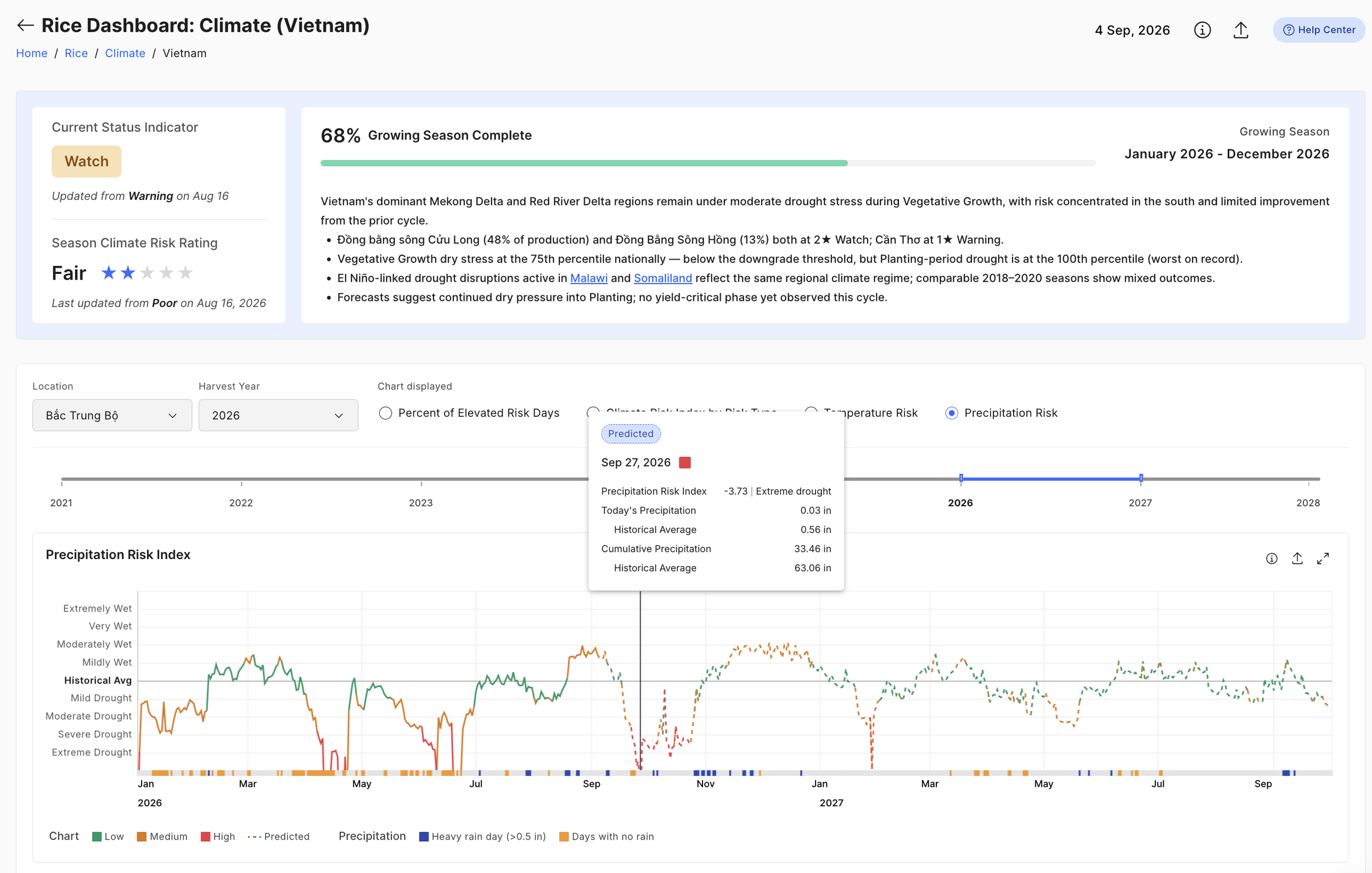
Vietnam rice, national view. Planting drought at the 100th percentile; status eased from Warning to Watch on 16 August. Source: Helios Horizon, 4 September 2026.
Thailand's story is similar in shape. Northeastern Thailand, half of national output, recorded planting drought at the 100th percentile, the worst in eight seasons. Western Thailand is a smaller region at 2.5% of output, but it shows what the extreme looks like: 88% of planting days under dry stress, more than double the previous eight-season maximum of 39.1%. The country sits on Watch at two stars; Western Thailand is on Warning at one.
Helios flags the same climate regime behind the El Niño-linked drought disruptions active in Malawi and Somaliland. The pattern is regional, not a set of unconnected local problems.
Which exporters carry the most risk into Q4 and Q1?
Three origins have climate stress and a price forecast moving in the same direction. All three are forecast to rise through the harvest window, which is when export prices normally soften.
Vietnam is the clearest overlap. All-varieties FOB is at $424/t, up from $411 a month ago. Helios forecasts $461/t by December (+10%) and $541/t by March 2027 (+28.6%). The 15% broken grade is forecast to reach $510/t by December, and the 10% grade carries the steepest path of any rice series on the platform. Vietnam ships 12.9% of 2026/27 world exports.
Pakistan (8.0% of exports) has the sharpest near-term price move and a calmer national climate read. Punjab, which grows 52% of the crop, is neutral. Sindh, at 38% of output, is at two stars with vegetative-growth heat at its highest recorded level for the phase. All-varieties FOB is $382/t, forecast to $430/t by December (+13.2%) and $446/t by March (+17.5%). White Long Grain runs to $481/t by March. The forecast explicitly inverts the usual October to November harvest softening, on heat and excess-precipitation risk through reproductive and harvest phases.
Thailand (11.9% of exports) is the smaller-magnitude version. White Long Grain 25% is at $437/t, forecast to $448/t in December (+2.3%) and $458/t by March (+4.6%). Modest on paper. The reason to watch it is the forecast for the upcoming Reproductive Development phase: roughly 40% wet-stress days in a yield-critical window that falls inside Q4. If that verifies, the price risk is skewed upward.
Does India change the picture?
India is 39.8% of 2026/27 world rice exports. Whatever happens in Vietnam or Pakistan, India sets the ceiling.
The national read is All Good at three stars, and export prices are forecast down: all-varieties at $352/t now, $337/t by December (−4.3%) and $317/t by March 2027 (−8.6%). India is the one large origin where Helios has prices easing while climate risk builds. Telangana, 22% of output, moved from All Good to Watch on 23 August. Its dry stress in Vegetative Growth has come down sharply, from 36.1% of days a week earlier to 13.1%, but that is still the 88th percentile. Andhra Pradesh is also at two stars.

Telangana, 22% of India's rice output. Dry stress down to 13.1% of days but still the 88th percentile; forecast risk building into the harvest window. Source: Helios Horizon, 4 September 2026.
The forecast is the part worth stress-testing. Helios projects around 61% wet-stress days in Reproductive Development, and December carries a compound flag for heat, cold and excess-precipitation risk. December is also the month the price forecast expects to be lower. If the climate risk lands, that is the single forecast most likely to be revised up.
Why does the national rating hide the local picture?
Because the country number is an average, and the places that grow the rice are not.
Chinthakunta, in Telangana, is rated Poor at one star against Telangana's Fair at two. Cumulative precipitation is 24.82% below normal (64.70 inches against a historical average of 86.06). The local forecast for peak harvest in November is severe excess rainfall on top of a dry year. That is a drought-then-flood sequence, at the harvest end of the season.
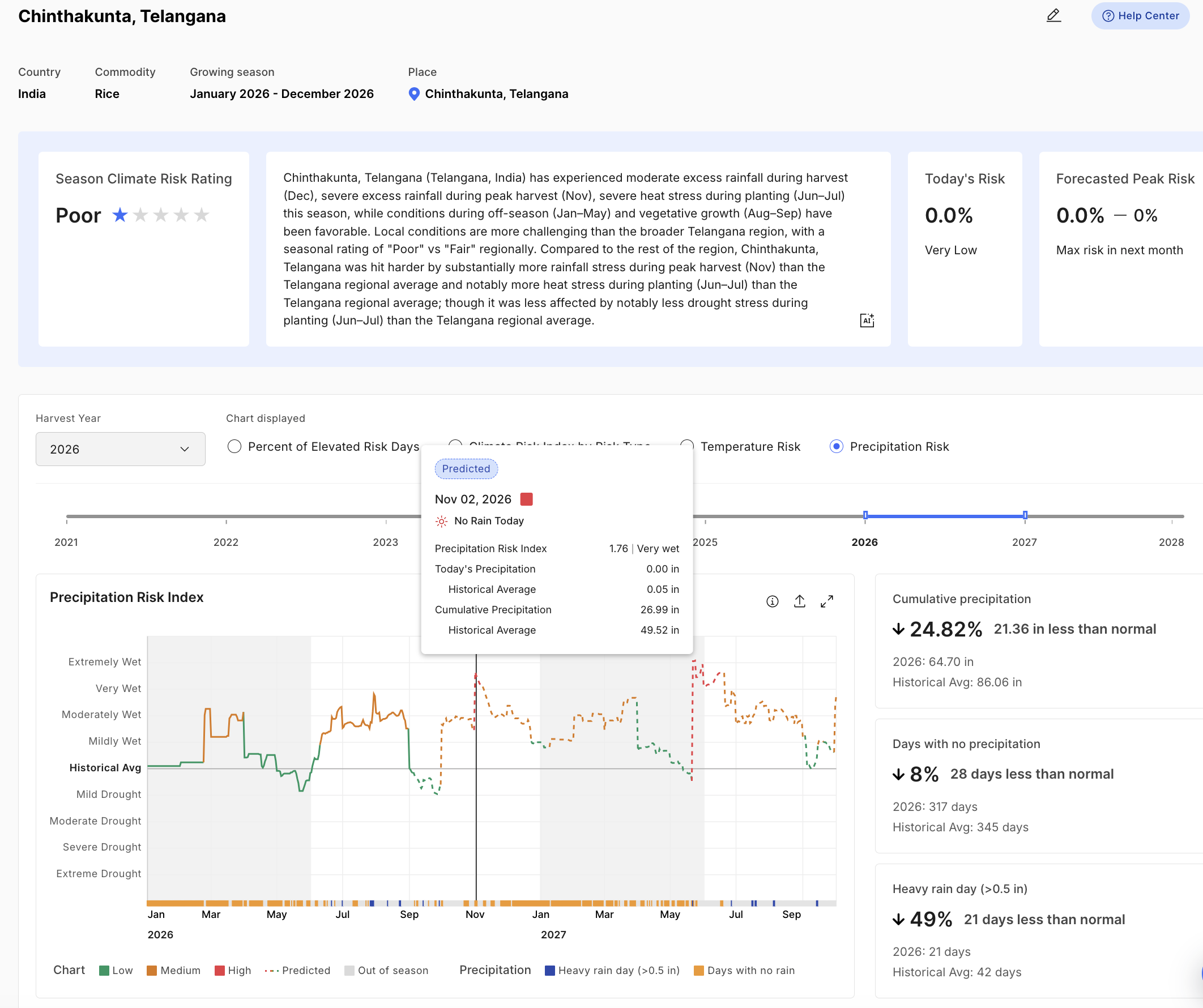
Chinthakunta, Telangana. One star locally against two for the region; a dry year with severe excess rainfall forecast at peak harvest. Source: Helios Horizon, 4 September 2026.
China is the best-rated major producer nationally, All Good at four stars, with reproductive-development heat at the coolest level on record. Yet a locality in Hunan (Gugang, Liuyang) is rated Fair at two stars against a Neutral regional average, with today's risk at 42.9% and forecast peak risk at 100% for October harvest, driven by excess rainfall. Yield prospects there sit below the regional expectation.

Gugang, Hunan, China. Four stars nationally, two stars here. Forecast peak risk 100% for October harvest on excess rainfall. Source: Helios Horizon, 4 September 2026.
If you buy from a specific mill or a specific district, the national rating tells you what the market believes. The local one tells you what will show up at the gate.
What else is in the Q4 and Q1 window?
The US has the worst climate rating in the set: Warning at one star. Arkansas, half of US production, recorded 98.4% of planting days under drought against a prior worst of 36.1%. The season closes in November, so the damage is largely written into the Q4 crop. Helios does not carry a US rice export price series, so exposure there reads through the Chicago rough-rice complex.
Brazil is the Q1 story. Pre-season and rated Too Early, upgraded from Take Action on 23 August, with the riskiest month flagged as November 2026 for excess rainfall. Off-season wet stress is the highest in nine seasons and forecasts show 100% wet days through every phase from planting to harvest. The 2019 season with the same wet fingerprint came in 5.7% below average. The 2024 season with the same pattern came in near average.
Cambodia (6.1% of exports) is All Good today but carries record wet stress in Vegetative Growth (60.7% of days), with elevated wet stress forecast through Harvest and Peak Harvest into February 2027.
Indonesia is a demand-side shock rather than a supply one. Take Action status, with three flood events damaging more than 142,700 hectares across Aceh and North and West Sumatra, and Peak Harvest dry-stress days at 100% against a historical maximum of 12.9%. Indonesia exports very little rice. It imports a lot, and an import surge would tighten the Asian balance further.
The short version
Vietnam and Pakistan are where El Niño climate risk and forecast price appreciation line up into Q4 2026 and Q1 2027. Thailand is a quieter version of the same, with a yield-critical wet window still ahead. India is the release valve, and the December compound-risk flag is the assumption worth testing before you lean on it. Brazil's November rainfall window is the new-crop risk for Q1. Indonesia's damage would pull demand into an already tight market.
Helios AI covers rice prices at the export level. The wholesale and farmgate series can be added to a subscription on request.


.png)

Personalized commodity intelligence for the teams that feed the world.
