
Europe's 2026 Fry Potato Crop Is Short on Length Before It Is Short on Tonnes.
The north-west European processing crop is down a quarter on the growers' body NEPG's first count, in every one of its four origins; the number that will decide this campaign is the share of tubers above 50 mm, and that share is down by about a third in France and the Netherlands, and in Belgium by more than half at the end of July, after a month that recorded almost no rain.

October 15, 2026
3 min read
The Crop Was Graded Small Before It Was Weighed.
Belgian Fontane digs on 27 July found a third of the crop above 50 mm. On the 33 practice fields of the Proefcentrum voor de Aardappelteelt (PCA) and Viaverda, 9 tonnes of a gross 28 tonnes a hectare were above 50 mm; at the end of July 2025 the same programme had 77%.
The Dutch digs read the same way. The 15 August test dig of the growers' association Verenigde Telers Akkerbouw (VTA), reported by Nieuwe Oogst, put 50% of the crop at or above 50 mm against 73% in 2025 and a five-year 56.8%, on a tuber count of 175 against 146. In France, a chamber of agriculture survey in Nord-Pas-de-Calais put the over-50 mm fraction 30% below its five-year mean, a single-source figure.
The specification has already moved. On 2 September the French potato interprofession, the Comité National Interprofessionnel de la Pomme de Terre (CNIPT), lowered the minimum calibre for conservation potatoes sold with the "frites" claim from 50 mm to 45 mm for the 2026-27 campaign. The North-western European Potato Growers (NEPG) wrote on 14 September that "Sizes and lengths are far lower than on average" and that "Traders and processors must adapt their specifications". The number processors will fight over this winter is the share above 50 mm.
Tonnage Is Down in All Four Origins.
NEPG's first estimate of 14 September puts the four-country crop at 20.695 million tonnes. That is 25.4% below 2025, for consumption potatoes excluding seed and starch. Area fell 13.7%. Yield fell to 40.5 tonnes a hectare, 13.9% below last year and 9.4% below the five-year mean.
Every origin lost on both area and yield. France yielded 37.4 tonnes a hectare, 13% less than in 2025; Belgium 38.5, 21.6% less; Germany 40.0, 11.3% less; the Netherlands 46.0, 9.4% less and within 1% of its five-year mean. Area fell by between 9.7% in France and 17.5% in Belgium.
The split between origins is in size and length. Tonnage is short everywhere; the three western origins have published a degraded size profile and Germany has published none.

A Wet June Set the Tubers. A Dry July Starved Them.
The crop set a high tuber number in a wet June. The Royal Netherlands Meteorological Institute (KNMI) measured 85 mm in June against a 64 mm normal, and the Royal Meteorological Institute of Belgium (RMI) recorded its fifth-wettest June at Ukkel.
Then the rain stopped. In our observed rainfall series, pulled 12 October, July 2026 delivered 3% of the norm in Hauts-de-France, 6% in West Flanders, 9% in Hainaut and 16% in Zeeland. Each was drier than July 2022. Hauts-de-France recorded zero rainfall on every day from 3 to 25 July. The meteorological services agree: Météo-France puts the national July deficit at 70%; RMI measured 13.0 mm at Ukkel from 1 July to 15 August against a 115.6 mm normal, the third-lowest since 1892; KNMI recorded 15 mm in July against 78.
August rain restarted bulking late. West Flanders, Hainaut and Zeeland received 107% to 137% of their August norm; Hauts-de-France 88%; Groningen 40%. The Belgian digs climbed from 28 tonnes a hectare on 27 July to 32 net on 24 August and 38.2 on 21 September. The tonnes came back on tubers set in June and stalled in July, so the over-50 mm share rose from a third to about half by the end of August, on the Energy and Climate Intelligence Unit's (ECIU) reading. No later size share has been published.

Heat During Bulking Makes Many Small Tubers.
The agronomy is published and dated. Arvalis, the French arable-crops institute, wrote on 31 July for the Nord of heatwaves limiting tuber growth in long-cycle varieties, tuberisation blockage on some plots, regrowth and dry matter trending high. Van Iperen's adviser told Nieuwe Oogst on 7 August that under heat the plant reaches the fill phase and stops producing. Helios does not measure tuber size, dry matter or storability.
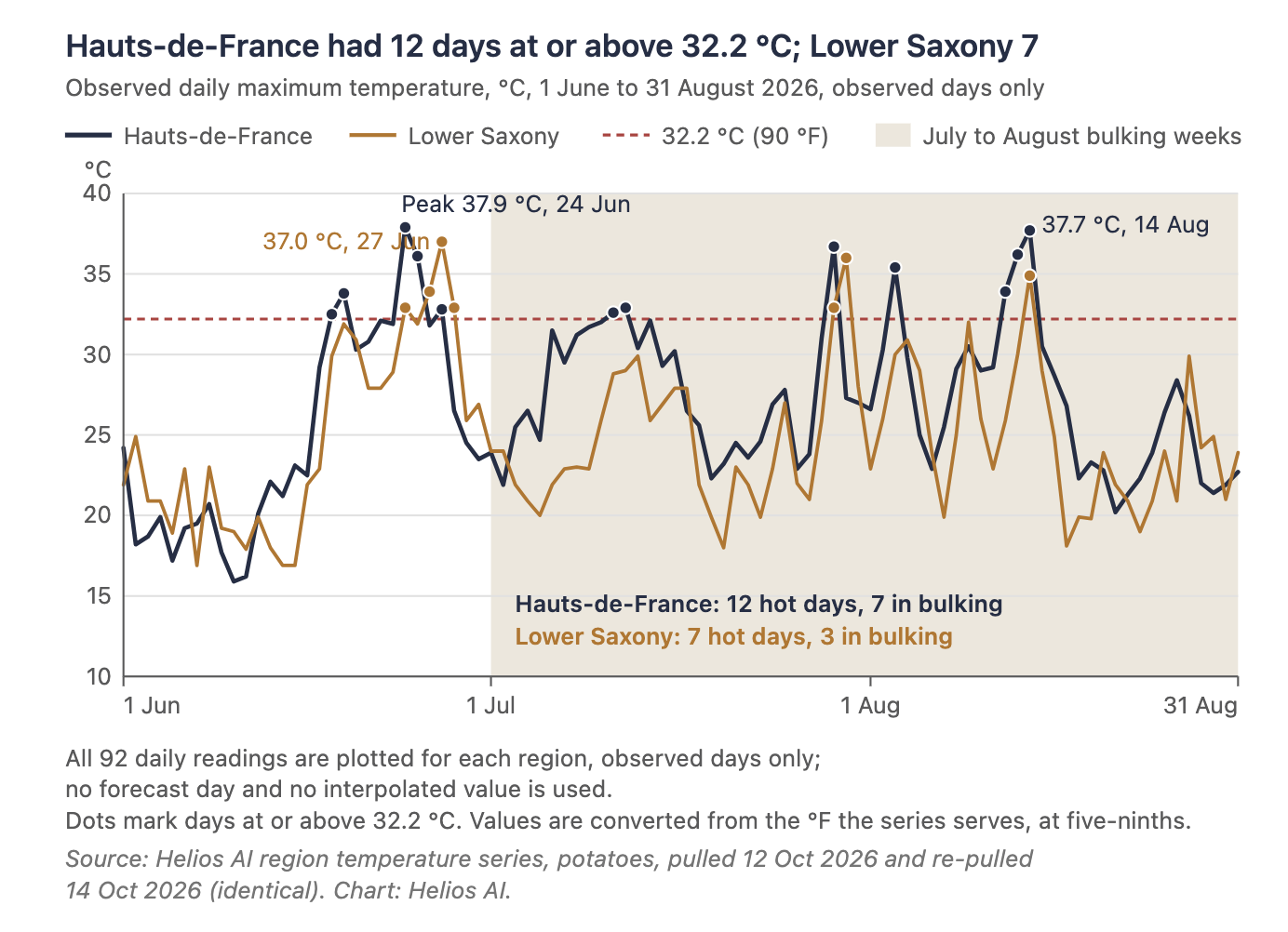
The heat sat on top of the drought. Météo-France calls summer 2026 the hottest since 1900, 3.6 °C above the 1991 to 2020 normal. In our observed temperature series, pulled 12 October, Hauts-de-France had 12 days at or above 32.2 °C between June and August, against 5 in 2022 and 4 in 2025; 7 fell in the July and August bulking weeks. Lower Saxony had 7, 3 of them in bulking.
Our climate-risk ratings record the stress as dated flags. France moved to Warning on 26 July; Belgium and the Netherlands to Take Action on 6 September. Those are flags of stress through tuber initiation and bulking, not a harvest.
Germany's Yield Fell With the Others.
Destatis, the federal statistics office, counted 10.4 million tonnes of all potatoes at 38.9 tonnes a hectare in its preliminary estimate of 24 September. The federal agriculture ministry (BMLEH) puts that yield 15% below 2025 and about 11% below the multi-year average. By state, on preliminary figures reported on 27 September, Lower Saxony's yield is 14% below last year and North Rhine-Westphalia's 17%. Bavaria's statistics office reported 32.6 tonnes a hectare on 2 October, 28.7% below 2025, with heat, drought and Stolbur named by the office and by the Bavarian farmers' union, which expects smaller tubers.
Our observed rainfall agrees with the statistics office. July ran at 36% of norm in Lower Saxony, 61% in North Rhine-Westphalia and 81% in Bavaria; the German weather service, the Deutscher Wetterdienst (DWD), puts the German summer at 72% of normal rain. Our climate-risk ratings for the German regions carry no drought flag this season, so for Germany we rely on the statistics office and the observed rainfall rather than on the rating.
The Free Market Priced It in August. Contracts Were Set Before the Drought.
Belgapom's free-buy quotation of 9 October is 20 euros per 100 kg for Fontane and 20 for Challenger. The basis is excluding VAT, minimum calibre 35 mm, delivered by the producer loose on the truck, and Belgapom called the market "prijshoudend", steady. PotatoNL's category I free-buy range for large-scale processing, reported by Nieuwe Oogst, stood at 20 to 27.50 euros per 100 kg on 28 September, after a first 2026 indication of 18.50 to 22.50 on 27 July and a quotation of 22.50 to 27.50 on 10 August. The same report observed that lots with enough length were fetching the best prices. Helios has no European potato price series.
Contract prices were set in December, before any of this. Agristo's 2026-27 offer, reported by the Flemish farm news service VILT in December 2025, averaged 40 euros a tonne lower than the year before, a 17% cut, with 140 euros a tonne for mid-September to mid-October delivery; ECIU puts the sector's 2026 contract cut at 20%. Contracted volumes are 15% to 25% smaller on the Belgian farmers' union ABS's and the Dutch analyst DCA's accounts, and Nieuwe Oogst reported on 1 September that Belgian growers were drawing on 2025 stocks to meet 2026 contracts.
What Closes the Question, and When.
Four dated checks settle the size-and-storage read. NEPG's final figures; the Belgian statistics office Statbel's 2026 yield, unpublished on 9 October; the December store checks, the first reading of sprouting in store; and the contract round for the 2027 crop, due from December. If the store checks confirm the early sprouting NEPG says "will also be an issue for storage during campaign" and Top Pom reported on 3 September, with the high dry matter Arvalis found in July, then October's length problem becomes a storage-quality problem in the second half of the campaign. If they do not, the campaign is short, small and otherwise ordinary.
The Bottom Line.
The 2026 crop is a quarter smaller, and that is the easier half of the problem. The harder half is that Belgium's July digs found a third of the crop above 50 mm, the Dutch digs half, the French calibre floor has already dropped to 45 mm, and every origin that has measured size has published a profile worse than last year's. Germany has published none.
This campaign is bought by the millimetre, and the millimetres were lost in July.
Frequently asked questions
How big is north-west Europe's 2026 processing potato crop?
NEPG's first estimate of 14 September 2026 puts the EU-4 consumption crop (France, Germany, Belgium and the Netherlands), excluding seed and starch, at 20.695 million tonnes, 25.4% below the 27.750 million tonnes of 2025 and 13.7% below the five-year average. Area fell 13.7% to 521,455 hectares and yield fell to 40.5 tonnes a hectare, 13.9% below 2025. By origin, France is at 6.485 million tonnes, Germany 7.550, Belgium 3.431 and the Netherlands 3.229, down between 21.5% and 35.3% on the year. NEPG promises final figures later in the season.
Why do drought and heat during tuber bulking cut tuber size and not only tonnage?
Tuber number is set at initiation, in June and early July; size is built during bulking, in July and August. A wet June set high numbers this year, the Dutch VTA dig counting 175 tubers against 146 in 2025. July then delivered 3% to 16% of normal rain in Hauts-de-France, West Flanders, Hainaut and Zeeland in our observed series, pulled 12 October, so the plant stopped filling, and Arvalis and Van Iperen's adviser describe tuberisation blockage, stalled fill and regrowth. August rain restarted bulking on the same large number of small tubers, which recovers tonnes faster than it recovers size. Helios does not measure tuber size; the digs do.
Which of the four origins came through 2026 best, and why?
On NEPG's yields, the Netherlands, at 46.0 tonnes a hectare, within 1% of its five-year mean, though the VTA dig has only 50% of the crop at or above 50 mm against 73% last year and Groningen was the driest region in our nine-region set from June to August, pulled 12 October. Belgium is the worst on yield, 21.6% down, and France 13% down at 37.4. Germany's official yield is 15% below 2025 and Bavaria's 28.7% below, so Germany is not a spare origin. None of the three origins that measured size came through with a normal profile, and Germany has not published one.
What are free-buy potato prices now, and how do they differ from contract prices?
Belgapom's free-buy quotation of 9 October 2026 is 20 euros per 100 kg for both Fontane and Challenger, excluding VAT, minimum 35 mm, delivered by the producer loose on the truck, with the market described as "prijshoudend", steady. PotatoNL's category I free-buy range for large-scale processing was 20 to 27.50 euros per 100 kg on 28 September, with lots of sufficient length fetching the best prices. Contract prices are a separate market, agreed in December 2025 before the drought: Agristo's 2026-27 offer averaged 40 euros a tonne lower than the prior year, with 140 euros a tonne for mid-September to mid-October delivery, and contracted volumes are 15% to 25% smaller.
Will the 2026 crop store through spring 2027?
It is untested. NEPG wrote on 14 September that early sprouting "will also be an issue for storage during campaign", Top Pom's Antoine Geysels reported "particularly severe sprouting" on 3 September, and Arvalis found dry matter trending high in the Nord on 31 July, which in its storage guidance raises bruise sensitivity. The December store checks are the first reading of sprouting on the stored crop, and no origin has published a 2026 dry-matter survey yet. Helios does not measure storability; the December store checks answer this.
When will the 2027 contract prices be set and what will drive them?
No processor had published an offer for the 2027 crop as of 12 October 2026. The 2026-27 round opened with Agristo's offer on 4 December 2025, so a December opening is the pattern. On the table by then: NEPG's final 2026 figures, Statbel's Belgian yield, the December store checks, and a 2026-27 season in which contract prices were cut 17% to 20% before the drought, contracted volumes fell 15% to 25%, and NEPG expects some growers, particularly in Belgium and France, to fall short of their contracted tonnes. NEPG has asked processors to adapt their specifications; whether the 2027 contracts write that into the calibre clause is the open question.


.png)

Personalized commodity intelligence for the teams that feed the world.
