
Food security before the shock: our panel with IFPRI and the FAO ahead of Climate Week NYC
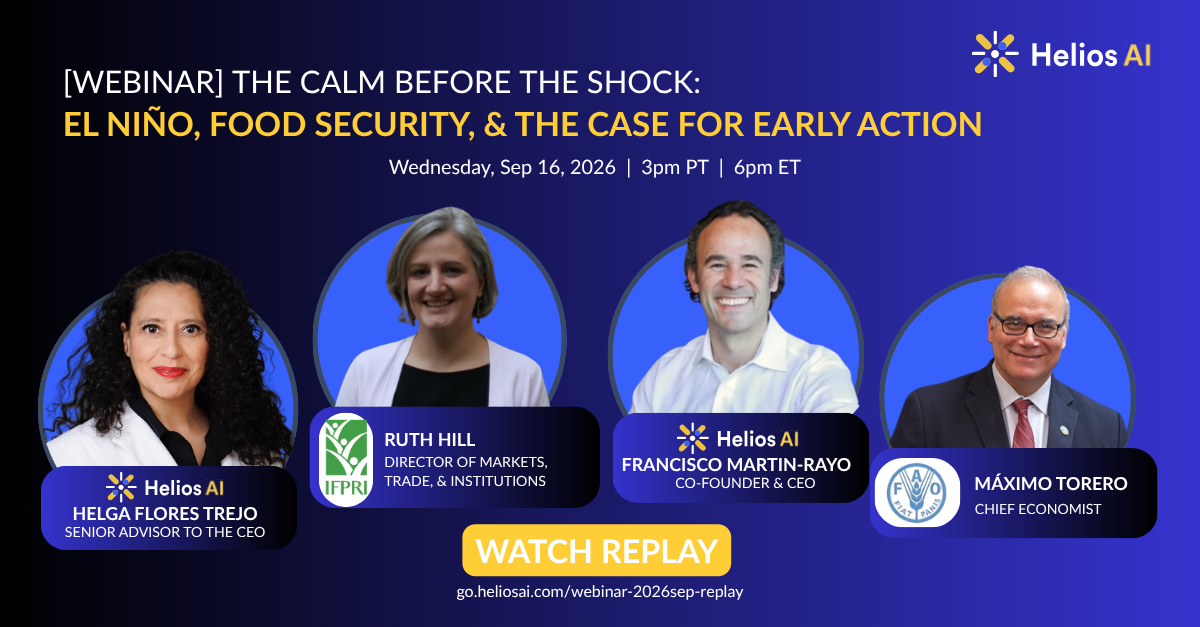
A Climate Week panel with IFPRI and the FAO on food security. Why prices are rising despite a strong harvest, and why early action works.

September 22, 2026
3 min read
What is changing in food security right now?
The panel met on 16 September, days before Climate Week NYC opened, and started from a point every speaker shared. Food supply chains have entered a new phase of risk, and climate shocks, logistics disruption, fertilizer shortages, fuel prices and geopolitical pressure are no longer arriving one at a time. They are moving together, and the signals now showing up in headlines around Super El Niño, food inflation, fuel costs and heat losses in agriculture all point back to the same underlying problem. Risk itself is not the open question. The open question is what governments, companies and international organizations do before the shock reaches markets and households.
Why do strong harvests not end hunger?
Because supply and access are different problems, and enough food can exist globally while millions of people still cannot afford it. FAO forecasts global cereal production in 2026 at 2.98 billion tonnes, the second largest harvest on record, but it is down about 2 percent on last year, and FAO has cut the forecast by 3.4 million tonnes with end of season stocks trimmed by 1.1 percent. A strong harvest is not a buffer on its own.
Food security depends on a wider set of conditions: import cover, foreign exchange reserves, trade flows, access to fertilizer, fuel and transport costs, climate exposure and debt stress. Any one of those can fail while the others hold, which is how a country can sit inside a comfortable global supply picture and still face acute hunger at home. In many cases the binding constraint is not the amount of food available. It is access, affordability and resilience.
Does El Niño affect every region the same way?
No, and a global average hides outcomes that run in opposite directions. Southern Africa faces drought risk and India a weaker monsoon, while Brazil faces heavier rain that can delay the safrinha harvest, and parts of the Horn of Africa may even see better harvests. That divergence is the reason food security analysis needs country level detail, and in some cases subnational detail. One headline number will not tell a procurement team or a finance ministry what happens inside their own exposure.
How do fertilizer, fuel and shipping routes drive food risk?
Input supply and logistics are where the current shock is concentrated, and both run through a small number of chokepoints. The Strait of Hormuz matters most, because it concentrates 30% of fertilizers, 25% of natural gas and 50% of the sulfur used for phosphates, and its closure has already fed through to grain markets. FAO attributed part of August's increase in international maize prices to concerns over input supplies following the closure of the strait. Fertilizers, hybrid seeds, energy and water pumping all depend on those flows, and diesel remains expensive, which raises production and transport costs across the system.
Other pressure points are compounding it. The Red Sea, the Black Sea and the Panama Canal are all constrained, as is the east to west gas pipeline affected by attacks on infrastructure. The Panama Canal Authority capped daily transits at 34 vessels from 4 September and cut that to 32 from 15 September, against an average of 35 transits through June and a working capacity of around 40 per day. Every reduction in throughput adds cost and waiting time, and in a system already under pressure each delay lifts the risk premium on food.
How much have food prices actually risen?
Less than a worst case, but the direction is consistent. In one recent episode, strong harvests, stock drawdowns and trade adjustments held the global increase to 4 to 5%, and the August 2026 readings show that pressure returning:
- the FAO Food Price Index averaged 133.3 points, up 1.9% on July and 2.5% on a year earlier
- the cereal index rose 2.2%, its highest level since May 2024
- wheat stood 15.0% above its year earlier level
- the sugar index rose 11.9%, the largest move of any group
Commodity prices move first and shelf prices in supermarkets and local shops follow, with a transmission lag that typically runs 3 to 6 months. So the households most exposed to this month's commodity move will feel it late in the year, and that lag is what makes the current moment deceptive. It produces a stretch of apparent calm immediately before the shock reaches dinner tables.
Does early action really protect households?
Yes, and the evidence is specific. Anticipatory cash support delivered before a shock produces measurably better outcomes than relief delivered after it, because it reaches households while they still have options. When households received cash a few days before a flood peak, they were able to buy food, move livestock and prepare for the shock. In one study, households that received cash were 62% less likely to go a full day without eating during the flooding period, and three months later, children in those households were still eating better than those in comparable households that received nothing in advance. Evidence from floods and droughts across several countries points the same way: support that arrives before the shock protects welfare more efficiently than support that arrives after it.
How good does a forecast need to be?
It depends entirely on what the forecast is being asked to trigger. Where the action is no regret, decision makers can move earlier and tolerate a higher false alarm rate, and cash support fits that model well, because the money still helps a household even if the shock never fully materializes. Other actions demand more precision. If a farmer switches crop variety or changes planting dates, the forecast has to be stronger, the advice has to fit local conditions, and the decision needs financing and extension support behind it.
The practical implication is that prediction systems have to connect directly to action systems. A forecast that does not terminate in a funded, pre agreed decision is not an early warning system, however accurate it turns out to be.
Can AI and better data improve foresight?
They already are, and three developments explain most of it: better weather data, better algorithms and cheaper compute. Together they make more sophisticated prediction platforms viable, and they give governments and companies more lead time before disruption reaches them. The binding constraint now sits less in the technology and more in adoption, trust and delivery. Farmers, procurement teams and public agencies need time to trust a forecast before they will act on it, and once they do, the value of the signal compounds.
What can governments do now?
The most important decision is not to wait for confirmation, because the measures that work take time to reach households. Practical steps available today include:
- finance households before the shock arrives
- match the action to the quality of the forecast
- use no regret support wherever possible
- improve logistics planning
- clear rivers and identify alternative road routes where infrastructure is exposed
- protect trees and long lived crops where deep El Niño risk is rising
- use trade to move surpluses toward deficit areas
- strengthen coordination across financing agencies
Trade matters particularly over the next several months, because the system needs redistribution from surplus regions to deficit ones, and that redistribution has to be allowed to happen rather than blocked at the border.
What should governments avoid?
Two common responses make the situation worse, and both tend to look protective at the moment they are announced.
Export restrictions
Export restrictions amplify price spikes in food and fertilizer markets alike. They protect one domestic market briefly and raise the cost of the shock for everyone else, including future buyers in the restricting country.
Input subsidies
Input subsidies can backfire. They distort input allocation, suppress efficiency and become politically difficult to withdraw once the shock has passed. The alternative to either measure is not inaction. It is action that builds resilience rather than deferring cost.
Why is the response still too slow?
Because coordination, not information, is now the binding constraint. The world has more data, more logistics visibility and more risk monitoring than at any previous point, and policy response still lags. Financing institutions, governments and agencies frequently act without alignment, and countries also avoid drawing on flexible financing tools because the process appears too complex. That self exclusion weakens the overall response.
A shared view of who is funding what, and when, would reduce duplication and improve timing. That structure now matters as much as the forecast does, because a signal no one is organized to act on changes nothing.
What should come next?
Food security sits at the intersection of climate risk, trade disruption, fertilizer supply, logistics and household affordability. All five are moving at once, which is why the response cannot be sequential either. The harm is still reducible, and the path runs through early warning, anticipatory action, better financing, stronger coordination, smarter trade policy and no regret support for households and farmers. The shock will not wait for policy to catch up, and early action is what gives food systems their best chance of absorbing the next disruption rather than reacting to it.
.png)

Personalized commodity intelligence for the teams that feed the world.
