
Global Commodity Outlook 2026: Early Climate Signals Shaping Food Markets
As global food systems enter 2026, climate risk is no longer a background variable—it is an active market force. Patterns that emerged in late 2025 are…

January 15, 2026
3 min read

As global food systems enter 2026, climate risk is no longer a background variable—it is an active market force. Patterns that emerged in late 2025 are accelerating into the new year, widening the gap between commodities that remain resilient and those facing compounding volatility. Using Helios Horizon’s climate-risk modeling and early-season forecasts, Helios AI has identified a focused set of staples and fresh produce categories where climate conditions are likely to have an outsized impact on supply, pricing, and sourcing strategies in 2026.
This outlook highlights six commodities—across staples and fresh produce—where early warning signals are already visible. These signals point to heightened procurement risk, increased price sensitivity, and the growing importance of timing and geography in sourcing decisions.
DOWNLOAD FULL REPORTHigh-Risk Staples: Early Signals Helios AI Is Detecting for 2026
Staple commodities often benefit from structural demand and policy support, but even these markets are increasingly shaped by short-term climate variability. In early 2026, Helios AI is detecting diverging risk profiles across sunflower seed, rice, and coffee—each responding differently to moisture patterns, seasonal timing, and regional exposure.
Sunflower Seed (Ukraine)
Price stability masks early-season production risk
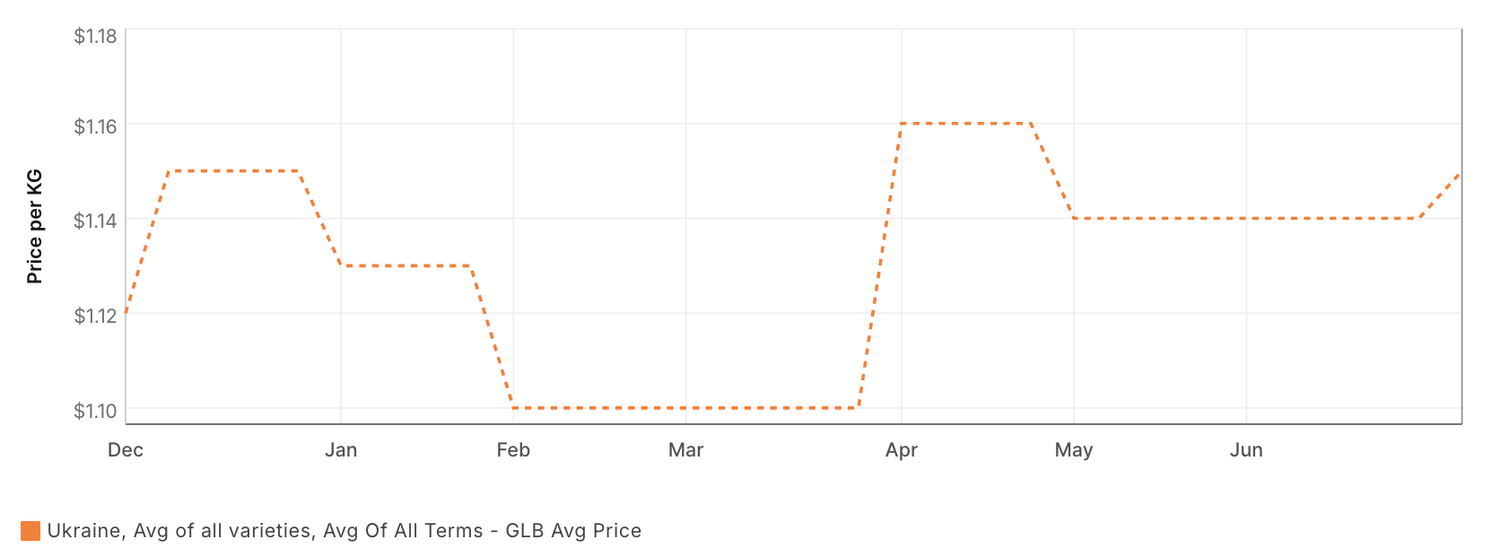
Ukrainian sunflower seed prices enter 2026 relatively stable, fluctuating within a narrow range despite ongoing geopolitical and logistical pressures.
Climate data, however, reveals elevated early-season risk, particularly in January, when 70–80% of days are classified as “too wet.”
Excess moisture during planting increases the likelihood of delayed fieldwork, poor germination, and uneven crop emergence.
As conditions shift rapidly toward drier weather later in Q1, crops face additional stress, potentially limiting yield potential even if prices remain supported.
Rice (Vietnam)
Gradual price gains supported by moderate but shifting climate conditions

Vietnamese rice prices are projected to rise steadily from January into April–May 2026, reflecting tightening supply and seasonal demand dynamics.
Overall climate risk remains moderate, but moisture variability in January and February introduces uncertainty ahead of key mid-season stages.
These early fluctuations may translate into stress later in the growing cycle, increasing exposure to mid-season price peaks.
Procurement teams may benefit from securing volumes earlier to reduce risk during the April–June window.
Fresh Produce at Risk: Fruits & Vegetables to Watch in 2026
Fresh produce markets are inherently more exposed to short-term climate shocks, and early 2026 is shaping up to be particularly challenging. Across tropical and subtropical regions, Helios AI is detecting overlapping risks from excess moisture, drought, and rapid weather transitions—especially during planting and early growth stages.
Sweet Potatoes (Southern Africa)
Multi-region drought creates compounding supply risk
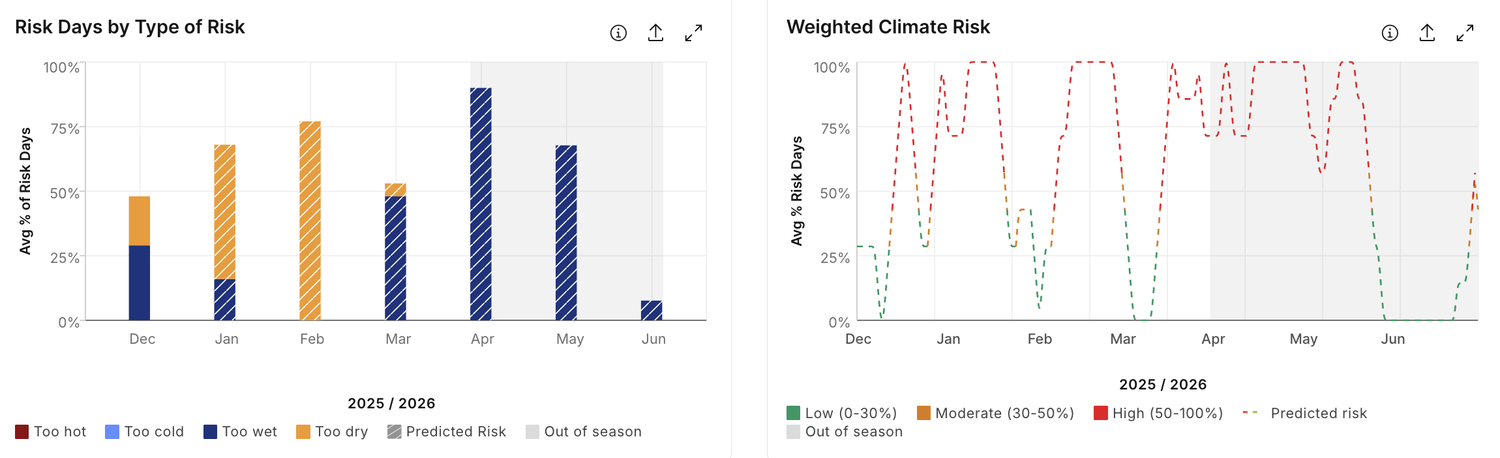
Risk Days and Weighted Climate Risk graphs show extreme fluctuation due to the combination of “too wet” and “too dry” days in Sout Africa
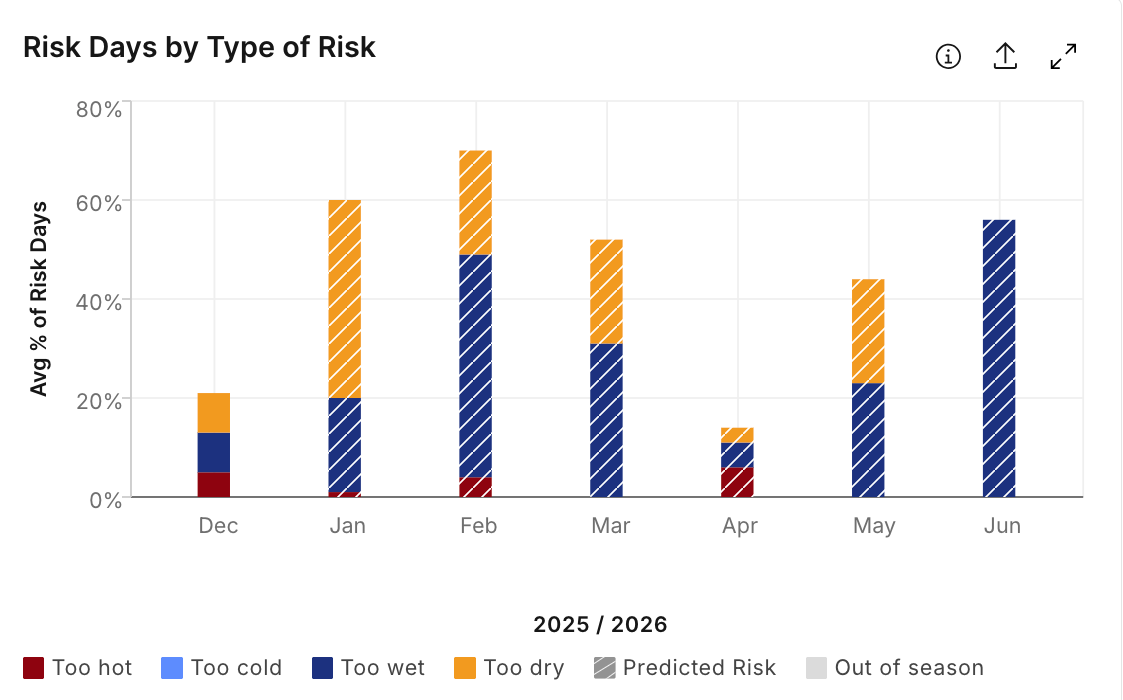
The combination of “too dry,” “too wet,” and “too hot” risk days increase Avg % of Risk Days to around 70% in February 2026 in Malawi
Sweet potato production in Malawi, Tanzania, and South Africa is exposed to prolonged drought from December through February, aligning with planting and early growth stages.
Drought stress during this period threatens root formation, marketable size, and total yields, with losses difficult to recover later in the season.
Although rainfall conditions improve by late March, early-season damage is likely to carry forward into mid-2026, increasing supply volatility across sourcing regions.
Zucchini (Mexico)
Moisture extremes disrupt a critical export window
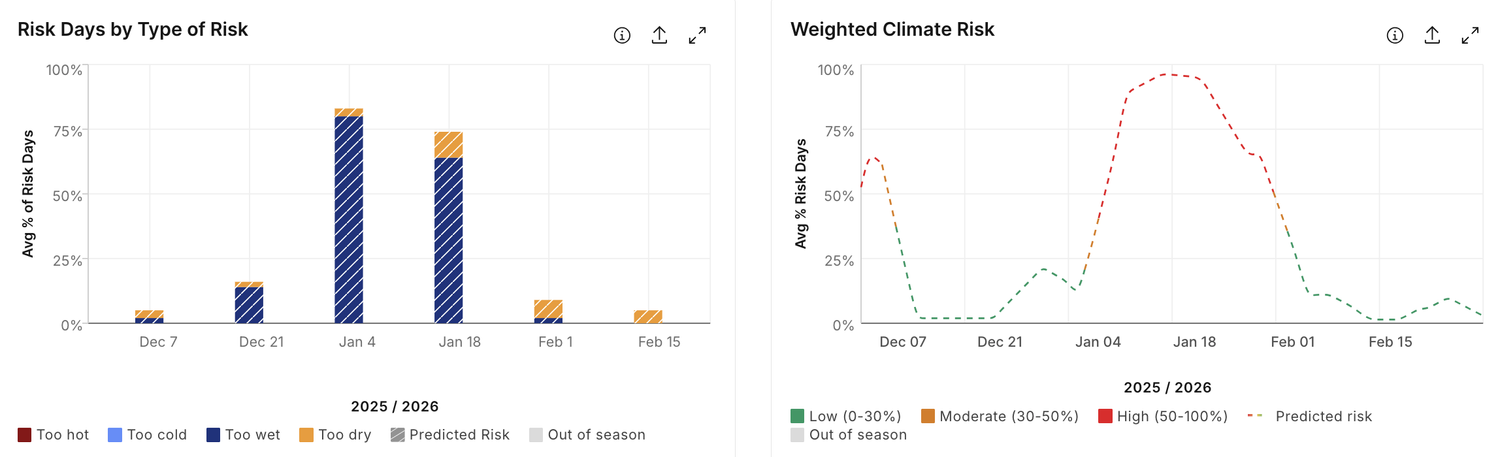
Mexican zucchini production experiences early-season instability, with repeated cycles of excess moisture followed by drying from January to March.
Climate risk peaks at 60–90%, as wet conditions delay planting and elevate disease pressure.
These fluctuations threaten yields during a key export period for North American markets, positioning zucchini as one of the most climate-sensitive winter vegetables entering 2026.
What This Means for 2026
Taken together, these early signals suggest that 2026 will not be defined by a single global shock, but by localized climate stress accumulating across multiple commodities and regions. Staples may appear stable on the surface, while hidden production risks build beneath. Fresh produce markets, meanwhile, remain highly exposed to short-term weather volatility that can rapidly disrupt supply chains.
Helios AI will continue to monitor these conditions through Helios Horizon, translating climate risk into actionable intelligence for procurement, sourcing, and risk management teams as the year unfolds.
ACCESS THE WHITEPAPER


.png)

Personalized commodity intelligence for the teams that feed the world.
