
Global Commodity Outlook: What 2025 Taught Us & What 2026 Will Demand
2025 reinforced a structural reality: volatility is now the baseline for global food supply chains. Climate whiplash, extreme rainfall variability, heat…

December 28, 2025
3 min read

🌍 2025 in Review: The Signals That Will Shape 2026
Executive Summary
2025 reinforced a structural reality: volatility is now the baseline for global food supply chains. Climate whiplash, extreme rainfall variability, heat spikes, and shifting trade flows created unpredictable outcomes across fruits, vegetables, and grains. Yet within this turbulence, a set of clear signals emerged — revealing which commodities flourished, which collapsed under pressure, and where climate exposure is intensifying fastest. These signals form the foundation of Helios AI’s highly accurate 2026 forecasts.
Unlock Full Global Commodity Outlook (2025 Recap + 2026 Forecast)🍎 Fruits: The Standouts of 2025
Flourishing — Pineapples (Global Origins)
Pineapples defied broader market instability in 2025. Demand stayed resilient across the U.S. and Europe, and stable growing conditions across Costa Rica, Guatemala, Honduras, Mexico, and Ecuador supported steady supply. Mid-year dips were seasonal rather than climate-driven, and late-season prices strengthened sharply — one of the clearest flourishing fruit stories of the year.

Volatile — Cherries (Czechia)

Cherries saw some of the harshest climate-driven instability in 2025. Repeated WA%R spikes during flowering — triggered by alternating cold snaps, heat surges, and moisture extremes — drove yield variability and market volatility. Cherries are a prime example of a fruit whose sensitivity is magnified by climate unpredictability.
🥕 Vegetables: Climate Winners & Losers
Flourishing — Tomatoes (Mexico)
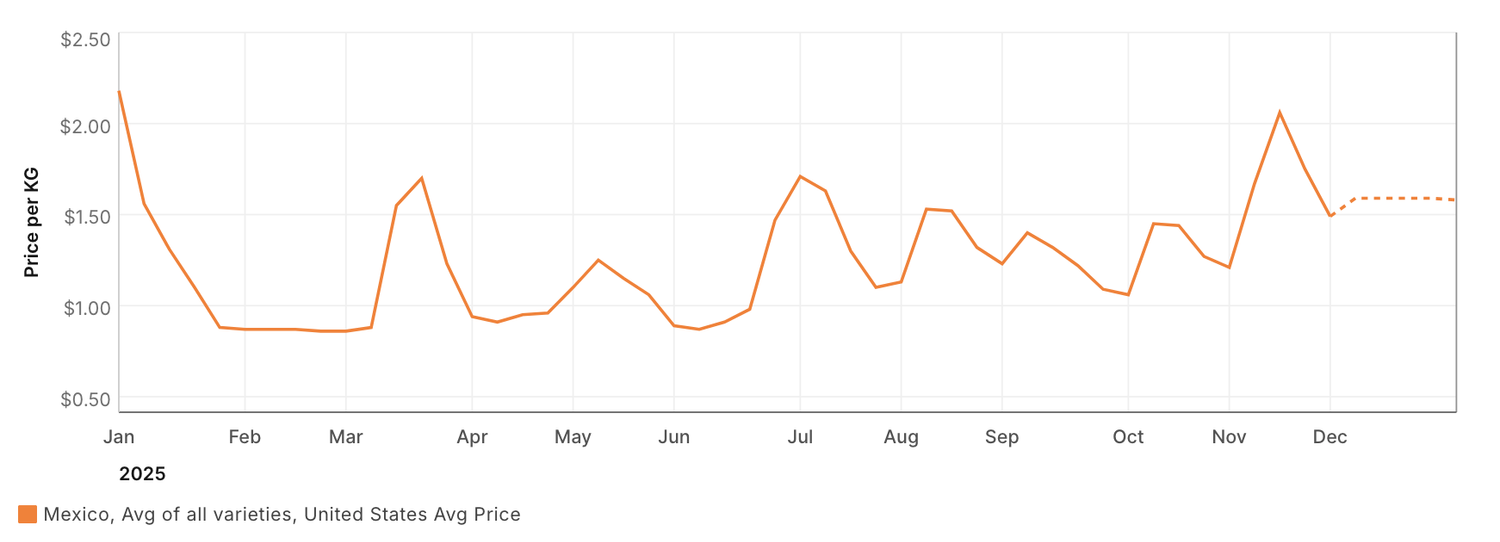
Mexican tomatoes performed exceptionally well in 2025. Price surges tracked directly with WA%R spikes tied to wet/dry oscillations in March–May and again in September–October. Stable conditions outside these windows supported strong yields. Tomatoes emerged as the most climate-advantaged vegetable of 2025.

Volatile — Sweet Potatoes (United States)
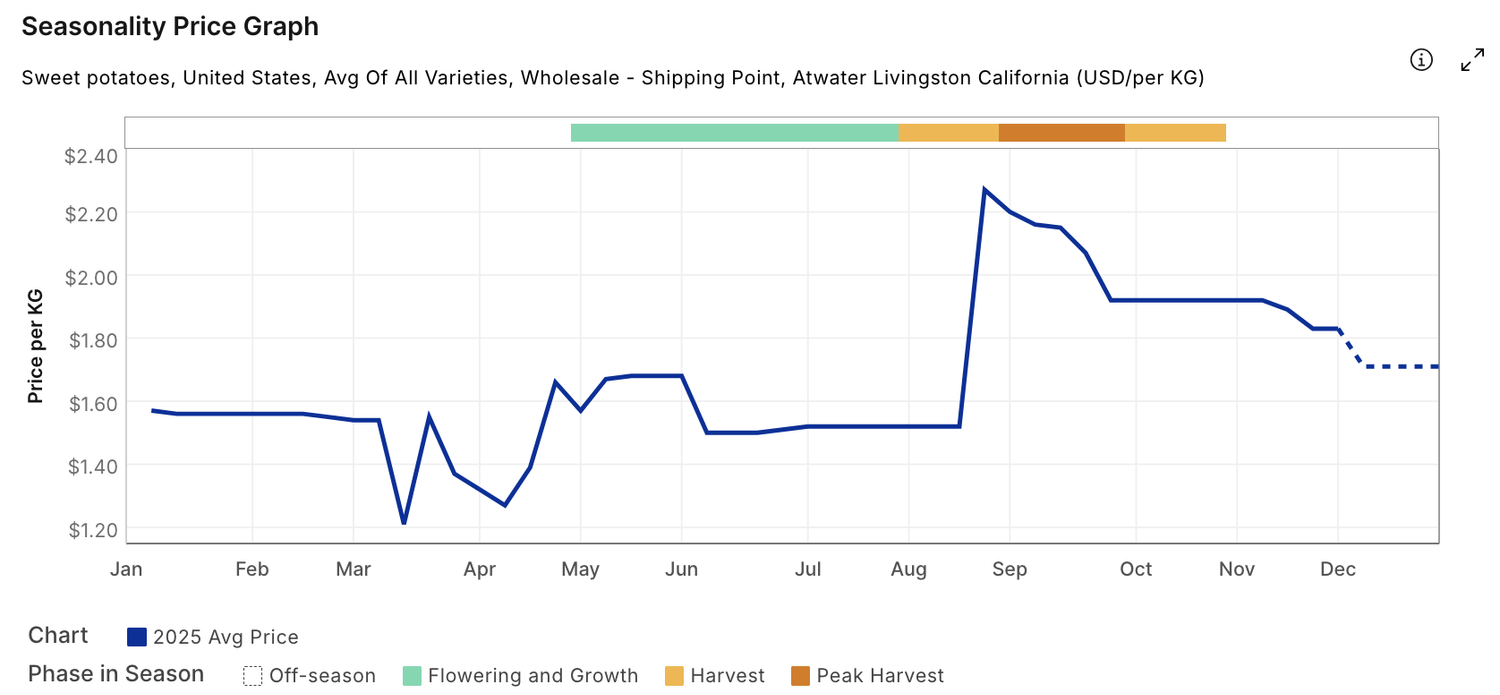
U.S. sweet potatoes were heavily climate-exposed. Early-season drought risk, followed by mid-year wet spikes, disrupted root sizing and harvest patterns. The price graph mirrored these shocks with sharp drops and rebounds — a classic case of volatility driven by misaligned moisture cycles.
🌾 Grains, Oils & Seeds: Stability vs. Stress
Flourishing — Rice (India & Pakistan)
After years of deflation, rice prices bottomed out in mid-2025 before climbing steadily into 2026. Stable monsoon performance and reliable export flows helped produce one of the most orderly grain markets of the year. Rice stands out as a flourishing commodity entering 2026 with upward momentum.

Volatile — Cocoa (Colombia)
Cocoa was one of the most climate-fragile crops globally in 2025. Excessive wet-season exposure — with too-wet risk dominating nearly every month — increased fungal disease pressure and destabilized supply. Late-year WA%R spikes near 80–100% amplified concerns heading into 2026.

Geographies That Defined 2025
Spain — Hot/Dry + Sudden Rainfall = Unstable Veg Markets
Erratic moisture cycles stressed shallow-root crops like peppers and lettuce. WA%R spikes directly aligned with price swings.
Italy — Warming winters enabled new subtropical crops
Warmer temperatures and drier soils expanded feasibility for mango cultivation in Sicily and Calabria — a major sign of Europe's shifting agricultural map.
Turkey—Extreme wet/dry oscillations hit berries
Blueberries were highly exposed to frost → rain → heat cycles, stressing flowering and early fruiting.
Czechia — Rainfall extremes destabilized cherries
Loamy soils became saturated during critical bloom periods, producing one of Europe’s highest-risk fruit seasons.
Mexico — Heat surges + storm clusters impacted vegetables
Tomatoes, eggplants, and zucchini all showed clear climate–price correlations.
Colombia — One of the wettest signatures globally
Too-wet risk dominated cocoa regions, causing yield and quality instability.
India & Pakistan — Monsoon unpredictability shaped grains/oilseeds
Soybeans and rice faced alternating drought and flooding, driving late-year price movement.
East & Southern Africa — Rain shocks hit root crops
Sweet potatoes showed consistent vulnerability to prolonged wet periods followed by fast-onset dryness.
Looking Ahead: Why Helios AI Can See 2026 Coming
Helios AI delivers the industry’s most reliable climate-commodity forecasts by merging two engines:
1. WA%R (Weighted Climate Risk)
A crop-specific model measuring how often conditions become too hot, too cold, too wet, or too dry, weighted by biological sensitivity and growth stage.
2. Helios Horizon Market Intelligence
A machine-learning system combining trade flows, pricing behavior, logistics patterns, and policy dynamics into a forward-looking 24-month forecast.
Together, these systems translate 2025’s climate signals into high-confidence predictions for 2026, identifying which commodities will tighten, where supply chains will destabilize, and how early-season climate pulses will shape global markets.
This short version highlights only a fraction of the insights Helios AI extracted from global data in 2025. The full whitepaper includes:
Deep-dive climate risk analytics
Commodity-specific price projections
High-risk geography profiles
Early procurement guidance for 2026


.png)

Personalized commodity intelligence for the teams that feed the world.
