
Helios AI at West Coast Produce Expo 2026: Key Takeaways
West Coast Produce Expo 2026 delivered on all fronts — farm tours, pickleball, a Coachella-themed reception, and some genuinely sharp content on the main…

June 2, 2026
3 min read

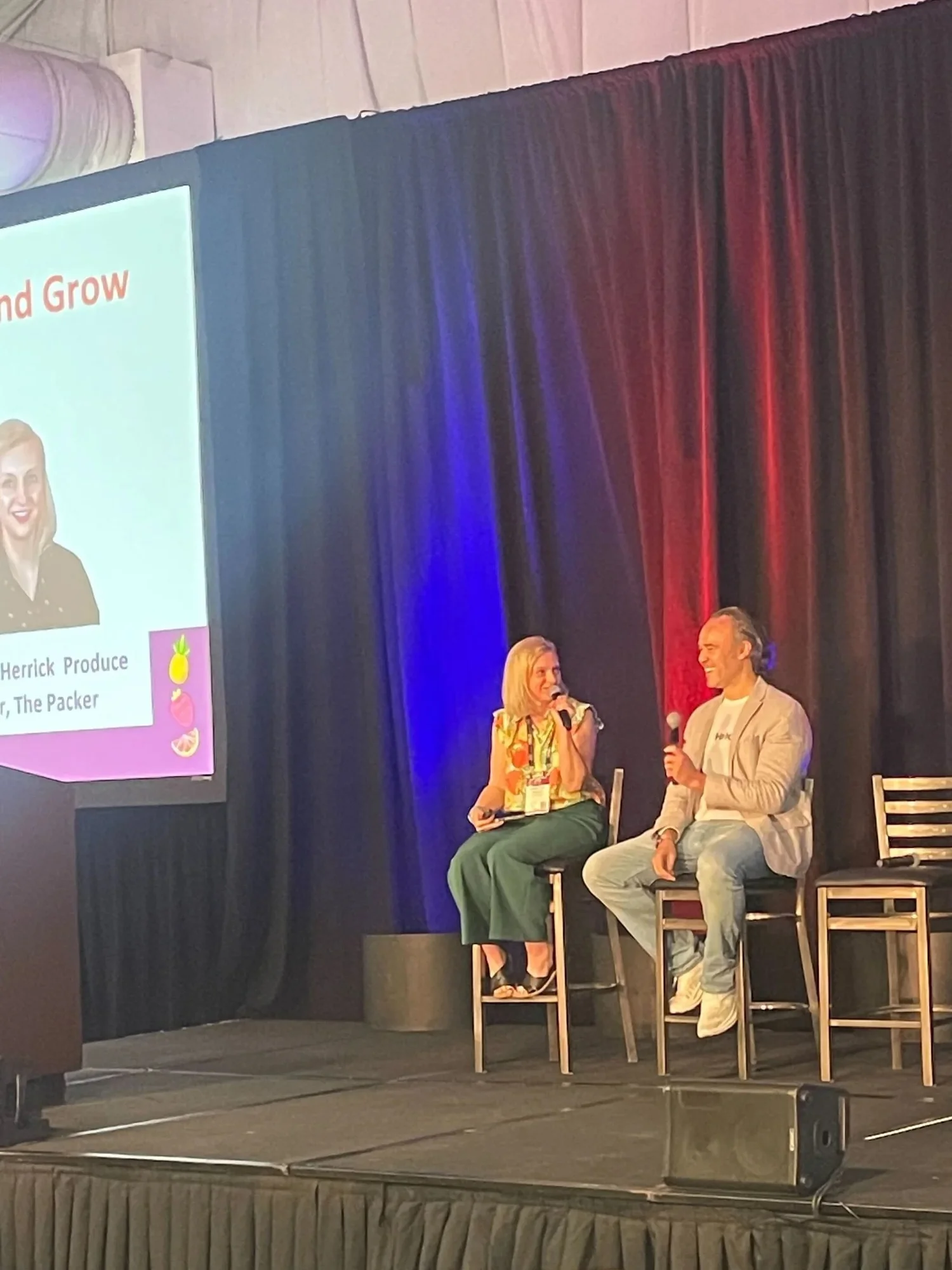
Francisco Martin Rayo with Christina Herrick from The Packer at the fireside chat
West Coast Produce Expo 2026 delivered on all fronts — farm tours, pickleball, a Coachella-themed reception, and some genuinely sharp content on the main stage. A fitting backdrop for an industry navigating a lot of moving pieces right now.
Here's what stood out.
Is your product mix keeping up with who's actually buying fresh produce?
One of the bigger themes running through the show was just how rapidly the customer base is shifting. Hispanic consumers are now outspending other demographics on fresh produce by 4% annually. That's not a niche trend. That's a structural shift in who's driving the fresh-first mindset, and it has real implications for product mix, variety selection, and how retailers think about the floor.
If you're not factoring this into buying and merchandising decisions, you're leaving money on the table.
AI is already here. The question is whether you're using it.
At our CEO’s session, the room was asked to raise their hands if they use AI every day. 95% of hands went up. The other 5%? Once a week or once a month.
That's not a future conversation. That's the room we're already in.
The session walked through three real examples from the production side, Taylor Farms, Wonderful Orchards, and Wish Farms, showing what AI actually looks like when it works:
Taylor Farms deployed a computer-vision waterjet harvester that reads each lettuce head in the field. Same crew. Productivity went from 400 to 700–800 lbs/hour.
Wonderful Orchards uses soil-moisture and evapotranspiration sensors across 85,000+ acres to adjust irrigation hour-by-hour. Pistachios yield up 30% per gallon of water.
Wish Farms started with generative AI in their marketing team — no data scientists, no IT project. Just a marketing director using ChatGPT to draft content, then rewriting it in their own voice.
The lesson isn't "you need a massive budget." It's this: pick the one decision in your operation that costs you the most when you get it wrong, and start there.
What does the Middle East disruption actually mean for food supply chains?
This was one of the most engaging parts of the session, and the live polling results from the room told the story clearly.
Attendees were asked: How long do you think the disruption impacts in the Middle East will last?
A few months: 11%
A year: 17%
More than a year: 72%
The room already knows this isn't going away. But here's the part most people haven't connected yet: this isn't primarily an oil story. It's a fertilizer story.
Brazil's and Argentina's fertilizer buying window runs from June through August, aligning exactly with the current disruption period. Under-fertilized crops can't be retroactively corrected after planting decisions lock in September through November. The chain runs like this:
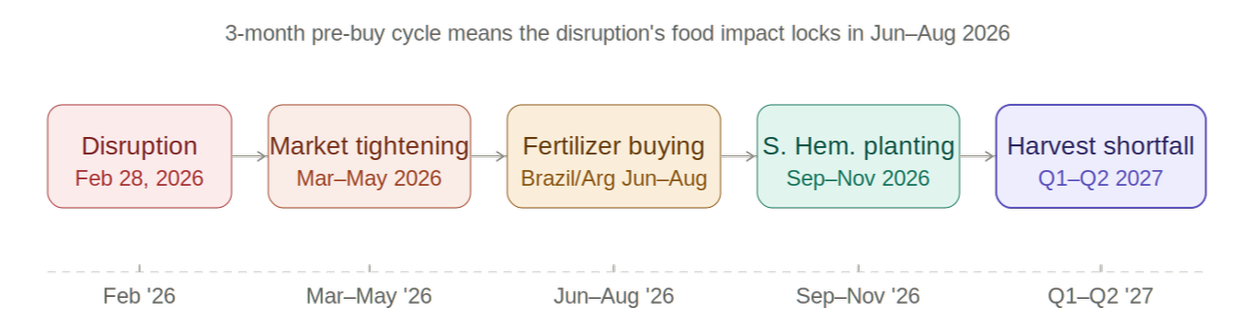
Northern Hemisphere crops, U.S. corn and soy, largely dodged this because input purchases happened before the disruption hit. Southern Hemisphere exposure is severe and direct. Watch Q1–Q2 2027 closely.
The four pitfalls killing ag AI projects & the playbook that works
A standout question from the floor: "What advice would you give smaller shops that don't have deep pockets for AI?"
The honest answer: you don't need deep pockets. You need the right problem.
Most ag AI projects fail for three reasons:
The Pilot Trap. Works in one block, dies at scale. The subsidy ends, the champion leaves, and adoption collapses.
Off-the-shelf models don't fit. Generic AI fails on local crops and conditions. It needs your data, your seasons, your varieties.
Multi-year "data strategies." Patience, most farm businesses don't have it. 36% of organizations have meaningful AI implementations. The other 64% are still in pilot.
The four-step playbook from the session:
Pick ONE decision that costs you when wrong. When to scout. What to harvest. What to discard. Tie it to the margin.
Test inside one season. Value should show in weeks, not quarters. If you can't measure it, you can't scale it.
Pair AI with your best operator. Not in place of them. Human-plus-AI beats either alone in every credible study.
Own your data before you license the model. Soil maps, yield history, and customer data are the moat.
Download the free Hormuz Scenario Analysis
Want to go deeper on the supply chain implications covered in the session? Download the free Strait of Hormuz Scenario Analysis or reach out at [email protected].
DOWNLOAD FULL ANALYSIS
.png)

Personalized commodity intelligence for the teams that feed the world.
