
Holiday Calm, La Niña Winter: The Hidden Risks Behind ‘Falling’ Food Prices
As December begins, the global commodity landscape looks deceptively calm. The FAO Food Price Index slipped to 126.4 points in October 2025 — its lowest…

December 9, 2025
6 min read

Why Procurement Leaders Should Treat December’s Commodity Dip as a Strategic Window, Not a Signal to Relax
As December begins, the global commodity landscape looks deceptively calm. The FAO Food Price Index slipped to 126.4 points in October 2025 — its lowest point since January and 1.6% below the previous month. Cereal prices have dropped nearly 10% year-over-year, and inventories across major crops appear comfortable. For procurement teams, this looks like the long-awaited moment to exhale after two years of relentless volatility.
But beneath that calm, Helios Horizon’s climate and commodity intelligence reveals a very different reality. La Niña has re-emerged, projected to intensify through February–March 2026, and is already reshaping weather patterns across more than 60% of the world’s agricultural output zones. Meanwhile, persistent drought in key logistics corridors continues to increase landed-cost volatility — even if it hasn’t yet spilled into headlines.
The result: today’s low prices reflect last season’s supply, but the risks forming now belong to this season’s climate. December is not a moment to relax. It is a moment to get ahead.
The Illusion of Calm — Why Low Prices Mask Rising Risk
The recent decline in the FAO index can be traced back to strong harvests earlier in 2025, but the underlying structure of the market is fragile. Vegetable oils surged 2.7% in October as palm and soybean oil tightened. Meat and dairy softened, yet both categories remain above their five-year averages. Wheat futures remain 14–18% below 2024 levels, offering a veneer of stability even though the crop’s Q1 sensitivity makes it one of the most climate-exposed categories heading into 2026.
At a macro level, global cereal inventories are projected to rise just 1.2% this year — a thin cushion that evaporates quickly when exposed to La Niña-driven stress across soy, corn, sugar, coffee, and vegetable oils. The market is calm only because it is backward-looking. The forward-looking signals are telling a different story entirely.
La Niña’s Winter Return—The Climate Signal Reshaping 2026 Before It Begins
La Niña is already exerting influence on global production zones. Sea-surface temperatures in the Pacific sit 0.7°C below neutral, confirming a strengthening pattern. Across southern Brazil, rainfall deficits have reached 15–25%, and Argentina’s soil moisture sits 20–35% below normal. Both regions are critical to global soy, corn, and sugar production.
This matters because La Niña does not merely impact crop outcomes — it impacts markets. In the last notable La Niña cycle (2020–2021), soybean futures climbed 34%, corn increased 28%, and palm oil soared 40%. These moves did not wait until harvest failures materialized; markets priced the risk months in advance.
Helios Horizon’s models indicate that the same early-stage volatility drivers are now resurfacing. December is the inflection point.
South American Soybeans—The First Stress Test for 2026
South America produces more than 53% of the world’s soybeans, making it the global hinge for feed and vegetable oil markets. Every forward-looking indicator—climate models, planting progress, seasonality data—shows mounting stress.
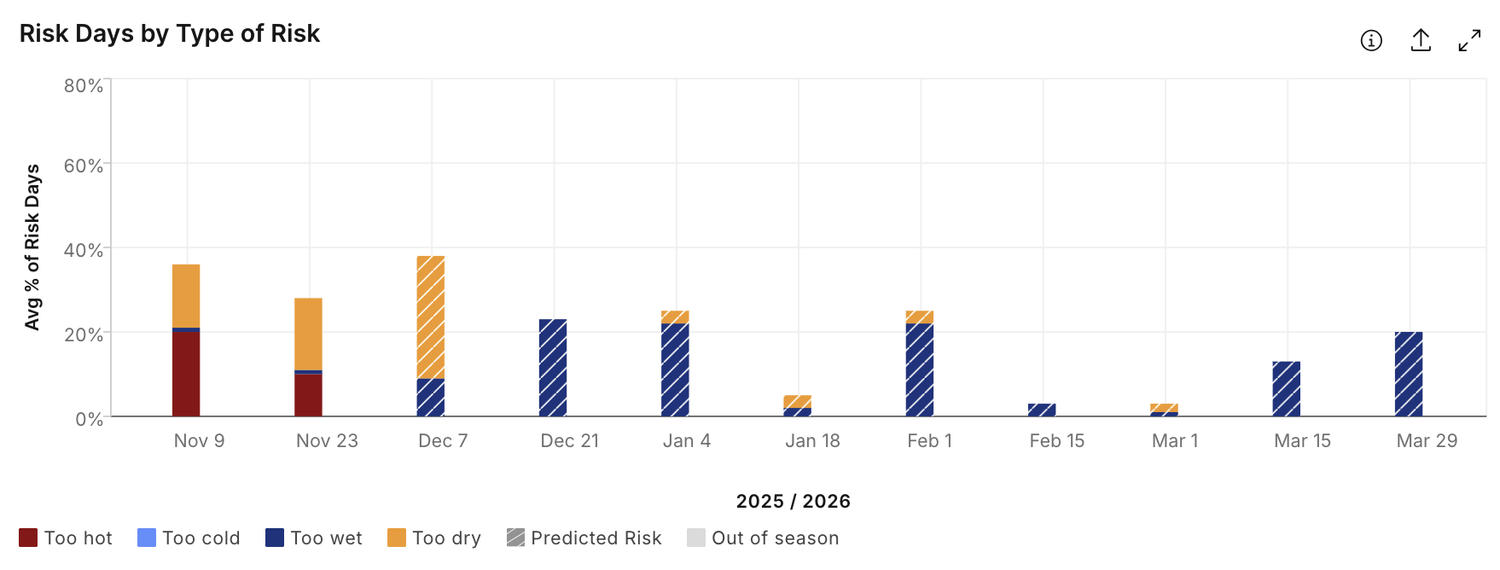
Climate risk is visible directly in your first chart (“Risk Days by Type of Risk”). Mato Grosso enters December with some of the highest predicted climate-risk days of the season, with the week of December 7 showing risk levels approaching 35–40%. The blend of too wet and too dry conditions is a hallmark of La Niña transition years, when rainfall variability disrupts germination and early vegetative growth. Even brief periods of erratic moisture during planting can reduce emergence uniformity and suppress yield potential months before markets react.
Planting delays reinforce the trend. By late October, Mato Grosso was 12 percentage points behind its historical planting pace, and southern Brazil’s rainfall deficits of 20–25% further constrained early development.
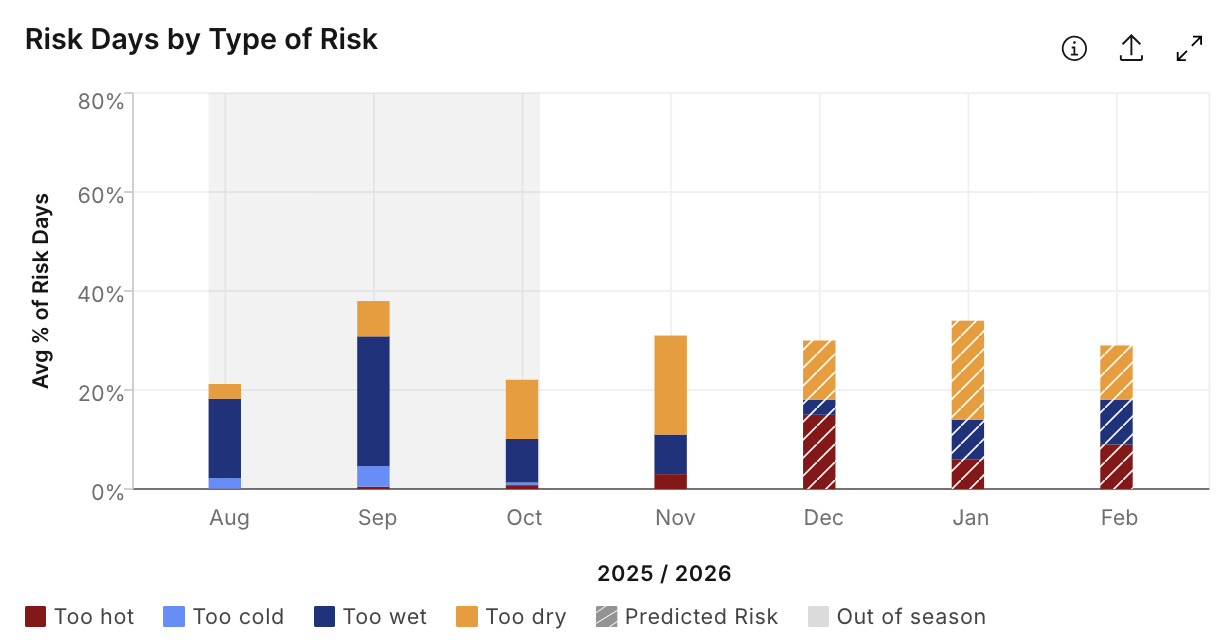
Argentina is facing an even more concerning trajectory: not only has the country reduced its soybean area by 400,000 hectares due to moisture scarcity, but Helios Horizon’s climate-risk models show dryness risk becoming the dominant stressor from October onward. The share of “too dry” risk days climbs sharply through November and peaks in December–January—a pattern that mirrors past La Niña years where early-season drought suppressed pod-set and cut national yields. This combination of acreage reductions and increasing dryness risk places Argentina firmly on a lower-yield path before the crop has even entered its critical development window.
A Broader Web of Risks—Corn, Sugar, Coffee, Palm, Canola, Sunflower, Wheat
While soy is the anchor risk, Helios Horizon identifies an interconnected set of commodities exposed to the same climate stressors. And it’s not just soybeans flashing early-warning signals. Other climate-sensitive commodities are already showing signs of pricing pressure as La Niña progresses. Coffee, in particular, has emerged as one of the clearest indicators of sticky inflation heading into 2026. As our CEO, Francisco Martin-Rayo, notes,
“Coffee is once again a leading indicator of sticky inflation. Our Helios AI models show rainfall in Brazil’s Minas Gerais region running roughly 25% below seasonal norms, compounding the effects of prolonged drought. Add to that the risk of new U.S. tariffs on Colombian imports — at a moment when Colombia supplies nearly 10% of America’s beans — and you get a perfect storm. Retail prices could climb another 12 to 18 percent this quarter alone. That kind of sustained pressure doesn’t just hit café menus — it feeds directly into CPI month after month.”
Coffee enters 2026 with deep structural fragility. Brazil has already cut output estimates by 11 million bags, raising the likelihood of a fifth consecutive Arabica deficit. Vietnam’s robusta belt remains highly sensitive to heat stress and erratic rainfall. With global stocks-to-use ratios near 21%, the market carries minimal buffer into Q1.
Corn production belts in Brazil and Argentina face similar moisture deficits. In the last La Niña cycle, corn prices climbed 28%, largely because drought during tasseling and silking hindered kernel development.
Sugarcane, which requires consistent rainfall, is similarly vulnerable; drought reduces both tonnage and sugar concentration.
Palm oil, canola, and sunflower seed remain tethered to soybean oil. When soy tightens, the entire vegetable-oil complex tends to follow — a pattern that already appears in futures curves for 2026 and 2027.
Even wheat, which appears stable, remains highly sensitive to Q1 moisture shifts. La Niña years historically make wheat markets more volatile in late winter and early spring.
Across all of these commodities, one through-line is clear: La Niña turns localized climate volatility into global price volatility.
The Quiet Amplifier—Freight and Climate Working in Tandem
While not warranting a standalone section, freight risk must be acknowledged as a quiet but powerful amplifier to climate-driven volatility. Persistent drought conditions continue to challenge the Panama Canal, responsible for moving roughly 40% of U.S. grain exports to Asia. Even modest restrictions, reduced drafts, and limited transit slots can raise freight costs by 8–15% and add 5–10 days to shipment times.
When soy, corn, wheat, and vegetable oils are already under climate-related stress, even small logistics disruptions can accelerate price instability. Helios Horizon flags these freight dynamics not as isolated risks but as multipliers of the climate narrative.
Why December Is a Strategic Window, Not a Break
The most important insight from Helios Horizon is simple: today’s prices reflect stability, but tomorrow’s conditions do not. La Niña is strengthening. Soy, corn, sugar, coffee, palm, canola, sunflower, and wheat all sit inside elevated risk zones. Planting delays, moisture deficits, and climate-driven uncertainty are increasing — yet none of these pressures are fully priced into futures or cash markets.
This creates a narrow but critical window for procurement leaders to act while markets remain soft. December allows teams to secure forward coverage at favorable prices, evaluate exposure to Brazil and Argentina, run La Niña stress scenarios for feed and oil inputs, and monitor freight conditions closely as water levels fluctuate along key shipping corridors.
Markets do not move when risk appears. They move when everyone finally sees it. December offers procurement leaders the rare chance to be early.


.png)

Personalized commodity intelligence for the teams that feed the world.
