
How AI Is Enabling Proactive Supply Chains in Agriculture | What We Learned at World Agri-Tech’s AI Benchmarking Forum
At this year’s World Agri-Tech Innovation Summit in San Francisco, one idea came through clearly: AI in agriculture is no longer about visibility; it’s…

March 18, 2026
4 min read

At this year’s World Agri-Tech Innovation Summit in San Francisco, one idea came through clearly:
AI in agriculture is no longer about visibility; it’s about foresight.
Across the AI Benchmarking Forum, speakers explored how artificial intelligence is evolving from analyzing data to understanding the real world and ultimately enabling better decisions across the agri-food system.
How is AI evolving beyond traditional data analysis?
We heard how new geospatial AI models are pushing beyond traditional large language models, allowing systems to interpret the physical world, from satellite imagery to infrastructure, land use, and environmental patterns. These models don’t just map farmland; they understand context, relationships, and change over time.
At the same time, advances in physical AI are bringing intelligence directly into the field. From optimizing how inputs are applied at the leaf level to measuring real-world outcomes in real time, AI is moving from abstract insights to execution and control, helping farmers and operators close the gap between decision and outcome.
But a consistent theme across sessions was that better data and better models alone are not enough. The real challenge is turning that intelligence into better decisions on the ground, especially when those decisions need to balance profitability, sustainability, and operational constraints.
Why are supply chains becoming harder to manage?
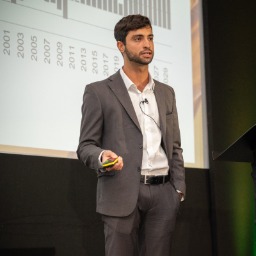
But while these innovations are powerful, the most urgent message came from our CEO, Francisco Martin-Rayo, who grounded the conversation in a reality every procurement and supply chain leader recognizes:
Volatility isn’t increasing — it’s already the baseline.
Driven by tariffs and trade uncertainty, accelerating climate disruption, and a sharp rise in supply shocks, global agri-food systems have become fundamentally harder to manage. And yet, most teams are still relying on tools that were built for a different era.
DOWNLOAD PRESENTATIONAt the same time, discussions across the forum highlighted another layer of complexity: even when better practices exist, adoption depends on whether they clearly improve margins. Growers are not just optimizing for yield or sustainability goals; they are optimizing for profitability within highly constrained systems.

The problem with today’s supply chain tools
As Francisco pointed out, today’s systems are often:
Reactive: telling you what already happened
Fragmented: forcing teams to piece together insights across platforms
Too late to act on: arriving after prices move or supply is already constrained
The result? Teams are left scrambling, reacting to price spikes, chasing supply, and trying to protect margins after the fact.
This gap extends beyond procurement tools. Across the value chain, data is often disconnected from real-world outcomes, making it difficult to translate insights into actions that actually improve performance on the farm or across sourcing decisions.
What does a proactive supply chain actually look like?
The shift now is toward something fundamentally different: proactive supply chains.
Francisco outlined what that looks like in practice:
Predicting disruptions months in advance, not weeks after they occur
Connecting climate signals directly to price and supply impact
Enabling early action, from sourcing adjustments to contract timing
In one example, Helios identified climate risks in Brazil’s citrus supply months before the market reacted, allowing customers to adapt sourcing strategies ahead of major disruptions. In another, early signals enabled a customer to achieve 15% savings on mandarin procurement, a meaningful edge in an industry where margins are tight.
This idea of early, actionable insight connects directly to another theme from the event: the biggest gains in agriculture often come from improving execution across many small decisions. Whether it is input application, timing, or sourcing strategy, incremental improvements compound over time when they are tied to clear economic outcomes.
Raising the standard for AI in agriculture
The takeaway wasn’t just about what Helios is building but about what the industry should now expect.
In a world of constant volatility, procurement and supply chain teams should no longer settle for static dashboards or delayed reports. They should demand:
Centralized intelligence across climate, commodities, and disruption
Customized insights tailored to their specific supply chains
Actionable forecasts that tell them what to do next, not just what happened
Crucially, those insights must connect back to real operational and financial impact, whether that is protecting margins, improving sourcing decisions, or enabling more efficient and sustainable practices at the farm level.
What made this session stand out?
What made this session stand out was how clearly it mapped the evolution of AI in agriculture:
From understanding data to understanding the physical world to ultimately anticipating and acting on risk before it materializes. And that’s the real shift underway.
Because in today’s environment, the question isn’t whether disruption will happen. It’s whether you’ll see it coming early enough to do something about it.
DOWNLOAD PRESENTATION

.png)

Personalized commodity intelligence for the teams that feed the world.
