
More Sucrose Went Into the Mills. Less Sugar Came Out.
Centre-South Brazil crushed more cane of better quality this season and made 12.4% less sugar because its mills moved the product mix, and that decision moved more tonnes than the…

September 9, 2026
11 min read

Centre-South Brazil crushed more cane of better quality this season and made 12.4% less sugar because its mills moved the product mix, and that decision moved more tonnes than the climate did.
By João Pedro Rodrigues Morciani · Senior Analyst, Helios AI
Helios AI figures pulled 8 September 2026. The verified Brazil mix series stops at 1 July 2026, and this piece says where that matters.
The Cane Got Better. The Sugar Got Worse.
UNICA published the whole argument in one table and left it uncommented. The Brazilian sugarcane industry association's accumulated report for Centre-South Brazil, 1 April to 1 July 2026, released 6 August: cane crushed up 3.82% to 214.47 million tonnes, total recoverable sugars (ATR) per tonne of cane up 1.29% to 123.75 kg, sugar output down 12.38% to 10.754 million tonnes.
Weather acts on the first two numbers, and both went the right way. The split changed: 51.04% of recoverable sugars went to sugar last season, 42.52% this season, a move of 8.52 percentage points. Kilograms of sugar per tonne of cane fell 15.61% while litres of ethanol per tonne rose 19.03%. That is not weather.
Price that decision. Hold this season's crush and its recoverable sugars, apply last season's mix, and Centre-South sugar comes to 12.909 million tonnes, up 5.17% rather than down 12.38%. The gap is 2.16 million tonnes of sugar in three months from one region, computed two ways that agree. Our own São Paulo commentary, citing the national crop agency CONAB, puts the climate footprint on the 2025/26 crop at a 0.5% national production dip. Climate sets the size of the crop. The mix sets the split.
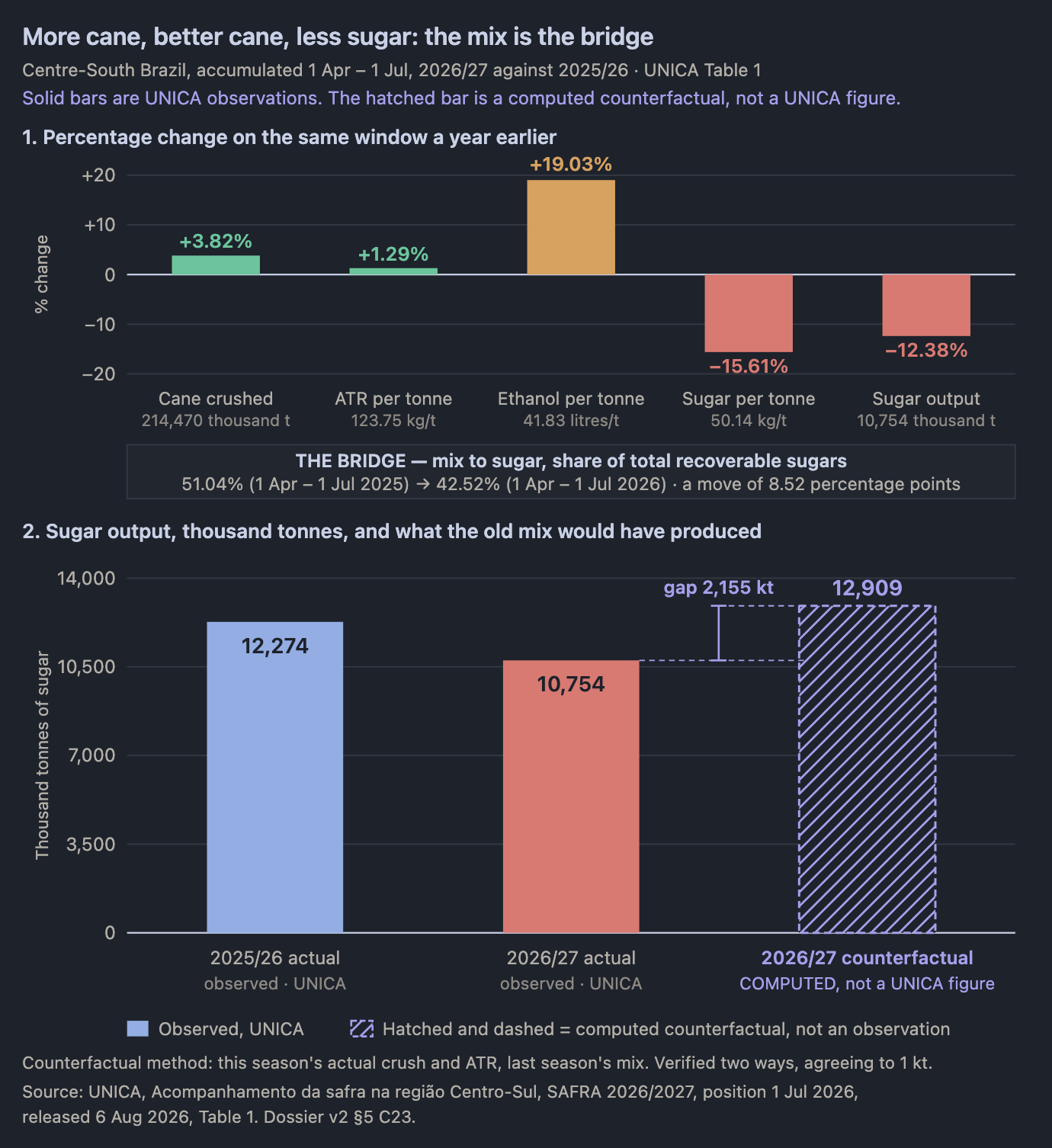
Chart 1 — the Brazil decomposition: Centre-South Brazil, accumulated 1 April to 1 July 2026 against the same window of 2025. The two measures weather acts on both improved: cane crushed +3.82% and total recoverable sugars per tonne of cane +1.29%. Sugar output still fell 12.38%, and kilograms of sugar per tonne of cane fell 15.61% while litres of ethanol per tonne rose 19.03%.
The bridge is the mix: 51.04% of total recoverable sugars went to sugar in the 2025 window against 42.52% in the 2026 window, a move of 8.52 percentage points.
The counterfactual bar is computed, not a UNICA figure, and it is drawn hatched with a dashed outline for that reason. Method: this season's actual crush and ATR at last season's mix, giving 12,909 thousand tonnes, verified two ways agreeing to 1 kt. The gap to the observed 10,754 is 2,155 thousand tonnes. No other bar on this chart is modelled.
Units: percentage change year on year in panel 1; thousand tonnes of crystallised sugar in panel 2.
The window closes 1 July 2026. UNICA's Centre-South fortnightly reports have not been openly available since the 6 August release, so nothing here extends past that position date.
Source: UNICA, Acompanhamento da safra na região Centro-Sul, SAFRA 2026/2027, Posição até 01/07/2026, released 6 August 2026, Table 1. Data supplied to UNICA by SIAMIG, BIOSUL, ALCOPAR, BIOINDMT, SIFAEG, SISERJ and SUDES. Dossier v2 §5 C23.
Our Mix Series Stops on 1 July, and the Incentive Behind It Has Turned.
Say the limitation before the argument leans on it. UNICA's Centre-South fortnightly reports have not been openly available since the 6 August release. Our verified mix series therefore ends at 1 July 2026, and every mix figure in this piece is that window.
The incentive that produced this mix has since reversed. ICE Sugar No.11 rolling front month closed 13.35 US cents per pound on 22 June 2026 and 18.70 on 2 September, 40.1% higher, then settled 18.07 on the 4 September session, ICE Futures U.S., relayed by Barchart. Czarnikow's 5 June explanation, that low sugar prices and a strong real made ethanol the preferred output, was accurate when written. The second half of the season need not look like the first.
One disclosure belongs here, because this piece quotes our own ratings. Our El Niño playbook of 4 July called Brazil Centre-South a stressed core in the middle of the cut, with São Paulo at 2.0 stars and on Watch on 13 July 2026. It reads 3 stars and All Good today. We upgraded the state during the harvest we called stressed.
India Did Not Move Cane Into Ethanol. It Moved Rice Into Ethanol.
The second origin ran the same decoupling through a ministry rather than a mill accountant. Answering the Rajya Sabha on 11 August 2026, the Ministry of Consumer Affairs, Food and Public Distribution gave sugar diverted to ethanol as 43 lakh tonnes in ethanol supply year (ESY) 2022-23, 24 lakh in 2023-24, 35 lakh in 2024-25 and 28 lakh in 2025-26 to 30 June 2026, a partial season, sugar-equivalent on the basis the department publishes. Diversion fell once, then recovered by 11 lakh tonnes.
The programme grew through all of it, and grain is what fed it. The Press Information Bureau's factsheet of 26 August 2026 puts nearly three-quarters of India's ethanol on grains, chiefly maize; the US Department of Agriculture's Foreign Agricultural Service, on 29 April 2026, puts sugar mills at about 30% of output. For ESY 2026-27 the Centre raised Food Corporation of India rice for distilleries to 72 lakh tonnes from 52 and added 55 lakh tonnes of broken rice by auction, 12.7 million tonnes of grain earmarked for a fuel programme, on reported reasoning of insulation against a weak monsoon in the cane belt.
Then the state priced the choice and left it there for four years. The Ministry of Petroleum and Natural Gas (MoPNG) sets an administered ex-mill price for each ethanol feedstock, in Table 4 of USDA's India Sugar Annual of 29 April 2026. The two routes that cost sugar have not moved since ESY 2022-23: cane juice, syrup and sugar at ₹65.61 a litre, B-heavy molasses at ₹60.73. Corn was raised twice, to ₹71.86, the best-paid route on the board. C-heavy molasses, the residue after crystallisation, went up ₹8.56. Every route that does not cost sugar has been repriced. Both that do are frozen.
No demand-side reason exists to expect that to loosen. Asked in the Rajya Sabha in August 2026, the Minister of State for Petroleum and Natural Gas answered: “So far, no decision has been taken by the Government for increasing ethanol blending with petrol beyond 20%.” USDA's April analysis agrees from the other side: “strong domestic sugar prices currently provide limited incentives for mills to redirect production toward ethanol.”
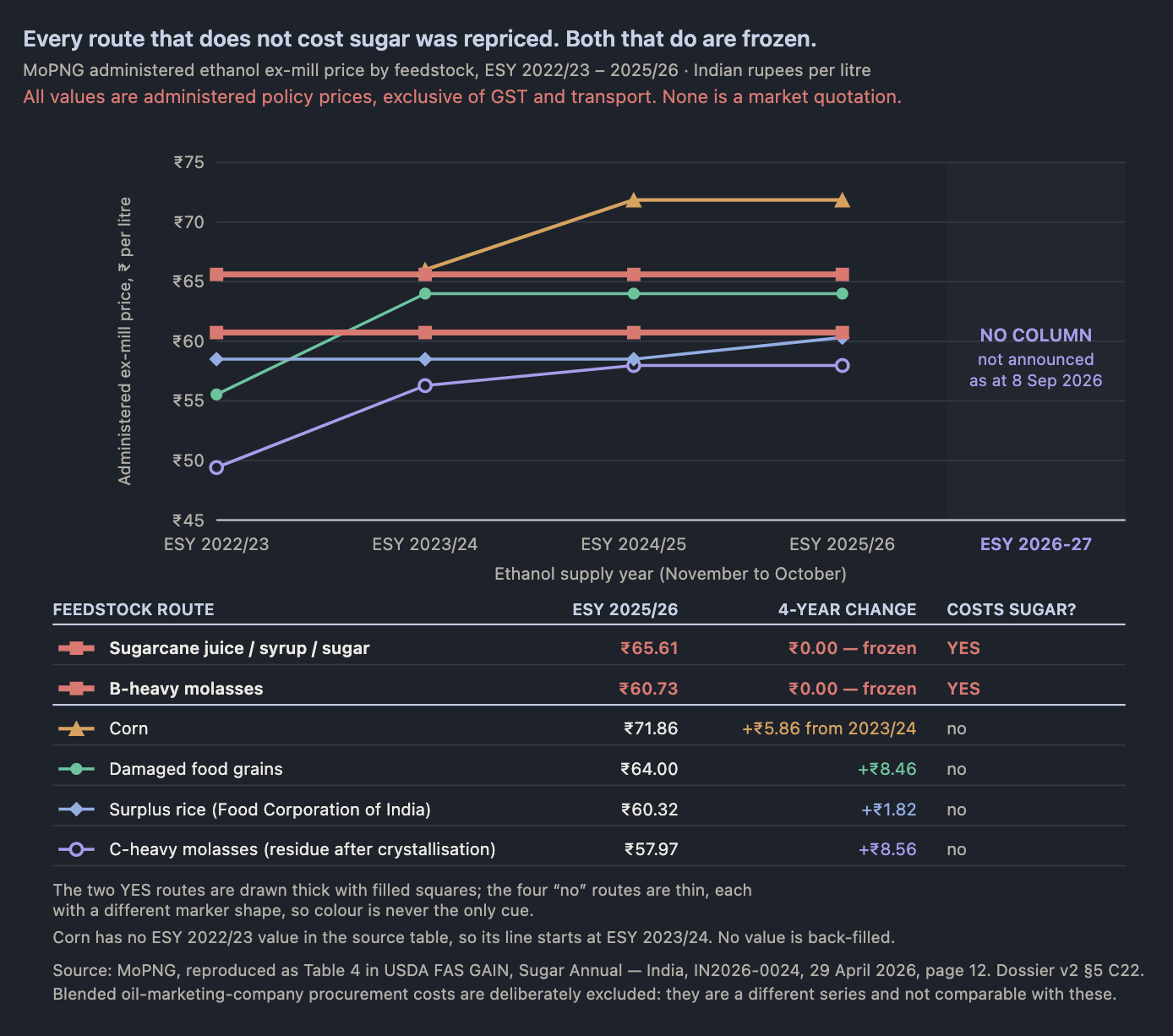
Chart 2 — the government table that argues itself. India's administered ex-mill ethanol price by feedstock, ethanol supply years 2022/23 to 2025/26, Indian rupees per litre. The two routes that cost the country sugar are drawn thick with filled square markers and are flat across all four years: cane juice, syrup and sugar at ₹65.61 and B-heavy molasses at ₹60.73. The four routes that do not cost sugar all rise, and corn at ₹71.86 ends above the frozen cane route.
Every value on this chart is an administered policy price, exclusive of GST and transport. None is a market quotation, and blended oil-marketing-company procurement costs are deliberately kept off the chart because they are a different series.
No ESY 2026-27 column exists. The fifth column is shaded and left empty, labelled not announced as at 8 September 2026. Nothing is projected into it. Corn also has no ESY 2022/23 value in the source table, so its line starts at 2023/24 rather than being back-filled.
Units: Indian rupees per litre of ethanol, ex-mill.
Source: MoPNG, reproduced as Table 4 in USDA Foreign Agricultural Service GAIN report IN2026-0024, Sugar Annual — India, 29 April 2026, page 12. Dossier v2 §5 C22.
So Our Warning on Indian Sugarcane Is Not a Supply Signal.
We escalated India to Warning on 6 September 2026, and it is still not the number that decides the balance. Karnataka sits at 1 star and Warning, with drought stress on every day of its fill phase, the worst in nine seasons. The same run upgraded Gujarat to 4 stars, and Uttar Pradesh, 45% of production, reads All Good.
Now set it against the mix. India's realised diversion swings 1.90 million tonnes between its best and worst complete supply years. Our supply module's national row for Indian sugarcane, dated 1 September 2026, forecasts sugar production 1.40 million tonnes above its own historical average, or 4.42%. All six Indian regional rows in that table read below their own averages, a conflict we have logged rather than resolved. The swing is 1.36 times the above-average crop our model forecasts, and 8.5% of the 22.24-million-tonne range we publish around it.
The market has been reading policy correctly all along. Ex-mill M-grade sugar in western Maharashtra was ₹43 to ₹44 a kilo in mid-July 2026 and ₹43.50 on 5 September 2026, ₹4,350 a quintal, a round trip in seven weeks attributed to a bulk-consumer stockholding cap, a cut in the dealer limit and authorisation for 10 lakh tonnes of duty-free raw imports. None of those is weather.
What Would Prove This Wrong.
UNICA's August and September fortnights are the test, and we cannot run it yet. If the Centre-South mix reverts toward 50% sugar while ICE holds above 18 cents, mills are tracking price faster than this article implies and Brazil's second half partly undoes its first. That falsifier is untestable on verified data today, which is a reason to hold the claim at the size stated. The dated second test is India's ESY 2026-27 contracting round in October 2026.
The Bottom Line.
This season, the weather did not set the sugar price. A mill's product mix and a ministry's allocation did. Saying so is not an argument against watching the weather. It is an argument for knowing which term is doing the work in any given year.
The cane still has to grow before anyone decides what to do with it. Helios rates sugarcane climate risk region by region and phase by phase, with the margin of error on every point. This season it moved Maharashtra in July and Tamil Nadu and Bihar in August, before the national picture caught up in September. In the years when weather is the term that matters, that lead time is the whole value.
Frequently Asked Questions
Why did Brazil's sugar production fall in 2026 if the cane crop grew?
Because mills chose ethanol. UNICA's accumulated figures for Centre-South Brazil from 1 April to 1 July 2026, released 6 August 2026, show cane crushed up 3.82% to 214.47 million tonnes and recoverable sugars per tonne of cane up 1.29% to 123.75 kg, while sugar output fell 12.38% to 10.754 million tonnes. The bridge between those is the mix: 51.04% of recoverable sugars went to sugar in the same window last season against 42.52% this season. Holding the actual crush and sucrose content and applying last season's mix gives 12.909 million tonnes, so the mix decision accounts for about 2.16 million tonnes of sugar over three months in one region.
What is the Centre-South sugar to ethanol mix in 2026/27?
On UNICA's published accumulated data the sugar share of recoverable sugars was 42.52% from 1 April to 1 July 2026, against 51.04% in the same window of 2025/26. São Paulo alone ran 50.86% against 57.29%, and the rest of the Centre-South 32.45% against 42.81%. Full-season figures near 47% circulating in trade commentary are projections rather than observations, and the two are not interchangeable. UNICA's Centre-South fortnightly reports have not been openly available since the 6 August release, so the verified series stops at 1 July 2026.
Is India diverting more sugarcane to ethanol in 2026-27?
There is no allocation yet. The Government of India's own figures, given in the Rajya Sabha on 11 August 2026, put sugar diverted to ethanol at 43 lakh tonnes in ESY 2022-23, 24 lakh in 2023-24, 35 lakh in 2024-25 and 28 lakh in 2025-26 to 30 June 2026, that last a partial season on the basis the department publishes. The ESY 2026-27 quantity, price and cap have not been announced as at 8 September 2026, and the contracting round falls in October 2026. What has grown is grain: rice from Food Corporation of India stocks for distilleries was raised to 72 lakh tonnes for ESY 2026-27 from 52 lakh, at an approved sale price of ₹2,390 a quintal, with a further 55 lakh tonnes of broken rice by auction.
Does a Helios Warning on Indian sugarcane mean the sugar crop is short?
No, and we would rather say so. Our national status for Indian sugarcane moved from Watch to Warning on 6 September 2026, driven by observed fill-phase drought in Karnataka and Tamil Nadu. The national supply row in our own supply table, dated 1 September 2026, forecasts sugar production 4.42% above its own historical average, and the six Indian regional rows in that same table read below theirs, a conflict we have logged rather than resolved. Both sit beside a bigger point: the swing that matters most to the balance is the ethanol mix, and we do not measure it. India's realised diversion has moved 1.90 million tonnes between its best and worst complete supply years, which is 1.36 times the entire above-average production our own model forecasts.
Why is ICE Sugar No.11 up 40% since June 2026?
The rolling front month closed 13.35 US cents per pound on 22 June 2026, reached 18.70 on 2 September, 40.1% above that low, and settled 18.07 on 4 September 2026, ICE Futures U.S. The dated drivers named at the time were global balance revisions and Brazil rather than India: Brazil's Centre-South sugar output was reported down 26.33% year on year in the June month alone, and several analysts cut their world balances through August. India's own contribution was a purchase rather than a shortfall, with duty-free raw imports permitted from 20 August 2026 while its industry body said there was no domestic shortage. The March 2027 contract, SBH27, settled 19.05 on 4 September 2026, the most expensive month on the board and the one expiring after both origins' decisions.
Will India raise ethanol blending above E20?
Not on any published decision. Asked in the Rajya Sabha in August 2026, the Minister of State for Petroleum and Natural Gas said: “So far, no decision has been taken by the Government for increasing ethanol blending with petrol beyond 20%,” adding that any change would follow scientific and technical study and consultation with vehicle makers, oil marketing companies and research institutions. The Press Information Bureau's own five-page policy document of 5 July 2026 names no forward Indian blending target at all. A forecast of E25 by ESY 2026/27 does appear in USDA's April 2026 India Sugar Annual, attributed to unnamed contacts; the government's own parliamentary answer came in August and says the opposite.


.png)

Personalized commodity intelligence for the teams that feed the world.
