
Our Climate Risk Predicts Wheat Basis Four to Twelve Weeks Out. It Predicts Nothing in the Week of the Shock.
We took Helios AI's regional climate risk, crossed it with weekly interior elevator bids published by the United States Department of Agriculture (USDA),…

August 6, 2026
12 min read

We tested our own signal against a decade of elevator bids. Wheat is where it works — and the horizon is the whole finding.
By João Pedro Rodrigues Morciani · Senior Analyst, Helios AI
Lead time is easy to claim and hard to measure. So we measured ours.
We took Helios AI's regional climate risk, crossed it with weekly interior elevator bids published by the United States Department of Agriculture (USDA), and asked a single question a physical grain buyer would ask: does our climate signal move before the elevator does, and if so, by how long and by how much?
The answer is yes, with a shape that matters more than the headline.
“Helios AI climate risk helps forecast where basis converges to; it does not beat the elevator in the week of the shock, because the elevator prices local weather almost immediately.”
Helios AI Research Note, “Does Helios AI regional climate risk anticipate elevator basis?”, 2nd edition, 22 July 2026
That is Helios AI's own conclusion, and it is the honest place to start.
We Tested the Signal Against a Decade of Elevator Bids.
The design is deliberately unflattering to us. Basis — the local cash bid minus the futures price — is the cleanest available measure of a local supply shock, because the futures leg strips out everything global. USDA publishes it, in a dataset — Grain Basis, on the agency's Agricultural Transportation Open Data platform — carrying state-level elevator bids for the core Corn Belt.
Against that we set Helios AI's state-level climate risk, daily, from 2016 to 2026 — the same series the platform serves clients, which we verified rather than assumed. In total: 14,483 weekly observations across our United States and international panels, spanning ten and a half years.
Two choices did most of the work. We de-seasonalised basis against each market's own week-of-year average, because without that step any correlation would mostly be the crop calendar restated. And we controlled for two things that would otherwise flatter the result: basis mean reversion, and the futures return over the same horizon. What survives those controls is what we are reporting.
Wheat Is Where the Signal Works Best.
We ran the full battery on nine class-state wheat series — hard red winter (HRW) in Kansas, Oklahoma, Montana, South Dakota and Washington; hard red spring (HRS) in North Dakota, Montana and Washington; and soft red winter (SRW) in Illinois. Wheat beat corn and soybeans on every test we ran.
One standard deviation (1σ) of above-normal climate risk is worth +1.2¢ per bushel in wheat basis at a two-week horizon (p=0.007), rising to +2.6¢ per bushel at twelve weeks (p<0.001). Every horizon we tested clears p<0.01.

Chart C1: The effect of one standard deviation of above-normal Helios AI climate risk on de-seasonalised US wheat basis, at four forecast horizons.
Source: Helios AI Research Note, “Does Helios AI regional climate risk anticipate elevator basis?”, 2nd edition, 22 July 2026. Price layer: USDA AgTransport Grain Basis (v85y-3hep). Climate layer: Helios AI state-level risk.
Range: Nine class-state wheat series, growing-season weeks, 2016–2026.
Two weeks is the number to notice, because in Helios AI's corn and soybean tests two weeks pays nothing at all.
Wheat is also the one market where the harder test passes. Relative risk between states predicts relative basis moves in wheat at +1.2¢ per 1σ (p=0.036). The same test fails in corn (p=0.14) and soybeans (p=0.26), so a state-versus-state view is defensible in wheat and nowhere else. Wheat's segmented classes and growing regions preserve exactly the local variation that corn's integrated market arbitrages away.
The Shape of the Result Is the Proof.
In corn and soybeans, the signal is worth nothing at one to two weeks, then grows with the horizon. By twelve weeks it reaches +2.38¢ per bushel in corn (p=0.001) and +1.62¢ in soybeans (p=0.024).
That shape is the most important thing in the study. A variable carrying information the market genuinely had not seen would pay immediately. A variable that leads the slow physical convergence of a local market pays late. We got the second shape, which is the one consistent with a real signal rather than a fitted one.
Temperature carries it. In soybeans the heat component alone accounts for +4.0¢ per σ (p<0.0001), and in corn heat and cold contribute in roughly equal measure, both significant at p<0.01. The precipitation components add nothing at four weeks. Our reading: severe drought makes headlines and gets priced fast, while accumulated heat stress is quieter and slower to reach the bid.

Chart C2: Which component of climate risk actually carries the four-week interior basis signal — and which one does not.
Source: Helios AI Research Note, “Does Helios AI regional climate risk anticipate elevator basis?”, 2nd edition, 22 July 2026. Price layer: USDA AgTransport Grain Basis (v85y-3hep). Climate layer: Helios AI state-level risk.
Range: Nine-state interior panel, growing-season weeks, 2016–2026. Four-week horizon.
Which is why the intuitive strategy loses money. Buying basis after risk crosses +1σ returns −4.3¢ per bushel over eight weeks in soybeans, against +2.6¢ when risk is low. Illinois in 2023 is the sequence in miniature: Helios AI's risk reading broke +1.5σ on 12 May 2023 and climbed to +2.5σ, and soybean basis did not jump until the week of 23 June 2023 — five to six weeks later. Whoever waited for the spike to be confirmed bought the top of the basis market.
The webinar, August 18th
We are taking this study into the live crop: wheat, corn and soybeans at 59% season completion, state by state, with the basis overlay applied.
The Rule Is a Qualifier, Not a Signal.
Sort every week into quadrants — risk high or low, basis above or below normal — and the pattern that emerges is mostly mean reversion. Cheap basis rises and rich basis falls under any risk regime. What Helios AI's risk does is modulate that reversion: it tells you which convergences run further, and which rich basis levels have a climate justification to stay rich.
The increment is the honest way to size it. In corn, cheap basis with high risk delivers +2.0¢ per bushel more over the following eight weeks than cheap basis without it. In wheat the increment is +5.2¢ (+8.9¢ against +3.7¢, at a 67% hit rate) — more than double corn's. In soybeans there is no increment at all: the high-risk cell returns slightly less than the low-risk one, and we are not going to present that as a win.
These are statistical anomalies, not executable profit and loss — no transaction costs, no carry. And the magnitudes are modest by construction: 1 to 2.6¢ per bushel per σ, against a 22 to 39¢ standard deviation of four-to-twelve-week basis moves on our own calculation. Real incremental information. Not a dominant driver.
Three limits travel with all of it. Our wide nine-state panel only begins in October 2019, with Illinois, Iowa and Nebraska carrying the full 2016–2026 window. The stronger effects we measure in 2021–2026 may partly reflect model calibration on the recent era rather than a genuinely better signal. And forward out-of-sample testing — the only clean proof — has not happened yet.
The Interior Is Where the Relationship Holds.
Everything above concerns interior basis — the bid inland, where a local shortage has to be bid for locally. We tested the ports too, and the interior is the stronger instrument. Brazil gives the cleanest side-by-side: soybeans in Paraná, inland, return +15.4 $/mt over the eight weeks following a divergence week, against +11.5 $/mt for the same beans quoted at Paranaguá. A port premium is quoted against a rallying futures leg; an interior bid is competing for bushels.
That test now runs well beyond the United States. Outside it there is no public elevator-bid layer, so we used the closest domestic equivalent in each region: ex-works cash quotations in Ukraine and Russia, CEPEA reference prices for Paraná, Paranaguá and ESALQ/Campinas in Brazil, and Bolsa de Cereales pizarra quotations in Argentina — thirteen origin-crop series in all, each against Helios AI's country-level climate risk.
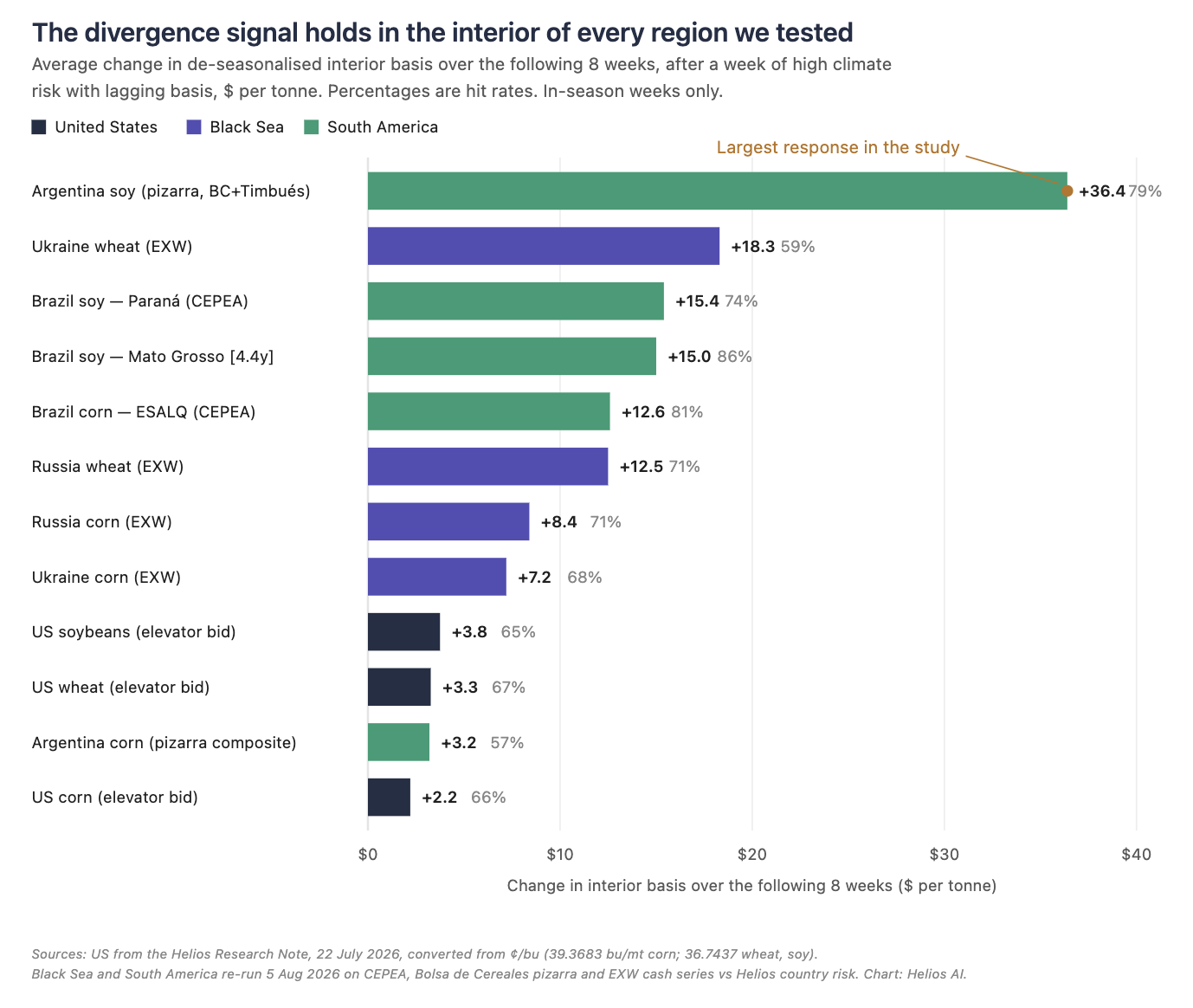
Chart C3: The interior basis response to a climate-risk divergence, by origin, largest first — all twelve origin-crop series positive.
Source: United States from the Helios AI Research Note, “Does Helios AI regional climate risk anticipate elevator basis?”, 2nd edition, 22 July 2026, converted from ¢/bushel at the study’s own factors (39.3683 bu/mt corn; 36.7437 wheat and soybeans). Black Sea, Brazil and Argentina re-run 5 August 2026 on the study’s own scripts, using CEPEA (Paraná, Paranaguá, ESALQ/Campinas), Bolsa de Cereales pizarra quotations and ex-works cash series against Helios AI country-level climate risk.
Range: United States 2016–2026; Black Sea 2019–2026; Argentina 2018–2026; Brazil 2020–2026, except the Mato Grosso soybean series which begins in 2022 and is marked [4.4y]. In-season weeks only.
Excluded: a thirteenth series, Brazilian corn in Mato Grosso, was dropped on data quality — its implied interior basis of −9.5 $/mt is implausibly shallow for the deep interior, against −153 $/mt for soybeans in the same dataset. It was also the only negative reading, so the exclusion is stated rather than left silent.
All twelve are positive. The divergence cell returns +12.0 $/mt at a 67% hit rate pooled across Black Sea wheat and corn, and +20.2 $/mt at 73% across South America. Argentine soybeans are the largest single response anywhere in the study, at +36.4 $/mt (79%).
A thirteenth series was dropped, and the reason matters more than the result. Brazilian corn in Mato Grosso implies an interior basis of about −9.5 $/mt — far too shallow for a state two thousand kilometres from port, where soybeans in the same dataset sit at −153 $/mt and freight is charged per tonne regardless of crop. That points at the price series rather than at the climate signal, so we have excluded it on data quality, not on its sign. It happened to be the one negative reading, and saying so is the point.
Two qualifications belong with that. The Black Sea effect is conditional, not linear: the pooled linear regression of interior basis on origin risk is flat (p=0.65 at four weeks), so the information sits in the divergence condition rather than in a smooth dose-response. And the Black Sea record spans the war — excluding February 2022 to June 2023 the divergence cell holds at +9.6 $/mt (64%), which is the reassuring direction, but on a shorter history than the US.
The United States sits at the bottom of that ranking, and it is the expected result rather than a disappointment. US elevator basis is the most heavily arbitraged interior grain market in the world, so there is less unpriced local information left in it to find. The claim we are making is therefore narrower than "climate risk moves grain prices," and more useful: modelled regional climate risk carries information about the interior basis a physical buyer actually pays, one to three months out, in every producing region we have been able to test.
The Bottom Line.
What Helios AI can defend today is narrow and useful: our regional climate risk anticipates the direction of de-seasonalised basis one to three months out, most reliably in wheat. For a physical buyer that is origination timing and basis locking, not a high-frequency signal. It will not beat your elevator in the week of the shock, and we would rather say so here than have you discover it in week one.
Three things follow for a wheat book over the next three months. Treat a rising risk reading with a still-flat basis as the setup, not the confirmation. Treat a risk spike that basis has already priced as a reason to wait. And for wheat specifically — and only wheat — a state-relative view is statistically supported; in corn and soybeans it is not. Next week we publish the live state-level read of the North American crop, which puts these numbers on the season now in the ground.
Frequently Asked Questions
What is grain basis, and what moves it?
Basis is the difference between a local cash grain price and the futures price. The United States Department of Agriculture's (USDA) Agricultural Transportation Open Data platform describes it as reflecting “both local and global supply and demand forces” — local supply, storage and transport availability, and global demand all feed into it. Because the futures leg nets out global factors, basis is the cleanest widely published measure of a purely local supply and demand shock.
Does climate risk data actually predict basis?
Yes, at four-to-twelve-week horizons, and the effect is strongest in wheat. Helios AI's study covers 14,483 weekly observations across 2016–2026. In it, one standard deviation of above-normal Helios AI climate risk was associated with wheat basis stronger by +1.2¢ per bushel at two weeks (p=0.007) and +2.6¢ at twelve weeks (p<0.001). The comparable corn figure was +2.38¢ at twelve weeks (p=0.001).
Why does the signal not work in the week of the shock?
Because local elevators price local weather almost immediately. Elevator bids reflect what the operator can see out the window, so by the time a climate-risk reading spikes, the bid has usually already moved and basis is already rich. Buying basis after risk crosses one standard deviation returned −4.3¢ per bushel over eight weeks in soybeans in Helios AI's sample, against +2.6¢ when risk was low.
Why is the signal strongest in wheat?
Two likely reasons. Wheat elevators appear slower to price climate stress than Corn Belt elevators — plausibly thinner local competition, plus protein and quality uncertainty that only resolves near harvest. And wheat's segmented classes and regions — hard red winter, hard red spring and soft red winter — preserve local variation that corn's more integrated market arbitrages away. That is why the state-versus-state test passes in wheat (+1.2¢ per 1σ, p=0.036) and fails in corn (p=0.14) and soybeans (p=0.26).
How large is the effect relative to normal basis volatility?
Modest, and we would rather state the ratio than the raw number. The effects are 1 to 2.6¢ per bushel per standard deviation of risk, against a 22 to 39¢ standard deviation of four-to-twelve-week basis moves on Helios AI's own calculation. That is real incremental information, not a dominant driver of basis. The divergence results also carry no transaction costs or carry — they are statistical anomalies, not executable profit and loss.
Does the relationship hold outside the United States?
Yes, in every producing region Helios AI has been able to test, and by a wider margin than in the US. Using domestic cash quotations in place of elevator bids — ex-works prices in Ukraine and Russia, CEPEA references in Brazil, Bolsa de Cereales pizarra quotations in Argentina — the divergence cell returned +12.0 $/mt at a 67% hit rate pooled across Black Sea wheat and corn, and +20.2 $/mt at 73% across South America, against roughly +2 to +4 $/mt equivalent in the US. All twelve origin-crop series charted were positive; a thirteenth, Brazilian corn in Mato Grosso, was excluded on data quality because its implied interior basis was implausibly shallow. The Black Sea result is conditional rather than linear — the pooled linear regression is flat — and its history spans the war, though excluding February 2022 to June 2023 the divergence cell still holds at +9.6 $/mt.
What did the study fail to prove?
The granularity claim. Relative risk between states did not predict relative basis moves in corn (p=0.14) or soybeans (p=0.26), and a highest-risk-versus-lowest-risk portfolio would have been right 50.8% and 42.7% of weeks respectively. The likely cause is that USDA state basis and Helios AI state risk are both averages, which discards the local variation the test needs — a bias against the thesis rather than for it. Forward out-of-sample testing has also not been done yet.
Join our webinar — the North American crop
We are walking through the state-level crop read behind this study — wheat, corn and soybeans at 59% season completion — with the basis overlay applied live, plus questions.
RESERVE YOUR SEAT


.png)

Personalized commodity intelligence for the teams that feed the world.
