
Same Letters, New Priorities: What World Agri-Tech South America 2026 Revealed About Brazil’s Next Five Years
For fifteen years, one acronym governed agriculture’s strategic conversation: ESG — environmental, social, and governance. At the World Agri-Tech South…

July 2, 2026
7 min read
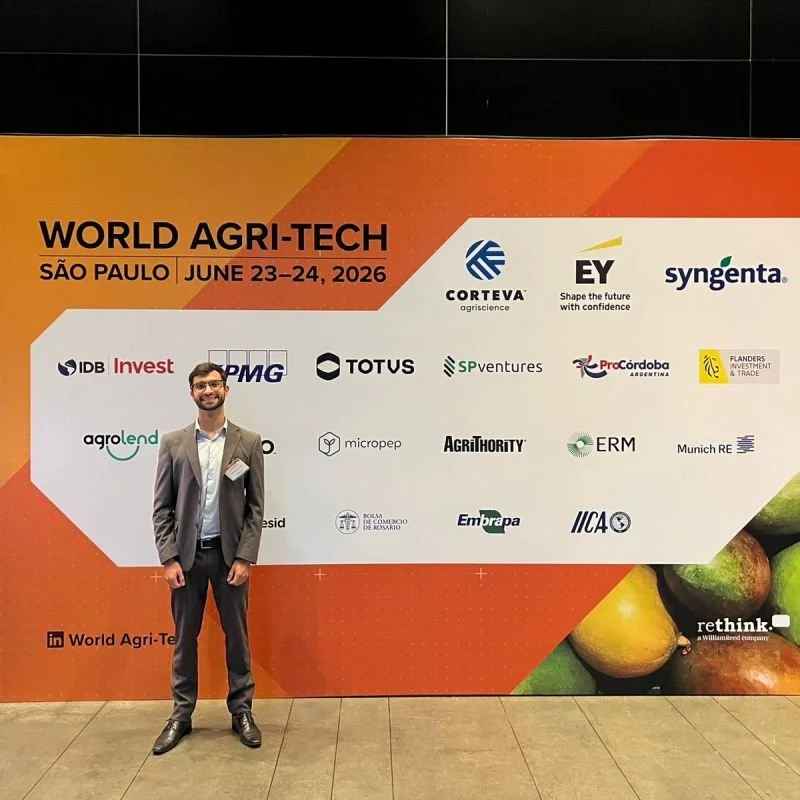
Joao Morciani, Senior Analyst, Helios AI
For fifteen years, one acronym governed agriculture’s strategic conversation: ESG — environmental, social, and governance. At the World Agri-Tech South America Summit in São Paulo last week, I watched an industry quietly re-sort those priorities toward something harder-edged: resilience, security, and value capture. The summit brought together producers, traders, agtech founders, and the food and beverage buyers who depend on all three. Across two days of panels, regenerative agriculture, livestock modernization, logistics and trade, and a fireside on the macro outlook, each room approached a different problem, yet each kept circling the same shift. Here is what came out of each one.
Regenerative agriculture: carbon is the complement, not the product
The clearest message from the regenerative panel was about sequencing. The operators on stage were explicit that carbon is a complement to the core business, not a replacement for it. SLC — the country’s largest listed soybean producer — described four carbon projects with commercial potential, spanning biochar, soil, and pasture conversion in the Araguaia region, while insisting the primary job is still producing food, fiber, and energy. Soil carbon content, in their framing, matters most as the headline indicator of soil quality and productivity: a soil with a high carbon stock is a more resilient, more productive soil, and the carbon credit is a second-order benefit.
The demand pull is coming from customers. CJ Selecta, among the world’s largest soy-protein-concentrate exporters, with a non-GMO book that is fully ProTerra-certified, walked through its “regenerating for the future” positioning and the Renova Terra program it built with Unilever, a €5.5 million push to bring regenerative practices to up to 45,000 hectares of Cerrado soy by 2030. The pressure points were Scope 3 emissions and export customers, including salmon producers in Norway and Chile who now buy soy protein concentrate on the basis of its carbon footprint, with some global aquaculture buyers already setting restorative-ingredient targets. The honest difficulty everyone named was measurement and monetization: regeneration is a process, not a one-time state, and proving it to the final consumer remains hard.
On the science side, the headline number was the scale of the opportunity: Brazil’s farmland holds the potential to accumulate on the order of a billion tonnes of carbon in the top 30 centimeters of soil alone, with continuous monitoring techniques — chamber measurements, flux towers, and newer sensors — increasingly able to verify it. Asked for the single word that would define regenerative agriculture’s success five years out, the panel landed on resilience.
Livestock: the next gains are in the breeding herd
The livestock sessions were a study of where the easy wins have already been taken. The economics push everyone toward fattening and a shorter cycle; a four-month finishing cycle turns capital far faster than the long rearing stage, so that is where the first wave of intensification went. The argument in São Paulo was that the real remaining opportunity sits upstream, in cria, the breeding and calving stage that has lagged on efficiency, where replacement rates are high and matrix-herd productivity is low.
Modernizing that stage, the panels argued, is a matter of integrated planning — logistical, nutritional, and genetic — rather than any single technology. Several speakers pointed to better genetics and traceability (ear-tag data and methane-reduction work) and to corporate AI tools that help producers benchmark their own averages against the dispersion across the wider herd, turning scattered field data into decisions. One thread worth flagging: panelists noted that breeding operations run by women were posting measurably better indices and saw revitalizing the cria stage as the way to consolidate Brazil’s position. The country already leads; the point was that holding the lead now depends on fixing the part of the chain everyone used to ignore.
Logistics and the EU deal: cost, capacity, and a segregation problem
The logistics session sharpened the cost side of Brazilian competitiveness. The transport matrix is still too dependent on trucks, and the consensus — one of the rare points where both right and left agree — is that rail and barge capacity have to scale, with new infrastructure aimed not only at Mato Grosso but also at the states projected to become major grain producers next. The financing model is shifting toward private investment and new concessions rather than public outlays, which raises the familiar problem: without proper returns, the capital that makes a corridor low-cost and efficient doesn’t show up.
The EU trade deal added a complication; the value chain is only beginning to be priced. Europe wants the deal, but its segregation requirements would force companies to re-engineer back-office and physical systems to keep compliant and non-compliant volumes apart — an EUDR-shaped challenge — without losing transport capacity in the process. Get that wrong, and a market that should be attractive becomes uneconomic simply because it can’t be segregated at scale.
AI, meanwhile, has moved from slideware to operations. Panelists described semi-automated locomotive systems that manage speed and idle time for fuel and productivity gains; predictive maintenance that turns multi-day stoppages into hours of screening; S&OP tools that coordinate across modes and even across companies; and pricing models that finally let operators set a competitive rail rate. The framing was practical: in a big country with a fragmented network, AI is less a moonshot than a way to wring efficiency out of assets that are already in the ground.
The macro fireside: biofuels, financing, and a new ESG
The outlook fireside, hosted by Ryan Daley of Ag Navigator, opened with three trends: fertilizer, China, and the elections, and I argued they are best read as one shift rather than three.
Biofuels remain the engine. Over the past five years, Brazil grew biodiesel output by roughly 50%; it is now the world’s third-largest biodiesel producer, behind the United States and Indonesia, and the second-largest biofuels producer overall. Because around 70% of its biodiesel feedstock is soybean oil, that policy pull reshaped the oil complex; Brazilian soybean oil even traded at a premium to US prices, a structural break from how the basis used to behave. The October 2024 “Fuel of the Future” law gave certainty to a rising mandate path, one percentage point a year toward a B20 blend by 2030, with B25 already authorized for the energy council to approve and now under testing. The more important change is qualitative: next year’s first SAF and renewable diesel mandates are written as carbon-intensity targets, which favor advanced feedstocks. SAF made from soybean oil needs close to three times the volume to match the decarbonization of SAF made from beef tallow, and projects like Acelen’s Mubadala-backed renewables complex on former Petrobras assets in Bahia are already planting native macaúba, a Cerrado palm that yields several times more oil per hectare than soybeans, on the order of 2,500 liters a hectare against roughly 500 for soy. (We unpacked the oils side separately in our note on vegetable oils at the center of the energy-supply-policy nexus.)
On financing, the constraint is the cost of capital: a Selic rate of 14.25% against inflation around 5% leaves a real rate near 9%, among the highest in the world, which kills greenfield builds, which is why sovereign funds have become a recurring source of long-dated money for refineries, ports, and railroads. Behind that sits a global tailwind; import-dependent countries are starting to treat food systems as infrastructure and to pay a premium for security of supply because the price on the screen no longer guarantees the cargo arrives.
The connective idea, and the one I’d ask people to hold onto, is a pivot from one ESG to another: from environmental, social, and governance toward economics, security, and geopolitics. The clearest evidence is the US EPA’s new Renewable Fuel Standard, which set the highest volumes in the program’s twenty-year history. The biodiesel and renewable-diesel mandate alone requires output to climb ~30% above 2025 while leaning on energy security and farm income rather than environmental benefits. (We made the same argument when biofuels were reclassified from a climate program into a “crucial asset.”) For Brazil, the resilience play runs through domestic demand: crush is growing fast enough to reach roughly 95% utilization of current capacity by 2028, and corn pricing in Mato Grosso has shifted from tracking Chicago toward the domestic B3 exchange as the corn-ethanol boom takes hold, both signs of an industry building a buffer against a market where geopolitics prices more of the curve every year.
What it means for buyers
Two points from the audience deserve to be on every slide made about Brazil:
● Expansion need not mean deforestation. Roughly 40 million hectares of degraded pasture could be brought back into production — enough, by the agriculture ministry’s own reckoning, to expand cropland without clearing a single hectare of native vegetation. That reframes a tired narrative about Brazilian growth.
● Smallholder integration is a food-security project, not just a commercial one. Of Brazil’s 213 million people, several million are smallholder farmers; folding them into commercial chains — biofuel feedstock chains among them — broadens the supply base, with carbon farming beginning to appear as a genuine additional revenue stream, as it has in the US.
The common thread across all four rooms is the one we track in the data every day: climate and geopolitical risk have left the ESG report and are now showing up in soil decisions, herd decisions, sourcing decisions, financing structures, and policy mandates. The operators and buyers who do best over the next five years will be the ones reading the full transmission chain — origin by origin, feedstock by feedstock, season by season — before the market reprices it for them.



.png)

Personalized commodity intelligence for the teams that feed the world.
