
The El Niño 2026 procurement playbook: what a strong event does to every ag book
The direction is settled; the timing is the decision. A strong El Niño is no longer a scenario we are watching for — it is present and strengthening. The US…

July 16, 2026
11 min read
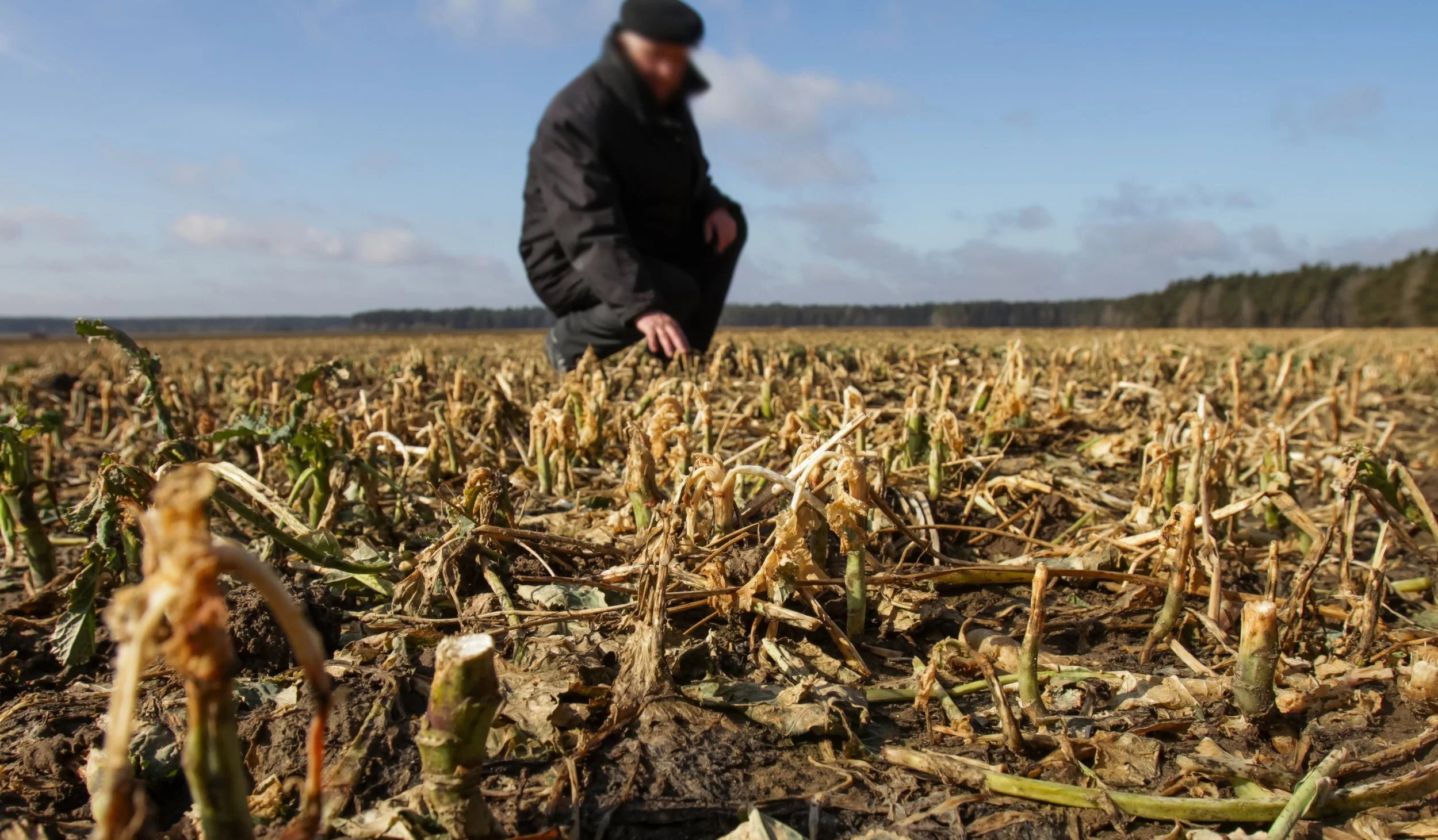
A strong El Niño is now the base case for late 2026 — but it will not hit every commodity book at once, and the calendar of exposure windows is the part most procurement plans get wrong.
By João Pedro Rodrigues Morciani · Senior Analyst, Helios AI
The direction is settled; the timing is the decision. A strong El Niño is no longer a scenario we are watching for — it is present and strengthening. The US National Oceanic and Atmospheric Administration's Climate Prediction Center (NOAA CPC) has an El Niño Advisory in effect as of 2026-07-09, with the monthly Niño-3.4 anomaly at +1.2 °C. "El Niño continues and will strengthen through the end of the year, with a 97% chance it will persist through early spring 2027," the CPC wrote in its July diagnostic discussion. The International Research Institute for Climate and Society (IRI), in its June El Niño–Southern Oscillation (ENSO) Quick Look, put the weekly Niño-3.4 at +1.7 °C centered on 2026-06-17, with a 24-model ensemble projecting a peak in September–November and 13 of 24 models indicating a very strong event of +2.0 °C or more. The World Meteorological Organization (WMO), in its early-June update, gave roughly 80% odds for June–August and at least 90% through November, with seasonal sea-surface anomalies expected to exceed +2 °C in key regions.
Those three numbers — +1.2, +1.7, above +2 — are not a contradiction. They are different windows of the same warming: a monthly average, a weekly reading, and a regional peak projection. Together they say one thing: the event is here, it is building, and it peaks into the fourth quarter.
What would falsify this call is specific, and worth naming. The event is not certain until it is over. A stall or retreat in the weekly Niño-3.4 back below roughly +1.5 °C through the northern-hemisphere autumn — or a break in the model consensus that currently shows negligible probability of neutral or La Niña conditions — would pull the "very strong" tail off the table and reset every window below. We will re-check the weekly reading before we act on any of it. That is the discipline the rest of this playbook runs on.
El Niño runs on each crop's clock, not one calendar.
The mistake is treating El Niño as a single event with a single price. It is not. It propagates through each commodity on that crop's own phenological clock — planting, vegetative growth, flowering, reproductive fill, harvest — and a September peak lands very differently on a crop being harvested now versus one going into the ground in October. That is why the playbook is a calendar, not a headline.
And here honesty matters more than drama. The historical link between El Niño and commodity prices is genuinely mixed. The academic record — the European Central Bank (ECB), Banco de España, and work out of UC Davis — is clearest for soybeans, corn, and rice, where the upside signal is real. It is weaker and statistically insignificant for wheat, and for coffee and cocoa the average price effect is close to zero, with several studies finding no causal link at all. The ECB has estimated that the shift to a strong El Niño can raise global food commodity prices "for up to two years, with a 9% peak in price increases occurring 16 months after the start of the strong El Niño episode" — a slow, diffuse effect, not a spike.
That mixed record is exactly why a seasonal average is the wrong tool, and a current, region-specific signal is the right one. We do not trade the history. We lead with what our climate-risk ratings show in each growing region right now — the verifiable field record, region by region — and treat the historical relationship as a range of hit-rates around it, never as a promise that El Niño reliably lifts any single commodity. Below, every window is anchored on today's Helios climate-risk ratings, with the market's own forward price shown as the consequence.
The window is open now: coffee in Brazil.
Coffee is the harvest window with a tail-risk story, not a shortage call. Brazil is in peak arabica harvest, and three of the four core arabica states still carry stress: Minas Gerais at 2.0★ Warning (upgraded from 1.0★ Take Action, improving off a rough base), Espírito Santo at 1.0★ Warning, São Paulo and Bahia at 1.0★ Take Action. Set that against the US Department of Agriculture's Foreign Agricultural Service (USDA FAS), which in June pegged Brazil's 2026/27 crop at a record 71.9 million bags, up 14%, with arabica up 25% — and noted exporters are holding stock back amid low inventories and El Niño uncertainty for the tail of this harvest and the 2027/28 cycle. ICE arabica (KC*1) closed at 343.00 US cents/lb on 2026-07-10, well off its October 2025 peak near 421 and its June 2026 trough near 248. The near-term case is not a deficit; it is a coverage-against-the-tail case while a record crop caps the downside. We ran the full single-commodity version of this in our coffee climate-premium analysis, and the chart below is the proof of concept for the whole playbook: the Helios signal escalated months before the market repriced.
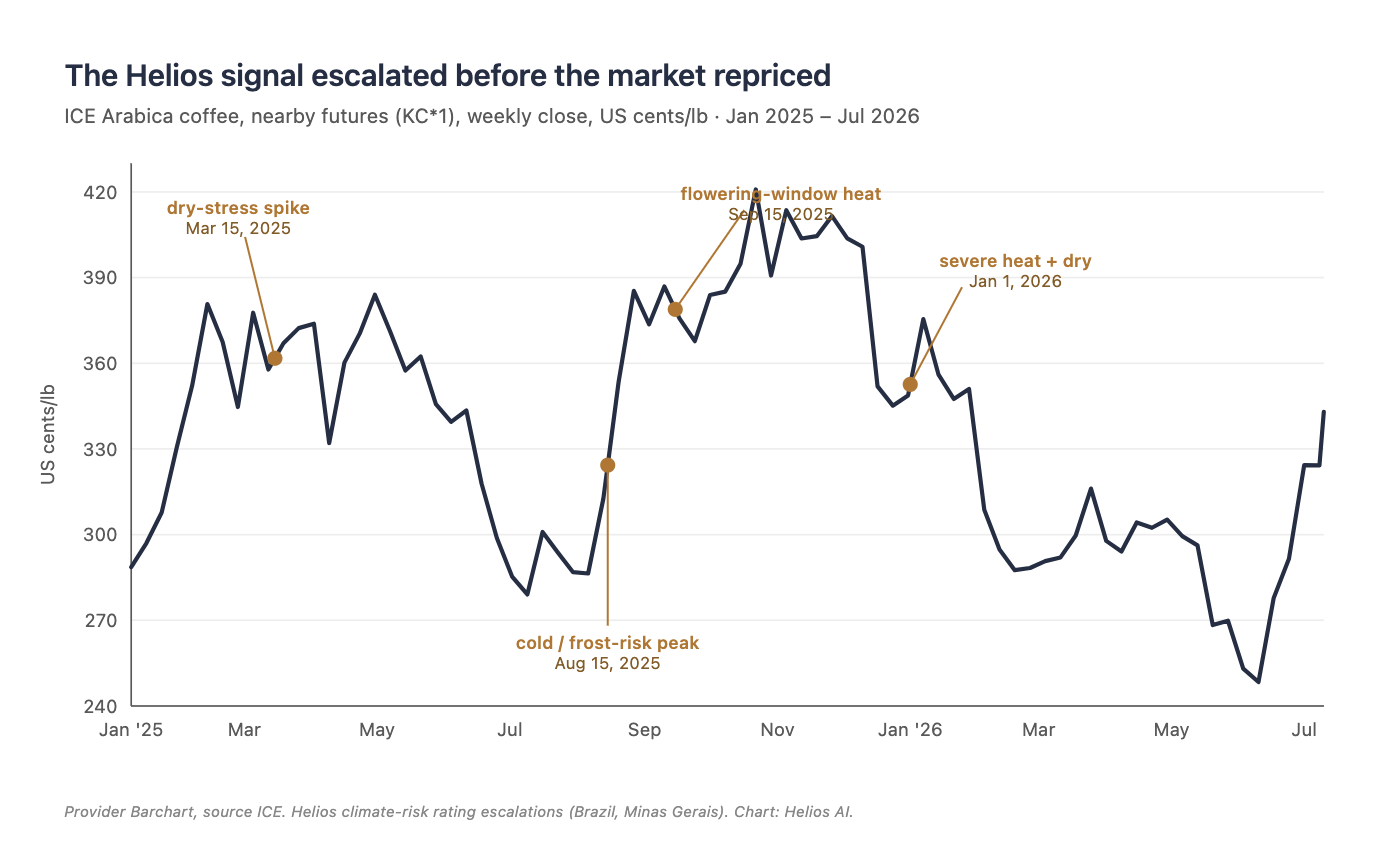
Chart 1: ICE Arabica coffee, nearby futures (KC*1), weekly close, US cents/lb. Helios climate-risk rating escalations for Brazil (Minas Gerais) flagged on the line.
Provider: Barchart. Source: ICE.
Range: Weekly close, January 2025 – July 10, 2026.
The window opening next: US soybeans and West African cocoa.
US soybeans are the honest counter to any doom narrative — low risk today, one window to watch. The crop is in vegetative growth and it is strong: Iowa at 4.0★ All Good, the majority of states at 3.0★, only a handful at 2.0★ Watch. USDA's July World Agricultural Supply and Demand Estimates (WASDE) report (released 2026-07-10) raised 2026/27 production to a record-if-it-holds 4.475 billion bushels. Yet Chicago Board of Trade (CBOT) soybeans (ZS*1) still firmed to 1,196.50 US cents/bushel on 2026-07-10, near the top of an 18-month range despite that record crop — the market is carrying a premium the US field alone does not yet justify, whether it reflects demand or South American weather risk. The window that matters is the August–September reproductive phase, when pod-fill meets the El Niño peak. Today's rating is All Good; the procurement move is not to chase the premium now but to pre-position coverage triggers against a reproductive-window downgrade.
Cocoa is the worked example of signal leading price — enter only through West Africa. Côte d'Ivoire is deeply stressed in our 2026-07-12 run, with Comoé and Lagunes at 0.5★ Take Action and most of the belt at Warning or Take Action into a below-average harvest. The market caught up abruptly: ICE cocoa (CC*1) rallied roughly 18% to 5,919 USD/tonne on 2026-07-10 on West African rain and quality concern, after collapsing from near 9,506 in January 2025 to under 2,800 in February 2026. The point for this playbook is the sequence — the regional stress rating was flashing before the July rally, not after it. That is the entire thesis in one book.
The Q4/Q1 window: pre-hedge South American planting now.
The Southern Hemisphere is where a September peak does its real damage, and the decision is today. South American soybeans and corn go into the ground in Q4, which puts planting and early growth directly under the El Niño peak. Our ratings already show the stress ahead of the season: Argentina's Chaco soybeans at 0.5★ Take Action and Córdoba corn at 0.5★ Take Action in the 2026-07-12 run. These are not harvest-now problems; they are pre-hedge-now problems, because the forward price will move on planting-window weather long before the crop exists.
Wheat proves the map is not uniform — and that is the point. Argentina's wheat is mostly All Good at planting, but Buenos Aires sits at 1.0★ Warning (2026-07-13). Australia, meanwhile, is at 3.0★ All Good across all its wheat states at planting — a clean counter-example that a strong El Niño does not light up every book. CBOT wheat (ZW*1) closed at 632.00 US cents/bushel on 2026-07-10, rebuilding a risk premium off its December 2025 trough near 507. Wheat is where the historical ENSO signal is weakest, so we weight the current ratings over the seasonal reflex: a targeted Buenos Aires watch, not a blanket wheat hedge.
The specialty book is the moat: where the rating is the price signal.
For the crops with no futures screen, a Helios regional Warning 90 days out is the price signal — there is nothing else to watch. Costa Rica, the world's dominant pineapple export origin, has Heredia and Alajuela at 1.0★ Warning in peak harvest (2026-07-12) — the sharpest specialty signal in the set. Peru's blueberry belt shows Ica and Lambayeque at 1.0★ Warning at harvest (2026-07-12); we cover the full cliff in our blueberry supply-cliff cluster. Peru mango has Lambayeque downgraded to 2.0★ Watch from All Good (2026-07-12); the origin-by-origin detail lives in the mango price map. And a genuinely under-covered citrus signal runs across mandarins — Peru's Ica, Morocco's Souss-Massa, and Spain's Cataluña all at 1.0★ Warning. None of these has a forward curve. The rating is the only lead time buyers get.

Chart 2: Specialty exposure table — pineapple, blueberry, mango and mandarin by origin, with Helios climate-risk star, status, and harvest phase.
Source: Helios seasonal climate-risk ratings, runs 2026-07-05 (Philippines pineapple) to 2026-07-12. Star is on a 0–5 scale, higher = lower risk.
The playbook, on one page.
Read this as a coverage cadence, not a forecast. Each row pairs the exposure window with the region and signal to watch and the procurement action for a book being managed today.
El Niño 2026 exposure calendarExposure window by commodity · bar color = status of the flagged region · shaded band = IRI Sep–Nov peakIRI peak — Sep–NovJulAugSepOctNovDecJan '27FebCoffee (arabica)Brazil · WarningPeak HarvestCocoaCôte d'Ivoire · Take Action≤Avg HarvestUS soybeansIowa · All GoodVegetativeReproductive (watch)S. American soy/cornArgentina · Take ActionPlanting → early growthWheatArgentina B.A. · WarningPlanting → growthAUS All GoodSpecialty basketRolling — Warning/Watch, signal is the screenWarning / Take ActionWatchAll GoodIRI Sep–Nov peak band
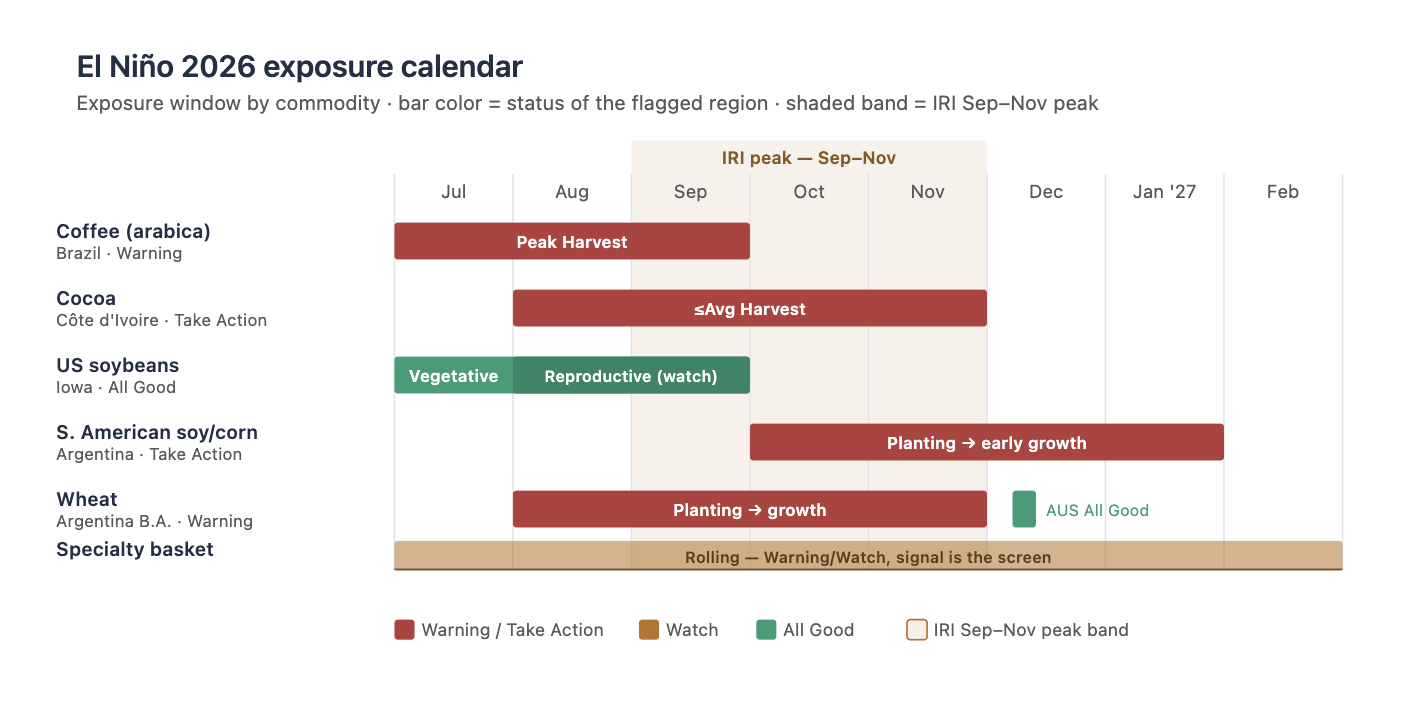
Chart 3: El Niño 2026 exposure calendar — each commodity's harvest-phase window against the IRI September–November peak band; bar color is the status of the flagged region.
Source: Helios climate-risk ratings (latest run per commodity, 2026-07-12 to 2026-07-13); IRI ENSO Quick Look Sep–Nov peak timing.
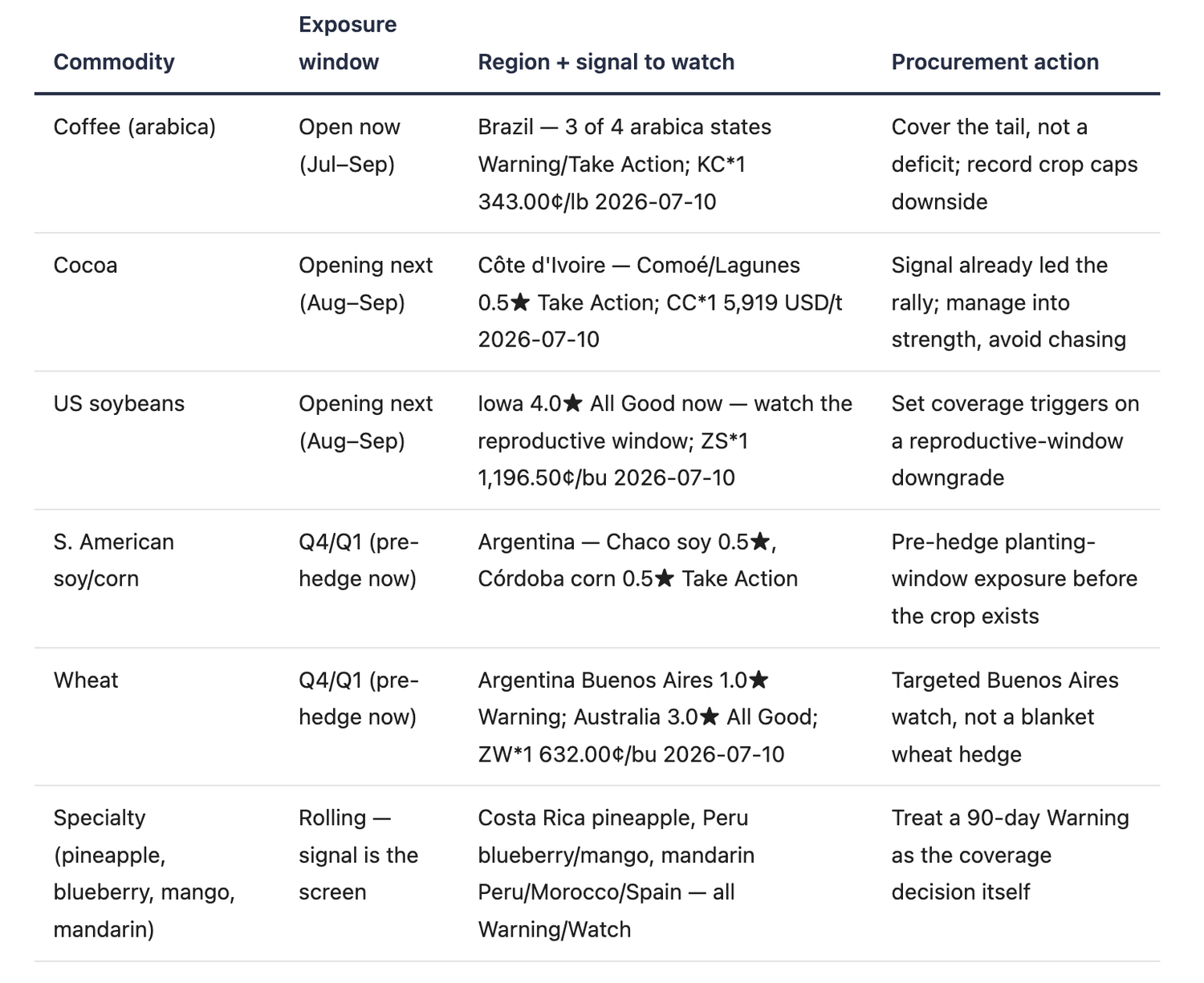
The Bottom Line.
The strong El Niño is the base case; the edge is knowing which window opens when. The direction is settled and the peak lands into the fourth quarter, but the price consequence is not uniform and the history is honestly mixed — which is precisely why a current, region-by-region signal beats a seasonal reflex. Coffee in Brazil is a decision for this quarter. US soybeans and West African cocoa are the next window. South American planting and Argentine wheat are the pre-hedge you place today for a problem that arrives in Q4. And the specialty book — where there is no screen and the rating is the only warning a buyer gets — is the part of the map no one else can draw. El Niño will not ring a bell for each book. The calendar already has.
Frequently Asked Questions
How strong is El Niño in 2026, and when does it peak?
It is present and strengthening. NOAA CPC (2026-07-09) reports a monthly Niño-3.4 of +1.2 °C with a 97% chance of persistence into early spring 2027 and 81% odds of a very strong event in October–December; the IRI's June reading was +1.7 °C weekly, with the peak projected for September–November. The WMO expects regional anomalies above +2 °C. Together they point to a strong event peaking into Q4 2026.
Which commodities does El Niño affect most?
The honest answer is that it varies by crop and region. The clearest historical price signal is in soybeans, corn, and rice; the effect on wheat is weaker, and for coffee and cocoa the average historical effect is close to zero. That is why we lead with current, region-specific climate-risk ratings rather than a blanket seasonal call — the field record is more reliable than the average.
How does El Niño change coffee and cocoa prices?
Through each crop's calendar, not a single move. In coffee, three of four Brazilian arabica states carry Warning or Take Action even as USDA projects a record crop, making the near-term case a tail-risk coverage story rather than a shortage, with ICE arabica at 343.00¢/lb (2026-07-10). In cocoa, our most severe rating in Côte d'Ivoire led an ICE futures rally of roughly 18% to 5,919 USD/t (2026-07-10) — the signal moved before the screen did.
What should a procurement team do about El Niño now?
Work the calendar. Lift near-dated coverage where the window is open and the screen is still cheap (the coffee tail, into a record crop); set trigger-based coverage on crops whose risk window opens next (US soybean reproductive phase); and pre-hedge Southern-Hemisphere planting exposure (Argentine soy, corn, and Buenos Aires wheat) now, before the forward price moves on planting weather.
Can climate signals be priced before the market moves?
In our field record, yes. In cocoa, our Côte d'Ivoire regional stress rating was flashing at 0.5★ Take Action before ICE cocoa rallied roughly 18% to 5,919 USD/tonne on 2026-07-10; in coffee, the Brazil escalation series led the market's repricing by months. For specialty crops with no futures screen, the rating is the only forward signal buyers get.
What would falsify a strong El Niño call?
A stall or retreat in the weekly Niño-3.4 back below roughly +1.5 °C through the northern autumn, or a break in the model consensus that currently shows negligible odds of neutral or La Niña conditions. We re-check the weekly reading before acting, because the accuracy position depends on saying when the call is wrong, not only when it is right.
Sources: NOAA Climate Prediction Center; International Research Institute for Climate and Society (IRI); World Meteorological Organization (WMO); USDA Foreign Agricultural Service and WASDE; Food and Agriculture Organization of the UN (FAO); International Cocoa Organization (ICCO); ICE Futures and CBOT prices via Barchart; European Central Bank; and Helios AI seasonal climate-risk ratings (latest run per commodity, 2026-07-05 to 2026-07-13). Futures levels as of 2026-07-10. Last updated 2026-07-16.


.png)

Personalized commodity intelligence for the teams that feed the world.
