
The Mango Price Map Is a Relay. The Risk Lives at the Handoffs.
A mango desk does not buy from one market. It buys from five origins in sequence — a relay, in effect, each origin handing the US market to the next on a…

July 29, 2026
12 min read
Five origins take turns supplying the US mango market, and Mexico's 2026 season showed where the price risk actually sits — at the handoffs between them, not in the middle of anyone's window.
By João Pedro Rodrigues Morciani · Senior Analyst, Helios AI
A mango desk does not buy from one market. It buys from five origins in sequence — a relay, in effect, each origin handing the US market to the next on a schedule you can write down in advance — and the price a buyer pays in any given week depends less on world supply than on which origin is in its window and how cleanly the next one arrives. This July made the point for us. A flowering failure took roughly a tenth out of Mexico's season and border prices nearly doubled year on year; by the last week of July the premium was gone, because the next stretch of Mexican volume started early. Below we lay the calendar out window by window, with our current climate-risk rating on each origin and the contracting decision each handoff implies.
The US Buying Year Is Five Windows.
Five windows cover the US mango year, and every one of them has a date on it. Mexico runs from the first week of January to the last week of October, with roughly 85 million boxes projected for 2026, per the National Mango Board's (NMB) crop report of July 23. Brazil picks up in the second week of July — its first 2026 shipment landed in the week ending July 11 — and holds through the second week of December, with about 12.5 million boxes projected to the US. Ecuador covers October to year-end; Fundación Mango president Bernardo Malo put the 2025/26 season at roughly 14.4 million cartons, about 8 percent below the prior year. Peru takes over from the second week of October and runs to the first week of April. The Dominican Republic fills February through August; its 2026 season has already concluded at 1.67 million boxes.
Shipping time is what makes this calendar binding. Fruit reaches US ports in two to three days from Mexico and in two to three weeks from Brazil, Ecuador, Peru or the Dominican Republic, per the same NMB report. Three weeks on the water means any South American substitution decision has to be made roughly a month before the fruit lands. A desk that waits for the gap to show up in the arrivals data has, in practice, already missed its chance to cover it.

Chart C1: The mango relay — 2026 origin supply windows for the US market, coloured by each origin's current Helios AI climate-risk rating (average stars across its rated regions). Rating colours are a July 2026 snapshot at run 2026-07-26, not a window-average: Mexico 2.25★, Brazil 2.33★, Ecuador 1.67★, Peru 2.75★, Dominican Republic 1.64★. Star scale: more stars = lower climate risk — five is a comfortable season, one is severe stress; "on watch" means worth monitoring, "warning" means stress building toward crop damage. Peru's window wraps the year end and is drawn in two segments.
Range: Calendar year 2026, January–December; five origins supplying the US import market.
Price implication: in the middle of a window, competing shippers anchor the price; at a handoff, it is set by whichever origin shows up short. Procurement action: treat the handoffs — Mexico to Brazil now, Ecuador to Peru around December, Peru back to Mexico in the first quarter — as the dates coverage decisions actually fall due, and move each one a month earlier for every ocean-freight origin.
Mexico Proved the Mechanism in Public.
Mexico's 2026 shortfall started in the winter flowering window, months before it reached a price. Cold-hour accumulation in Sinaloa ran far from optimal, and a March cold front disrupted flowering in Jalisco and Nayarit, per trade reporting of July 8. Our own daily climate-risk record is consistent with the industry's diagnosis — read as an observation, not a validated chill metric, Sinaloa's December–March cold-stress reading for 2026 was 6.9, the lowest in the eleven-year series. EMEX, the Mexican mango exporters' association, would not narrow the damage:
"We're still assessing the damage. Some say it's 30 percent; others say 60 percent. But we need to look closely at the data and seriously investigate."
— Myrna Castro, executive director of EMEX
Because Mexico was effectively the only origin shipping, the shortfall went to price immediately. In the week ending July 18, Mexico was 99.6 percent of US mango arrivals — 3,794,054 of 3,810,006 boxes. Kent out of Nogales printed $7.40 per 4 kg box against $3.79 a year earlier, up 95 percent (U.S. Department of Agriculture (USDA) Market News, average of high and low prices paid at point of importation, free on board (FOB) at point of entry, week ending 2026-07-18). On the Helios AI weekly Mexico series — USD per one-layer 4 kg (8.8 lb) carton, USDA Agricultural Marketing Service (AMS) imported shipping-point — week 26 printed $8.10 against $4.93 in 2025, up 64 percent, and week 28 ran 81 percent over.
By late July the premium was gone. Mission Produce's Galen Johnson named the shape of the risk on July 9: "Many growers are describing this as a production 'gap,' with limited supply anticipated through mid-to-late July." He was right about the timing. Los Mochis started earlier than normal, volume refilled the window, and by week 31 the same series printed $4.69 against $4.66 — a 1 percent premium. Worth noting: the shortage itself never went away. NMB still projects Mexico's 2026 season about 10 percent below last year, and the February–September season average to date, $7.34 per carton, is the highest in the Helios AI series back to 2020. The spike lived exactly as long as the gap did.
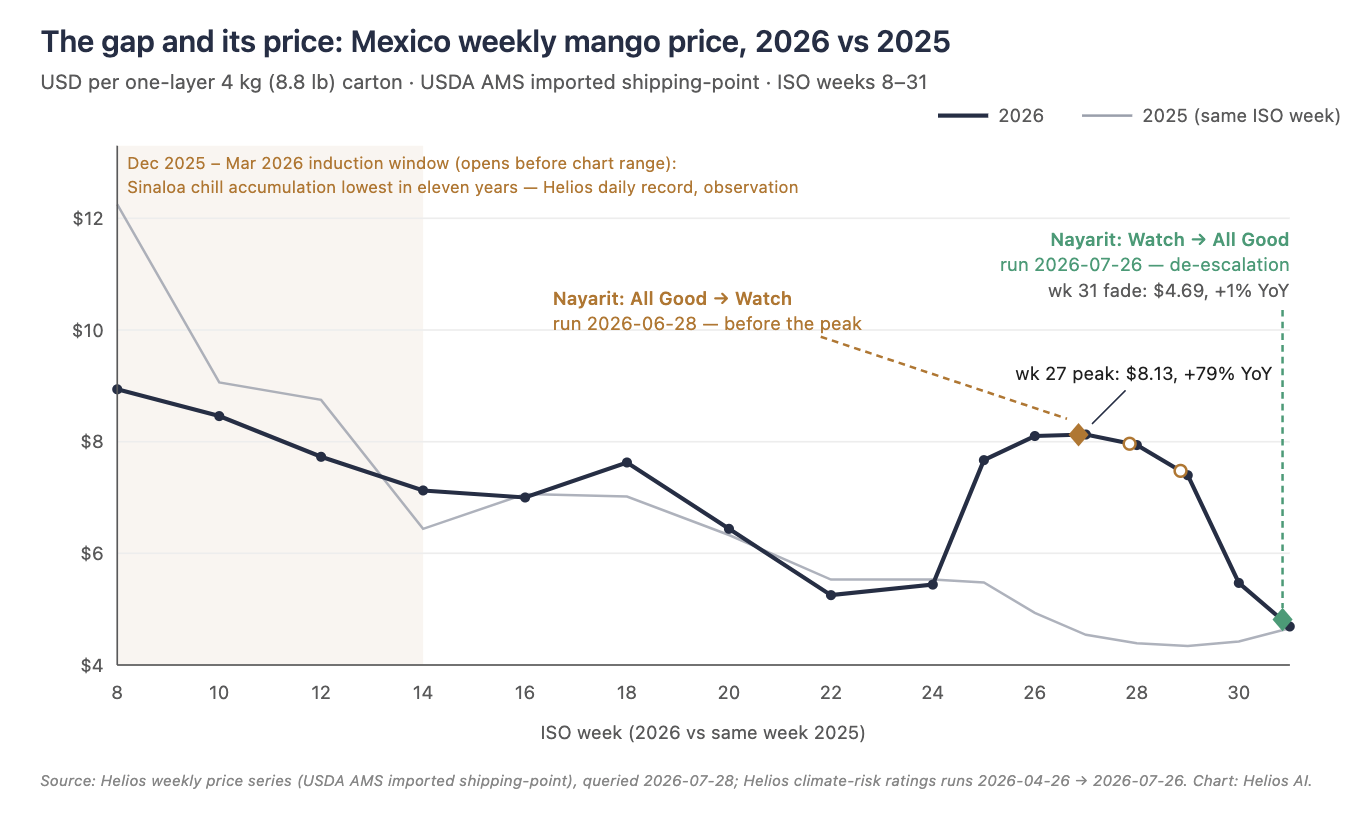
Chart C2: The gap and its price — Helios AI Mexico weekly mango price, 2026 vs 2025 same ISO week, USD per one-layer 4 kg (8.8 lb) carton, USDA AMS imported shipping-point. Flags are Helios AI climate-risk rating changes, Nayarit (mango), by run date: escalation All Good → Watch at run 2026-06-28, preceding the week-26/27 price peak; a brief return to All Good at run 2026-07-05 and re-escalation to Watch at run 2026-07-12 (small hollow markers); de-escalation Watch → All Good at run 2026-07-26, as early Los Mochis volume pulled the premium back to 1 percent. All flags are genuine rating changes from the post-2026-04-26 ratings record. Status scale, in rising order of concern: all good, watch (worth monitoring), warning (stress building toward crop damage), take action — so these flags mark Nayarit moving between a comfortable reading and one worth monitoring. The shaded band marks the December 2025 – March 2026 induction window, in which Sinaloa's chill accumulation read the lowest in the eleven-year Helios AI daily climate-risk record — an observation, not a validated chill metric. Cross-check: FreshFruitPortal independently reported a 63 percent week-26 price increase; the Helios AI week-26 figure is +64 percent.
Range: ISO weeks 8–31; 2026 line vs 2025 same-week line; prices $4–$13 per 4 kg carton.
Price implication: a mid-season shortfall spikes the price only while no other supply can reach the market; the number that belongs in a budget is the season average, which is up this year, not the peak print. Procurement action: cover weeks 30–33, projected by NMB about 18 percent below last year, against Brazil's ramp, projected 39 percent higher, and treat weekly NMB arrivals, not the spot print, as the trigger.
Peru Is the Handoff That Went the Other Way.
Peru shipped 22 percent less in 2025/26, and the price fell anyway. The season closed at 223,686 tonnes, down 22 percent year on year, per APEM, Peru's mango producers' and exporters' association, as reported by Agraria.pe on May 12. Yet the price a US desk paid fell through the season: the USDA imported shipping-point series for South American origins opened around $13.50 per 4 kg carton in October 2025 and finished near $6.25 by March 2026. Peru's compressed volume landed into soft demand while Ecuador's overlapping season held, so the window never actually went uncovered — and an uncovered window, not a smaller crop, is what moves this market.
The 2023/24 season shows what an uncovered window costs. When El Niño coastal heat suppressed flowering in Piura, Peru's fresh mango exports collapsed from 262,000 to 82,000 tonnes, down 68 percent, and the average export unit value rose 145 percent, from $1.55 to $3.79 per kilogram — Peruvian fresh mango FOB, full-campaign average, per Produce Blue Book in May 2024. The South American shipping-point composite's November–March season average went from $5.77 to $12.07 per 4 kg carton, up 109 percent, while Mexico, the substitute origin, rose 42 percent over the same window. That spread is the substitution premium: the extra cost of needing an origin that is not there. On lead time, we want to be careful. We would not claim we saw it before the trade did — Piura's daily climate-risk score first escalated sharply on 2023-09-18, the same week the trade press carried the bloom failure — but that escalation still preceded the composite's price peak by roughly five months.
Price implication: a volume shortfall by itself does not move the price; an uncovered window does. Procurement action: underwrite fourth-quarter and first-quarter exposure on the joint state of Ecuador and Peru rather than either origin alone, and put the review date in August–September, when the induction weather that decides both is already observable.
The Next Two Handoffs Are Being Decided Now.
The current ratings run is not a calm one. Helios AI scores climate risk for mango across 21 producing countries and 96 growing regions, including all six origins that supply over 98 percent of US mango volume. Each region carries a star rating — five stars means a comfortable season, one star means severe stress — and a status that tells a buyer how urgently to look: all good, watch (worth monitoring), warning (stress building toward crop damage), or take action (risk high enough to move coverage). At the July 26 run, 42 of the 96 regions sat in the two most serious categories. On the origins that matter for the US calendar: Mexico's rated regions average 2.25 stars — mid-scale, with Guerrero already at the warning level and Sinaloa flagged for monitoring. Brazil averages 2.33, with Bahia and Pernambuco flagged for monitoring. The São Francisco Valley, source of 90-plus percent of Brazil's mango exports, is irrigated, and it shipped more than 120,000 tonnes in the first half of 2026, up nearly 40 percent year on year per trade reporting; Brazil's 2026 problem so far has been rain on fruit quality, not water. Ecuador is the most stressed of the group at 1.67 stars, and Los Ríos has been at the warning level since June 28. And Peru — the origin everyone remembers — is today the calmest major origin Helios AI rates, at 2.75 stars.
Peru's rating describes today, though, and the window that will decide its next season is open now. SENAMHI, Peru's national weather service, projects insufficient cold hours for Kent floral induction in Piura for the 2026/27 campaign, and in the Helios AI daily record — again, an observation, not a chill product — Piura's June–September cold reading stands at 0.0, a level previously seen only in 2023. The July 9 diagnostic from the National Oceanic and Atmospheric Administration's Climate Prediction Center (NOAA CPC) puts an 81 percent chance on a very strong El Niño in October–December, a scenario whose origin-by-origin consequences we work through in our El Niño procurement playbook. The United Nations Food and Agriculture Organization's (FAO) caution belongs next to that number: El Niño does not reliably lift mango prices so much as reallocate which origin fails. The same handoff logic runs across the specialty basket, as we showed for blueberry supply cliffs.
Price implication: the fourth quarter's mango price gets set at the Ecuador–Peru handoff, and the weather that decides it is being recorded now, months before the first Peruvian carton sails. Procurement action: for December–April coverage, fix volume triggers by early September — sail date minus the three-week transit — and review the Piura and Ecuador ratings weekly through the induction window.
The Bottom Line.
US mango prices are set by a calendar. Five origins cover the year in sequence, and a mid-season shortfall corrects itself as long as the next supply can start early — Mexico's premium peaked at 81 percent on the Helios AI weekly series and was back to 1 percent inside five weeks. A failed handoff prices very differently: in 2023/24, a missing Peru cost the composite a 109 percent season. In every one of those cases, the weather that decided the outcome was on record months before the price moved. In a relay, you do not price the runner. You price the handoff.
See each origin's current rating
See the current Helios AI rating on each of these origins — book a platform demo and put multi-origin climate-risk ratings on your own coverage calendar.
Frequently Asked Questions
When does each major mango origin supply the US market?
Mexico ships from the first week of January to the last week of October; the Dominican Republic from late February through August; Brazil from the second week of July to the second week of December; Ecuador from October to year-end; and Peru from the second week of October to the first week of April, per the National Mango Board's July 2026 crop report and season trade reporting.
Which origins actually set the price a US buyer pays for mangoes?
Six origins — Mexico, Peru, Brazil, Ecuador, Guatemala and the Dominican Republic — supply over 98 percent of US mango volume, per industry reporting on National Mango Board data. Mexico dominates: in mid-July 2026 it was 99.6 percent of weekly US arrivals, so from May to September the US price is effectively Mexico's price.
Why did US mango prices spike in June and July 2026?
Poor cold-hour accumulation in Sinaloa and a March cold front in Jalisco and Nayarit cut Mexico's crop, and with Mexico supplying nearly all US arrivals the shortfall went straight to price: Kent at Nogales reached $7.40 per 4 kg box in the week ending July 18, up 95 percent year on year (USDA Market News, FOB at point of entry). By the last week of July, early volume from Los Mochis had pulled the year-on-year premium back to 1 percent.
Does a mango supply shortfall always mean higher prices?
No. Peru shipped 22 percent less in 2025/26 and the USDA shipping-point series for South American origins still fell from about $13.50 to $6.25 per 4 kg carton across the season, because Ecuador's overlapping supply held and demand was soft. Prices spike when a window goes uncovered — as in 2023/24, when Peru's 68 percent collapse drove the same composite up 109 percent season on season.
How does El Niño 2026 affect the mango season handoffs?
NOAA CPC's July 9 diagnostic gives an 81 percent chance of a very strong El Niño in October–December — squarely across the Ecuador-to-Peru handoff, and over Piura's floral-induction window, where SENAMHI already projects insufficient cold hours for the 2026/27 campaign. FAO's review of 2025 is a useful caution, though: El Niño tends to reallocate which origin fails rather than push all mango prices one way.
How should a buyer structure a multi-origin mango program?
Contract the calendar, not the origins: cover each window with its in-season origin, hold overlap options at every handoff, and time decisions to the transit — two to three weeks on the water from South America means substitution calls are made about a month before fruit lands. Monitor climate risk per origin during its induction window, months ahead of its shipping window, because that is where every recent failure started.


.png)

Personalized commodity intelligence for the teams that feed the world.
