
The Rain That Is Late in September Is a Corn Price in July.
El Niño's effect on Brazilian corn is not a rainfall story but a calendar story — and the first hard information about the 2027 safrinha arrives in Mato…

August 20, 2026
20 min read
El Niño's effect on Brazilian corn is not a rainfall story but a calendar story — and the first hard information about the 2027 safrinha arrives in Mato Grosso's planting-pace reports in late September.
By João Pedro Rodrigues Morciani · Senior Analyst, Helios AI
The Chain Is Ten Months Long, and It Starts in One Field.
A buyer pricing Brazilian corn for the back half of 2027 is already watching the September rains in Mato Grosso, whether they know it or not. The rains gate soybean planting; the harvest sets the date the field comes free; the safrinha goes in behind it, January to March, and is cut in northern Mato Grosso in June and July. So July here means the harvest and the Chicago Board of Trade's July contract — the export flow peaks August through October on Comex Stat data.
That chain carries most of Brazil's corn. Brazil's crop agency CONAB, in its eleventh survey of 13 August 2026, puts the second crop at 111.03 of the country's 142.96 million tonnes for 2025/26 — 77.7% — with Mato Grosso alone at 57.38 million tonnes, just over half the safrinha. USDA's 12 August World Agricultural Supply and Demand Estimates has Brazil at 44.00 of 210.48 million tonnes of world corn exports in 2026/27: a fifth of the world's traded corn, resting on one crop sown in one narrowing window.
El Niño Does Not Make Mato Grosso Drier. It Moves the Window.
The popular version of this story is wrong, and the correct version is more useful. The published climatology does not support "El Niño delays the rains in Mato Grosso." Heinemann and colleagues, in the International Journal of Climatology in 2021 — fifty stations across central Brazil, 1980 to 2013 — find El Niño associated with slightly earlier rainfall onsets in Mato Grosso; the significant onset delay belongs to La Niña.
What the same paper does find is the mechanism this piece is about. In Mato Grosso, El Niño years carry a later optimal sowing date and a narrower sowing window — and the El Niño–Southern Oscillation shows up in the yield of the second crop, not the first. A fifteen-day delay, plus the two to four weeks a sowing operation takes, pushes the second crop past February, "which increases the risk of a water deficit." Past that the crop is outside the window Brazil's official zoning treats as ideal; USDA's Foreign Agricultural Service puts the best Centre-West slot at mid-January to mid-February. USDA FAS made the argument itself on 5 August: the later soybean reaping "could compromise the optimal planting window for the following corn crop."
Two Windows, Five Seasons, and a Number That Does Not Clear Five Percent.
We modelled the two windows against each other. Across five seasons of Helios Mato Grosso region data, the too-dry component of our climate-risk score in the Helios-modelled soybean planting window (1 September to 31 October) and in the following safrinha planting window (1 January to 31 March) move together at r = +0.90, n = 5. An exact permutation test over all 120 orderings puts that at p = 0.058 — short of a conventional five-percent bar — and the 95% confidence interval runs from +0.11 to +0.99. Direction well supported, magnitude barely constrained: five seasons of region data is directional, not a law.
What survives every check is that direction. Drop the one strong El Niño season, and the correlation rises to +0.991 on the remaining four, p = 0.009: a planting-calendar relationship, not an El Niño artifact. And it runs one way — the soybean window tracks the next safrinha window at +0.884 and the one that preceded it at just +0.363. That asymmetry answers the obvious objection that Mato Grosso simply has dry years, and both windows inherit the regime. It is a reason to prefer the causal reading, not a proof.
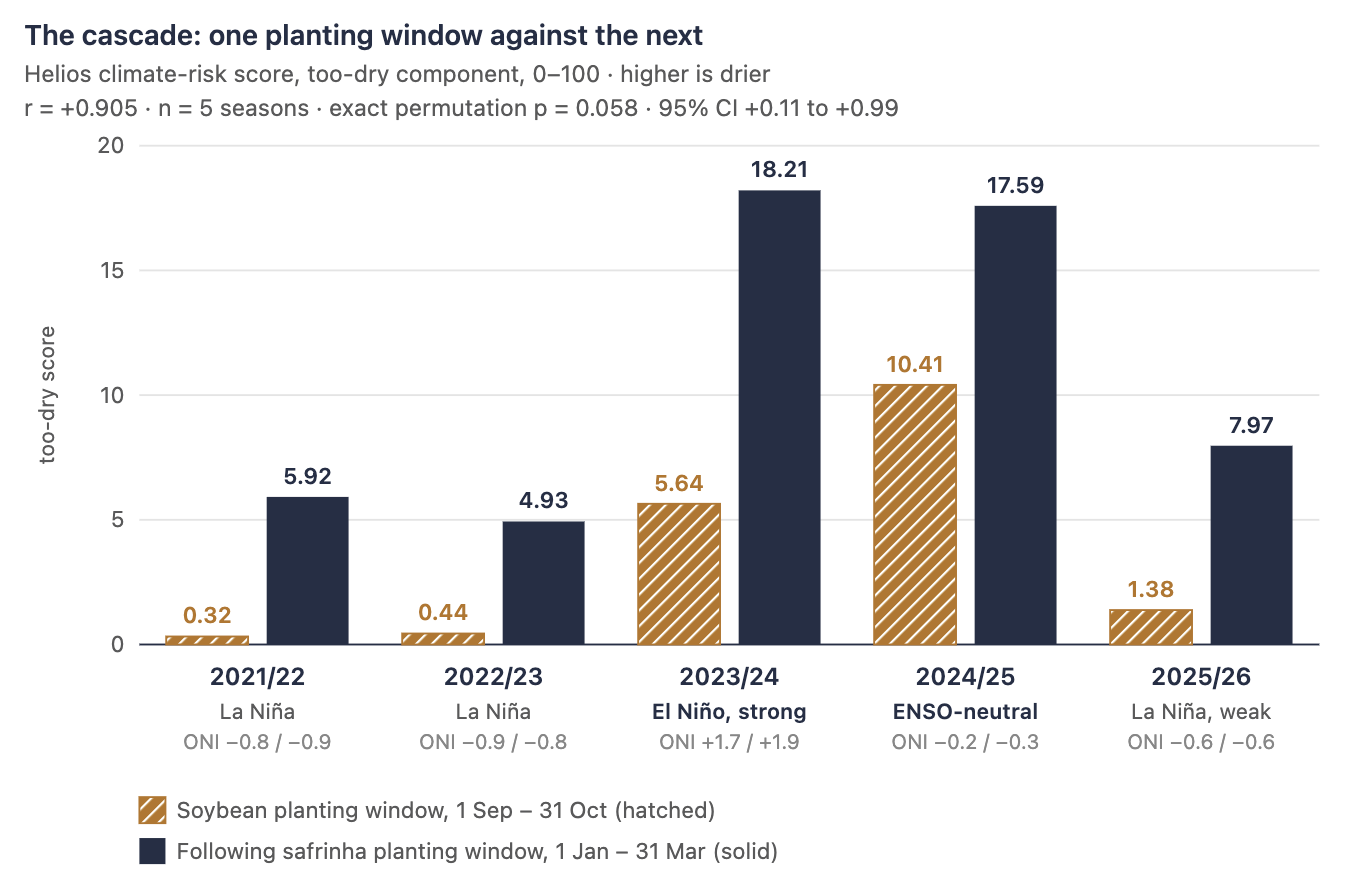
Chart 1 — the cascade: Mato Grosso soybean planting-window dry risk (1 September – 31 October) against the following safrinha planting-window dry risk (1 January – 31 March), five seasons. Units: Helios climate-risk score, too-dry component, 0–100. r = +0.905, n = 5 seasons, exact permutation p = 0.058 over all 120 orderings, 95% confidence interval +0.11 to +0.99 — five seasons of Helios region data is directional, not a law. The strong El Niño season (2023/24) and the ENSO-neutral season (2024/25) are both labelled, because the driest planting window in the sample is the neutral one: this is a planting-calendar axis, not an El Niño axis.
Source: Helios AI Mato Grosso region series, observed days, pulled 17 August 2026; Oceanic Niño Index (ONI), NOAA Climate Prediction Center.
What this chart does not claim: a determined loss, a yield penalty or a production forecast. Both bars are climate-risk window readings, correlation between them is not attribution, and the same test finds nothing past establishment (r = −0.232, p = 0.71) on a score that is phase-weighted down once the crop reaches harvest.
The Signal Is About Timing, Not Total.
The driest planting window in the sample was not the El Niño year. It was 2024/25 — ENSO-neutral, NOAA's Climate Prediction Center index at −0.2 to −0.3 — and it got there in a way a seasonal rainfall outlook would have missed. Mato Grosso recorded 2% of normal September rain, then 113% in October: a two-month total at 92% of normal, carrying the highest planting-window risk score in the five seasons. 2023 failed differently: 53% in September, 25% in October.
So the score tracks when the rain arrives, not how much falls. Talis Melo of Fiagril put it in a line on 17 August: "The main problem El Niño causes for the Cerrado is not necessarily that it rains less during the year, but that it rains at the wrong time." Which is why El Niño is one way to trigger this chain rather than a requirement for it.
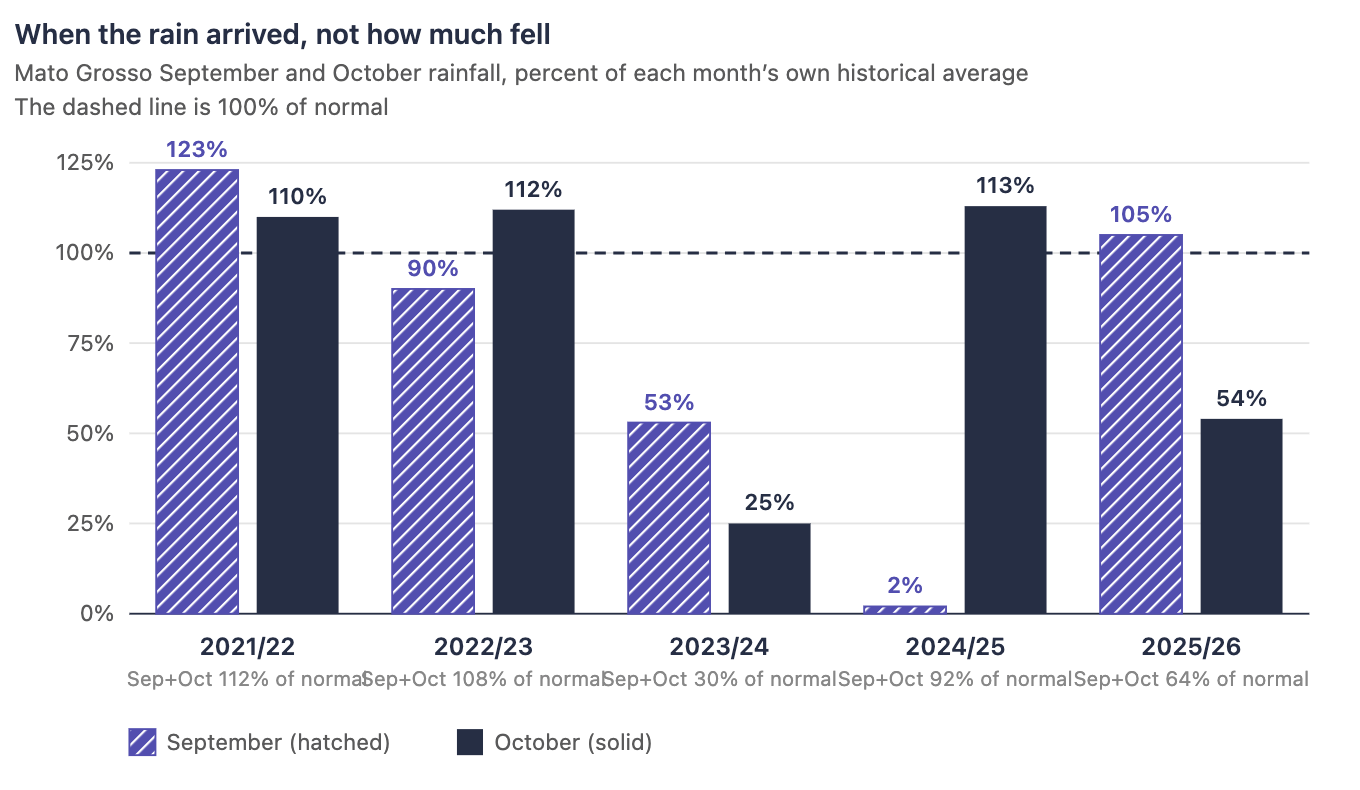
Chart 2 — the physical event at the top of the chain: Mato Grosso September and October rainfall as a percentage of its own historical average, five seasons. Units: percent of normal. The two seasons that fired the cascade failed in different ways. 2023 was a genuinely delayed onset in both months — 53% then 25%, a two-month total at 30% of normal. 2024 was a near-zero September that then caught up — 2% then 113%, a two-month total at 92% of normal — and it still carries the highest planting-window dry-risk score of the five seasons. The score tracks when the rain arrives, not how much falls across two months.
Source: Helios AI region-weighted precipitation series, observed days, pulled 17 August 2026. Cross-validated across five Mato Grosso crop weightings.
What this chart does not claim: an El Niño rainfall signal. 2024 was ENSO-neutral, and the published climatology does not support a reliable El Niño onset delay in Mato Grosso.
And Here Is Where the Signal Is Not.
The same test finds nothing past establishment, and our own instrument is part of why. From the soybean planting window to the following window, 1 April to 15 June, r = −0.232, p = 0.71. Helios models that stretch as vegetative growth then harvest, and the score is phase-weighted: dryness stops counting as risk once the crop reaches harvest. So the null bounds our measure — the signal does not reach past establishment — rather than showing that late-season drought does not matter.
The Season the Chain Ran, and the Crop Was Excellent.
In the strongest El Niño season in the sample the front of this chain ran exactly as described, and Mato Grosso was fine. The 2023 delay was real — Mato Grosso's crop institute IMEA had the state's soybeans 70.5% planted on 31 October 2023 against a 71.6% five-year average — and our dry-risk reading for the January–March 2024 safrinha window came in at 18.21, its high in the five-season sample.
Then the safrinha went in anyway: 42.1% planted on 14 February 2024 against a 40.6% five-year average, more than 90% of the state's area sown inside the ideal window on IMEA's count, and 47.98 million tonnes at the second-highest productivity in IMEA's series. CONAB's twelfth and final survey, 12 September 2024, placed that season's safrinha damage in Mato Grosso do Sul, São Paulo and Paraná instead. Brazil's corn crop did fall 12.3% nationally. And CBOT corn fell 17.6%: September 2023 corn settled at 464.75 US cents a bushel on the session of 1 September 2023, and the front-month September 2024 contract at 382.75 on 31 July 2024, on USDA AMS's published CBOT settlements. A record US crop and comfortable world balances dominated completely.
Read that as the point rather than the exception. Growers adapt, one origin is not the world balance sheet, and a climate-stress rating is an early-warning instrument, not a production forecast. The cascade describes risk to a window, not a determined loss.
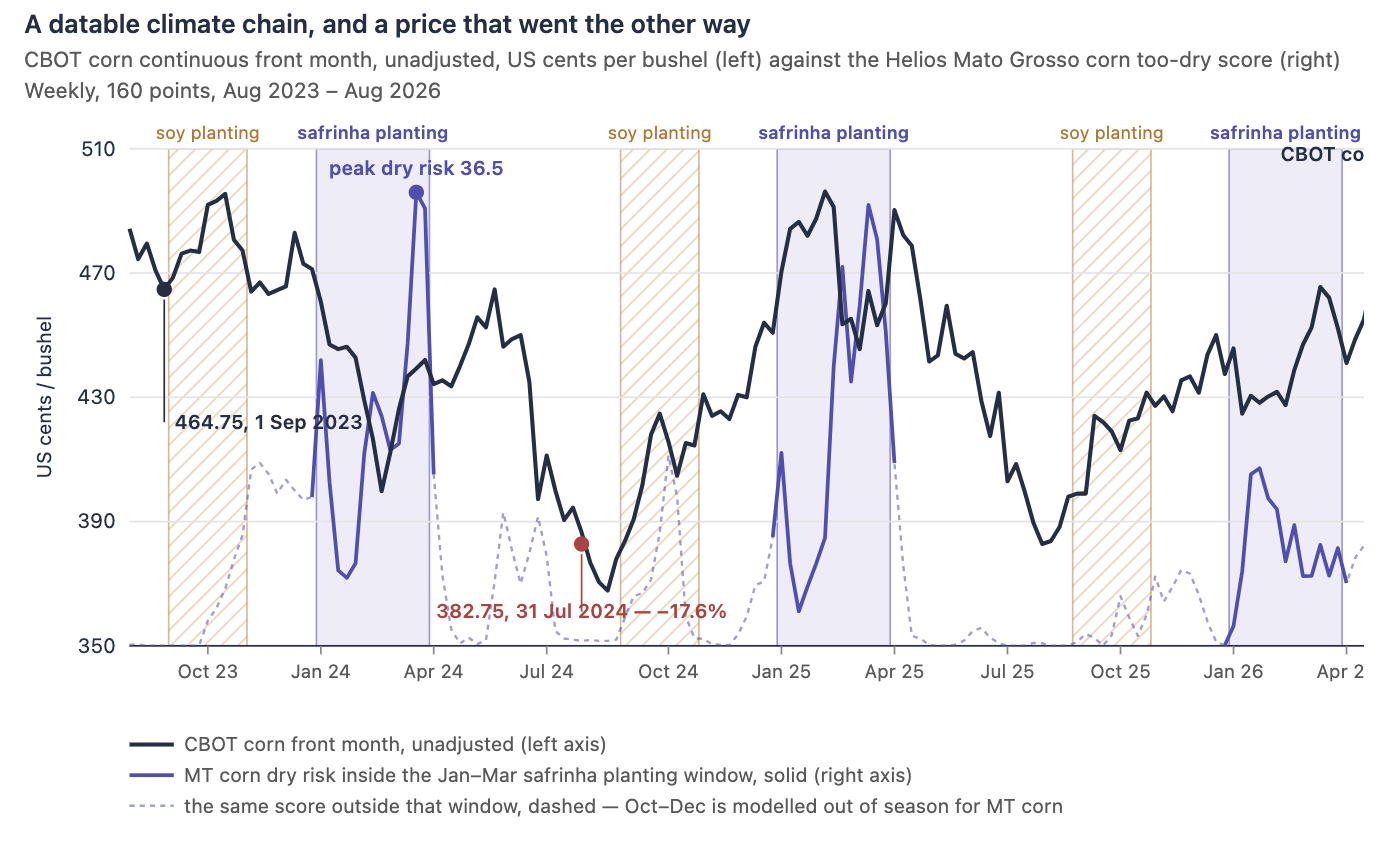
Chart 3 — a datable climate chain, and a price that went the other way: CBOT corn front month against Mato Grosso corn dry risk, with the Helios-modelled soybean planting windows (1 September – 31 October) and safrinha planting windows (1 January – 31 March) flagged as bands. Units: US cents per bushel (left axis), Helios climate-risk too-dry score (right axis). All twelve of the highest dry-risk weeks in the three-year window fall inside a safrinha planting window, and eleven of the twelve fall in February or March. The climate chain ran as modelled and the price fell: front-month corn closed 464.75 US cents a bushel on the session of 1 September 2023, as the delayed Mato Grosso soybean planting window opened, and 382.75 on 31 July 2024 — down 17.6% — because a record US crop and comfortable world balances dominated the price. Helios models Mato Grosso corn as out of season in October, November and December, so the risk line is drawn solid only inside the January–March planting window, where the crop is in the ground, and dashed elsewhere; those October–December values are not safrinha readings.
Source: Price — CBOT corn front-month settlements, unadjusted, US cents per bushel, exchange CBOT; 160 weekly points, series retrieved 17 August 2026. The two annotated sessions are verified against USDA AMS Livestock, Poultry & Grain Market News, Minneapolis Daily Grain Report (report 3046), “Futures Settlements — Closing Settlement Prices (¢/bu)”, as of 1 September 2023 and 31 July 2024; the 2025–2026 portion is cross-validated against Helios’s Barchart contract feed. Risk — Helios AI Mato Grosso corn too-dry component, weekly mean of observed days.
What this chart does not claim: that the cascade lifted corn. It did not. The chart is CBOT-only and carries no Brazilian contract, and no Mato Grosso crop damage is implied — in that same 2023/24 season more than 90% of the state's safrinha went in inside the ideal window.
What a Buyer Can Actually Watch.
Four dates. 7 September, when Mato Grosso's sanitary break ends and planting becomes legal. Late September into October, when IMEA's weekly planting-pace reports show whether the rains have established: about half a percent planted by 19 September last year and 15% by 3 October, against a five-year average near 90.6% by 7 November — and the weight sits on October, not September. 15 October, CONAB's first 2026/27 survey. Then January into March, where our monthly readings run 2.2 times more dry risk in March, 14.51, than in January, 6.60.
The forward view is split, and we are not going to resolve it. NOAA CPC put a very strong El Niño above 90% for the coming northern autumn and winter in its 13 August discussion, its own strength table peaking October to December. But Brazil's federal climate centre CPTEC/INPE, in its note of 20 July, puts a low probability on a delayed rainy-season start in the centre-west, Aprosoja-MT's consultant Clyde Fraisse says the opposite, and IMEA held its Mato Grosso soybean projection on 4 August with El Niño inside its methodology. Our own forward read shows almost no dry risk for the coming window — close to uninformative at this range: the trigger has not fired.
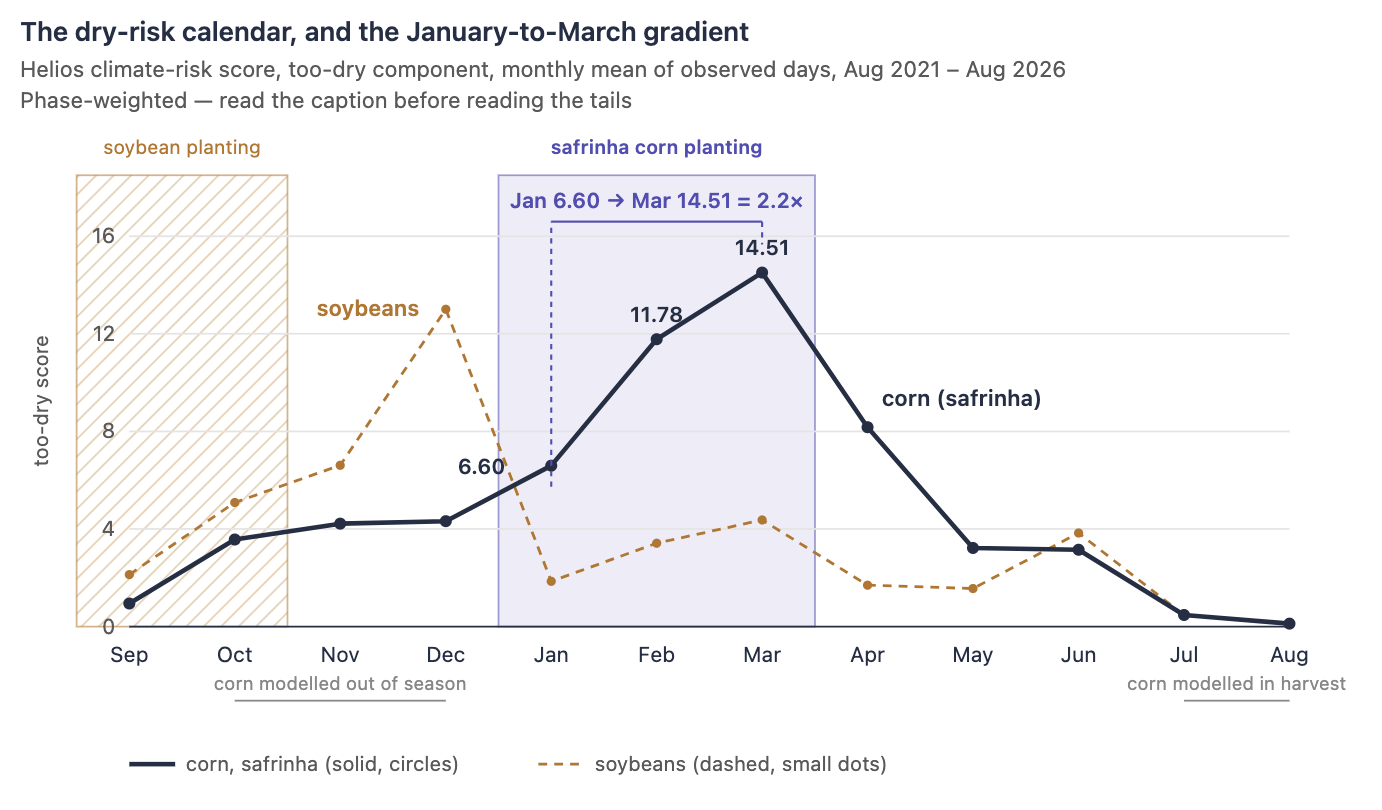
Chart 4 — the dry-risk calendar: the Mato Grosso monthly dry-risk means by month in season order, corn and soybeans, with the two Helios-modelled planting windows shaded. Units: Helios climate-risk score, too-dry component, monthly mean of observed days, Aug 2021 – Aug 2026. Inside the safrinha planting window the corn score runs from 6.60 in January to 14.51 in March — 2.2 times higher, which is what makes going in late expensive. The score is phase-weighted: July and August read near zero because Helios models the crop as in harvest, not because Mato Grosso is wet — dryness stops scoring as risk once the crop reaches harvest, so the near-zero tail is a property of the metric, not of the weather. Corn's October, November and December values fall in months Helios models as out of season for Mato Grosso corn and are not safrinha readings. The chart's claim lives in the January–March planting window, where the crop is in the ground.
Source: Helios AI Mato Grosso region series, observed days, Aug 2021 – Aug 2026, pulled 17 August 2026.
What this chart does not claim: that Helios's modelled planting window is the agronomically ideal one. It is the calendar period in which planting happens. USDA FAS puts the best Centre-West slot at mid-January to mid-February, and Brazil's official zoning closes its ideal window at the end of February.
The Bottom Line.
The chain is long, and the length is the point. It is the rare climate risk a buyer can see coming two crops ahead — and the only honest thing to do with two crops of warning is to name the dates and let them grade you. July 2027 CBOT corn settled at 515.00 US cents a bushel on the session of 17 August 2026, provider Barchart, exchange CBOT — ordinary old-crop carry, not a market pricing this cascade. As we set out last week, our South American series flip in-season from 1 September. Next week, rice.
The rain has not been late yet. That is a fact with an expiry date.
We built this piece out of the South America block during our webinar on August 18th, and the replay carries what the post could not. The US state-level scorecard that precedes the cascade, the Brazilian crush and Argentine concentration ledgers, the full slide walking the planting-calendar transmission, and the live Q&A.
WATCH REPLAYFrequently Asked Questions
What is the safrinha, and why does it matter more than Brazil's first corn crop?
The safrinha is Brazil's second corn crop, drilled into the same fields immediately after the soybeans come off — January through March — and harvested from about June. It has overtaken the first crop completely. CONAB's eleventh survey of 13 August 2026 puts it at 111.03 million tonnes of Brazil's 142.96 million tonne corn crop for 2025/26, a little under 78%, and USDA's Foreign Agricultural Service uses 77% for the same season. Mato Grosso alone is about half of it. And Brazilian corn is close to a fifth of the world's traded corn — 44.00 million tonnes of a projected 210.48 million in 2026/27, on USDA's 12 August World Agricultural Supply and Demand Estimates. When people say "Brazilian corn" in an export context, they almost always mean the safrinha, and when they say the safrinha, they largely mean Mato Grosso.
How can a September planting delay still be affecting corn in July?
Because the two crops share one field and one wet season. Soybean planting in Mato Grosso cannot legally begin before 7 September, and in practice waits on the rains establishing. If they establish late, the soybean harvest runs late, and the corn that follows goes into the ground late — into the tail of the wet season rather than its middle. Embrapa's own framing is that safrinha planning "begins with the summer crop, aiming to free the area as early as possible." The corn planted late is harvested late, and it reaches the export market in the second half of the following year. That is the whole lag: roughly ten months from the rain to the cargo, with the tonnage actually moving August through October rather than in July.
What does El Niño historically do to Mato Grosso rainfall?
Less than the trade commentary implies. Brazil's national institutes are blunt about the centre-west: it "does not present a high correlation with El Niño or La Niña episodes" (INPE, INMET, Funceme and CENSIPAM, joint technical note, June 2026). The most careful published study of the region — Heinemann and colleagues, International Journal of Climatology, 2021, fifty stations over thirty-four years — actually finds El Niño associated with slightly earlier rainfall onsets in Mato Grosso; the statistically significant onset delay belongs to La Niña. What the same study does find is the thing that matters here: in Mato Grosso, El Niño years carry a later optimal sowing date and a narrower sowing window, and ENSO shows up in the yield of the second crop rather than the first. So the mechanism is not that El Niño makes Mato Grosso drier. It is that El Niño moves and compresses the window, and the crop that pays for a compressed window is the safrinha.
How strong is the evidence for this cascade, and what are its limits?
Directional, not a law — and the sample size belongs in the same breath as the number. Across five seasons of our Mato Grosso region data, dryness in the soybean planting window and dryness in the following safrinha planting window correlate at r = +0.90. At five observations an exact permutation test puts that at p = 0.058, which does not clear a conventional significance bar, and the confidence interval on the correlation runs from +0.11 to +0.99. What survives every check is the direction: it holds when the El Niño season is removed, where the correlation rises to +0.991, it holds under every leave-one-out between +0.884 and +0.996, and it runs forward but not backward — the soybean planting window tracks the next safrinha window at +0.884 and the preceding one at only +0.363, with each series showing essentially no year-to-year persistence of its own. That asymmetry is the reason to prefer the causal reading over "Mato Grosso simply has dry years." It is a reason, not a proof: correlation between two climate windows is not attribution, and a shared seasonal signal could drive both independently.
Does the delay hurt yields after establishment?
No significant link — and why matters as much as the result. The same five seasons show nothing from the soybean planting window to the following window, 1 April to 15 June: r = −0.232, p = 0.71. Nor to the April vegetative phase, at r = +0.01. But Helios models that stretch as vegetative growth then harvest, and the score is phase-weighted, so dryness stops counting as risk once the crop reaches harvest. Read the null as the bound on our measure — the signal does not reach past establishment on this instrument — not as a finding that late-season drought is harmless.
It is worth being precise about 2015/16, the season usually reached for as the El Niño safrinha catastrophe, because it ran in two stages rather than one. A record El Niño peaked at +2.59 on NOAA's Oceanic Niño Index in the northern winter of 2015-16 and pushed the soybean calendar back, so the safrinha went in late. Then a separate event finished it: on CONAB and INMET's own account, an intensified South Atlantic subtropical high ended central Brazil's rainy season roughly three to four weeks early in April 2016, catching the late-sown crop at flowering and grain fill. CONAB's June 2016 bulletin describes exactly that for Mato Grosso — corn planted late, into a period whose water demand went unmet. That does not contradict the null above: the January-to-March dryness our five seasons measure is not what killed the 2016 crop. A late crop meeting an early end to the rains is.
The revision shape is what a buyer should take from it. CONAB raised its second-crop estimate through April 2016, to 57.13 million tonnes in its seventh survey, then took 16.3 million tonnes out of it by the September survey — an in-season collapse that was invisible at planting. Three precisions on that season. The loss was all yield and not area: second-crop area rose 8 to 10%. Paraná did not fail — its safrinha production rose 2.2% year on year, and the failures were Goiás at −38.4%, Mato Grosso do Sul at −24.9% and Mato Grosso at −22.9%, on CONAB's current historical series. And neither CONAB nor USDA's Foreign Agricultural Service attributed the loss to El Niño; both named the early end of the rains, and the Oceanic Niño Index was back to +0.09 by May–July 2016, with the El Niño advisory formally closed on 9 June, mid-drought. Soybeans in that same series fell 1.4% on 3.5% more area while the safrinha lost 21 to 25% depending on the vintage — calendar exposure rather than a bad-weather year, and the same asymmetry Heinemann and colleagues found in the station data.
What should a corn buyer watch between September and January?
Four dates. 7 September, when Mato Grosso's sanitary break ends and planting becomes legal — the floor, not the start. Late September into October, when IMEA's weekly planting-pace reports show whether the rains have actually established; the benchmarks are roughly half a percent planted by 19 September, about 15% by 3 October and about 90% by early November, and it is October, not September, that carries most of the statistical weight. 15 October, CONAB's first 2026/27 survey. And January into March, the safrinha planting window itself, where our monthly readings show dry risk running 2.2 times higher in March than in January — which is what makes going in late expensive. Two cautions from the last strong El Niño. In 2023/24 the front of this chain ran exactly as described, and then Mato Grosso's growers got the safrinha in ahead of the five-year average, more than 90% of it inside the ideal window, for the second-best productivity in IMEA's series; the damage landed in Mato Grosso do Sul, São Paulo and Paraná instead, and CONAB raised its second-crop estimate as that season ran. And CBOT corn fell 17.6% into the following July anyway, because a record US crop mattered more. A climate-stress rating conditions the odds on one origin's supply. It does not price the world.
Methodology and sources. Helios figures are the too-dry component of the Helios climate-risk score, 0–100, for the Mato Grosso region series (corn and soybeans, Brazil), observed days only, Aug 2021 – 17 Aug 2026, pulled 17 August 2026. Rainfall is the Helios region-weighted precipitation series for the same region, monthly totals in inches against each month's own historical average, observed days, pulled 17 August 2026. Price series: CBOT corn front-month settlements, unadjusted, US cents per bushel, exchange CBOT, series retrieved 17 August 2026; the 1 September 2023, 31 July 2024 and 26 August 2024 settlements are verified against USDA AMS Livestock, Poultry & Grain Market News, Minneapolis Daily Grain Report (report 3046), “Futures Settlements”, and the 2025–2026 portion is cross-validated against Helios’s Barchart contract feed; the July 2027 contract level (ZCN27, 515.00) is the 17 August 2026 settlement, provider Barchart, exchange CBOT. External benchmarks: CONAB 11º Levantamento, Safra 2025/26 (13 August 2026) and 12º Levantamento, Safra 2023/24 (12 September 2024); USDA World Agricultural Supply and Demand Estimates WASDE-674 (12 August 2026); USDA Foreign Agricultural Service GAIN reports BR2026-0015 (6 April 2026) and BR2026-0031 (5 August 2026); IMEA weekly Informe de Semeadura and productivity series; Comex Stat / SECEX-MDIC export seasonality (NCM 1005.90.10); NOAA Climate Prediction Center ENSO Diagnostic Discussion (13 August 2026) and Oceanic Niño Index; Zoneamento Agrícola de Risco Climático (ZARC), PORTARIA SPA/MAPA nº 326, 28 July 2026; Embrapa Milho e Sorgo; INPE, INMET, Funceme and CENSIPAM joint technical note (June 2026); Heinemann et al., International Journal of Climatology 41(S1), 2021, DOI 10.1002/joc.6684.
Limitations that travel with this piece.
n = 5 seasons. The cascade correlation rests on five observations of one region's data. r = +0.90 with an exact permutation p of 0.058 over all 120 orderings — short of a conventional five-percent bar — and a 95% confidence interval on r of +0.11 to +0.99. Direction supported; magnitude barely constrained. Five seasons of Helios region data is directional, not a law.
The post-establishment link is not significant, and the phase weighting is part of the reason. From the soybean planting window to the following window (1 April – 15 June), r = −0.232, p = 0.71; to the April vegetative phase, r = +0.01. Helios models 1 April – 15 June as vegetative growth (April) then harvest (May onward), and the score is phase-weighted down once the crop reaches harvest — so across most of that window the instrument is damped toward zero. The null therefore bounds our measure: the signal does not reach past establishment on this instrument. It is not evidence that late-season drought in Mato Grosso does not matter, and this piece makes no claim either way about it.
The score is phase-weighted. Dryness scores as risk only in proportion to how much it matters to the crop at that moment. That is why Mato Grosso corn reads near zero in July and August — Helios models the crop as in harvest then, not because Mato Grosso is wet. The near-zero tail is a property of the metric, not of the weather.
Helios's phase windows are model assumptions, not agronomic fact. Mato Grosso safrinha corn is modelled as Planting 1 January – 31 March, Vegetative Growth April, Harvest May–August, Post-Harvest September, Out of Season October–December; Mato Grosso soybeans as Planting 1 September – 31 October, Vegetative November, Reproductive Development December. Corn values falling in October, November and December are out-of-season days and are not safrinha readings. The published agronomy puts the ideal second-crop slot earlier than the modelled window: USDA FAS gives mid-January to mid-February for the Centre-West, and Brazil's official zoning closes its ideal window at the end of February.
Correlation is not attribution. A shared seasonal signal could drive both windows independently. The forward-versus-backward asymmetry and the agronomic planting chain are reasons to prefer the causal reading, not proof of it.
A Helios climate rating is not a harvest outcome. Ratings flag in-season, often regional stress episodes. The 18.21 reading for the January–March 2024 safrinha window is a window reading, benchmarked here against IMEA's planting pace and productivity series and CONAB's twelfth survey — and in that season Mato Grosso's crop was excellent.


.png)

Personalized commodity intelligence for the teams that feed the world.
