
The Triple Squeeze on the 2026/27 Crop: Fertilizers, Margins and El Niño
In March, our CEO framed the food system as three clocks — energy, fertilizer, and harvest running at different speeds. Two months later, the question is no…

May 20, 2026
10 min read

A continuation of “The Strait That Feeds the World”: the three clocks have begun to compound, and the compounding is forward-loaded.
By Joao Morciani, Lead Agricultural Analyst
In March, our CEO framed the food system as three clocks: energy, fertilizer, and harvest, running at different speeds. Two months later, the question is no longer how fast each clock is ticking. It is how they have begun to move together and where in the calendar they will next strike.
The framing has not changed. What has changed is the location of the risk. The fertilizer shock that opened with the Strait of Hormuz closure in late February was always going to land somewhere in the cropping calendar; the question was which crop, on which side of the world, and how prepared the producer was to absorb it. The answer is now visible. It is not where the headlines have been looking.
The Headline Price Has Cooled. The Forward Exposure Has Grown.
If you read only the front page of the fertilizer market this week, the story looks resolved. The benchmark urea barge price at New Orleans — the New Orleans, Louisiana (NOLA) free-on-board (FOB) print that the trade reads as a proxy for North American nitrogen — has retraced sharply from its April peak. The price has cooled because the largest buyers have already bought.

NOLA urea barge peaked near $734/st on April 8, then retraced to roughly $560/st by mid-May. The level still sits well above the three-year average.
The Northern Hemisphere did not foresee anything. It had already moved through its normal pre-plant window before the Hormuz event. Fall nitrogen prepay in the United States Corn Belt, and first-quarter European Union (EU) topdress deliveries had happened on schedule. The World Bank put it plainly in its April 2026 Commodity Markets Outlook: growers in the Northern Hemisphere had already secured much of their supply. The North Dakota State University (NDSU) Agricultural Trade Monitor, in its April 2026 update, put the same point quantitatively: most of the spring 2026 nitrogen book had been priced and contracted before the crisis. The three largest Western nitrogen producers — CF Industries, Nutrien and Yara — each confirmed on their Q1 2026 earnings calls that North American and European customers were fully covered for the spring planting season.
That is the half of the story the market is correctly relaxed about. The Corn Belt and the EU winter wheat belt will harvest broadly in line with the plan. The crop is in the ground, the nitrogen is in the soil, and most of the bill is paid.
Even the wheat side of the May 2026 World Agricultural Supply and Demand Estimates (WASDE) report — the smallest US wheat crop since 1972, with abandonment running well above last year — reads as just a weather event, not a system shock. The board traded limit-up on the day and moved on. Global corn ending stocks for the new crop year sit at their lowest level in more than a decade, but the May print absorbed none of the Southern Hemisphere demand response.
The World Bank takes the other side of that calm. Its fertilizer price index is forecast to rise sharply this year, with urea up by more, and a partial retracement is priced in only for 2027. Fertilizer affordability, the Bank concluded, will fall to its worst level since 2022, eroding farmers’ incomes and threatening future crop yields. That is not a statement about the spring crop. It is a statement about everything planted after it.
The Forward-Loaded Map
The exposure is not gone. It has moved south and forward.
Six planting decisions, in sequence, define the new risk surface. The first is already being sown. The last sits in the September Brazilian summer-soy window, and the fall prepay book that prices the 2027 North American corn crop. None of them had the luxury of fall 2025 prepay.
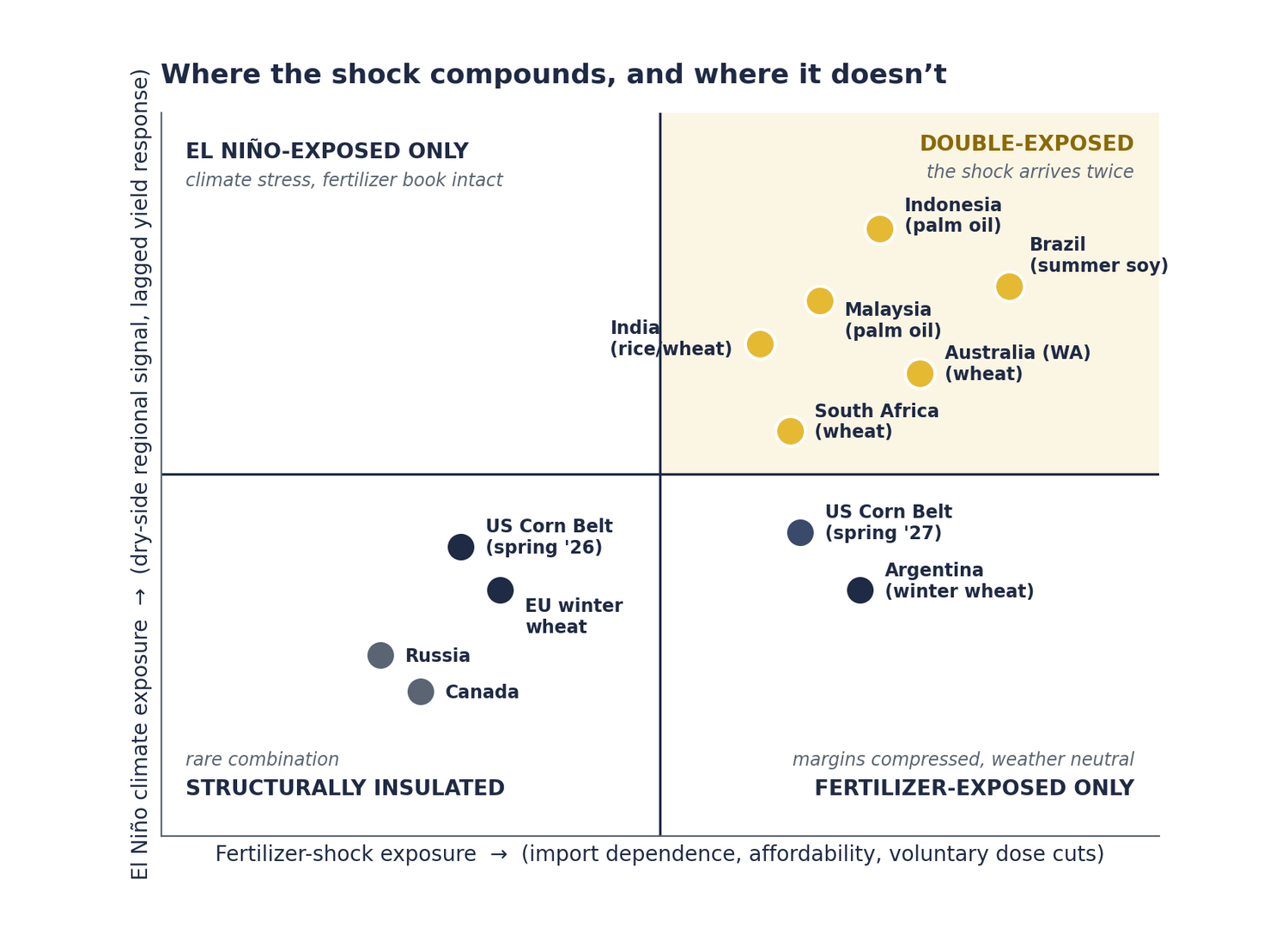
Where the shock compounds, and where it doesn’t. The upper-right quadrant — producers exposed both to the fertilizer shock and to the dry side of an El Niño — contains six of the world’s largest 2026/27 production cohorts.
Australian growers in the western grain belt have moved canola plantings to record territory at the expense of wheat. The Grain Industry Association of Western Australia (GIWA) projects the smallest wheat crop in three decades — the first print below four million hectares since 1995. The on-farm urea price has roughly doubled in three months, and the wheat-to-urea barter ratio has moved with it. The Albanese government announced a multi-billion-dollar package for fuel and fertilizer security in its May budget, and Export Finance Australia secured a handful of urea cargoes to underwrite supply. The intervention is real. It is not large enough to refill the program at last year’s application rates.
Argentina is sowing its winter wheat into the same cost structure. The Bolsa de Cereales de Buenos Aires (BCBA) presented its pre-campaign survey in mid-May at “A Todo Trigo” in Mar del Plata: more than half of producers plan to lower the crop’s technology level — fewer fertilizer passes, fewer crop-protection applications, and cheaper seed. The Bolsa de Comercio de Rosario (BCR) cut the projected area outright. Cristián Russo, who heads the BCR’s estimates desk, attributed the line that captures the season to a group of consulted agronomists: el trigo va por escalera y la urea por ascensor — wheat takes the stairs while urea takes the elevator.
South Africa is sowing its smallest wheat crop in more than a decade. The agriculture minister has been explicit that fertilizer and diesel together account for roughly two-thirds of the variable cost of that crop. The country is, on its own, a regional story. But it confirms that the pattern is not specific to the Pampas or the southern Australian grainbelt. It is wherever a margin-constrained producer meets a fertilizer-import-dependent supply chain.
Then comes Brazil, which is the cohort that matters most. The 2026/27 summer soy crop is the single largest fertilizer demand event in the world, and Brazilian growers import roughly 85% of what they apply (ANDA, Brazilian National Fertilizer Association, 2025 annual figures). The Mosaic Company — the Tampa, Florida-based phosphate and potash producer with significant Brazilian assets — has chosen to remove its own 2026 phosphate guidance, idle its largest Brazilian phosphate complex, halt regional mining, and curtail North American capacity rather than guess at the demand.
Palm oil belongs in the same quadrant. Indonesia and Malaysia together produce roughly four-fifths of the world’s palm oil, and the crop sits squarely on the dry side of an El Niño in the strength categories now dominating the National Oceanic and Atmospheric Administration (NOAA) forecast distribution. There is a track record. The strong El Niño of 1997/98 reduced Malaysian palm yields by roughly 20 percent the following year. The 2015/16 event — the most recent of comparable strength — cut combined Indonesian and Malaysian output by an order of magnitude not seen in a decade, with the trough printing eight to eighteen months after the sea-surface peak. Both episodes occurred against fertilizer affordability, which was healthier than today’s. Fertilizer is the single largest input cost line for palm growers, well over half of operating costs on the high-yielding estates and a larger share still for smallholders, who farm more than a third of the area in both countries. The Indonesian Palm Oil Association (GAPKI), the country’s principal palm grower and processor industry body, warned in early May 2026 that if El Niño emerges and fertilizer applications are delayed, output could be meaningfully cut, and that fertilizer prices have already risen sharply since the Middle East war began. The yield response is the catch: peer-reviewed work places the rainfall-driven fruit-set effect at five to six months and the full crude palm oil production effect at eight to twenty-two months after a strong El Niño peak. The dose decision is being made now. The yield miss will be printed in 2027.
And then there is the 2027 Northern Hemisphere spring decision, which is being made this fall, not next spring. The fall prepay window in North America is when 2027 acres are actually priced. NDSU has modeled it: the scenario in which transit through the Strait remains contested keeps urea well above pre-crisis levels straight through the prepay decision and into the new calendar year. The Corn Belt, whose May WASDE trend yield is 183 bushels per acre, relies on a procurement window that has not yet opened.
The Asymmetric Risk
On top of this margin-constrained, input-constrained map sits a climate signal that has hardened considerably since the March piece. The May 2026 El Niño-Southern Oscillation (ENSO) Diagnostic Discussion from NOAA’s Climate Prediction Center treats summer emergence and a winter peak as effectively resolved. The probability of intensity has not changed, and intensity is the price-relevant variable. India’s monsoon has already been pre-marked as below normal. Australia’s grain belt and Brazil’s Center-West sit on the dry side of the strength categories that now dominate the forecast. Argentina’s Pampas are the rare beneficiary; ironically, they are also the region where the BCBA’s farmers just told the exchange they intend to apply less.
The same compression is visible inside Brazil. The Mato Grosso Institute of Agricultural Economics (IMEA), which publishes the cleanest cost-and-margin series for the country’s largest grain state, has earnings before interest, taxes, depreciation, and amortization (EBITDA) per hectare down sharply on the new crop, on both soybeans and the safrinha second-crop corn. The April update has costs rising again into 2026/27 against soft prices. The combined picture is below.
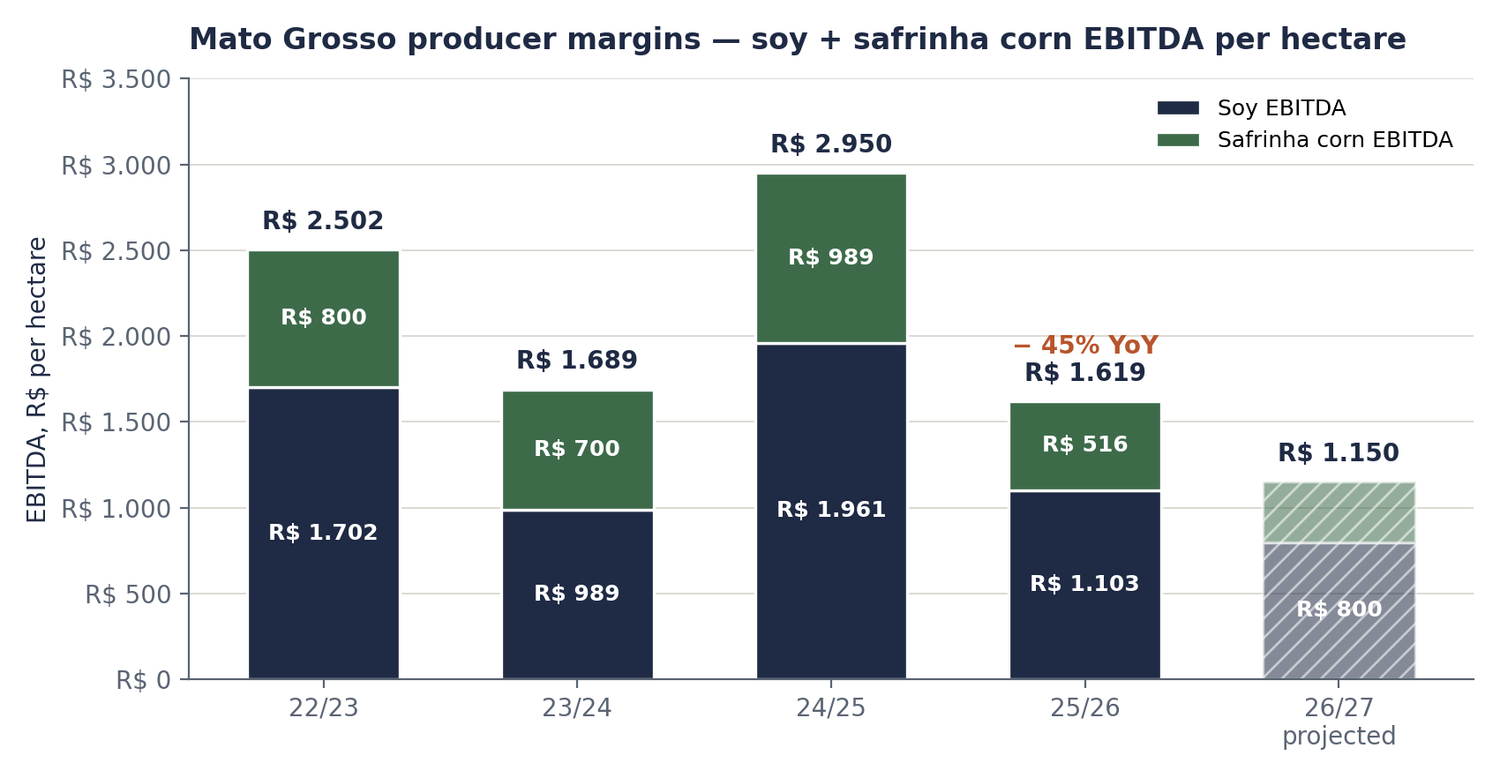
Combined soybean and safrinha corn EBITDA per hectare in Mato Grosso fell roughly 45% year-on-year on the new crop. The 2026/27 projection is provisional — IMEA’s full cost-of-production survey publishes in September — but the cost trajectory is already known.
This is what the consensus mark is mispricing. The May WASDE’s global corn yield assumption for the new crop includes no fertilizer haircut, and its acreage figures rely on a survey collected before Southern Hemisphere planting decisions had crystallized. Global corn ending stocks are already at their lowest level in more than a decade. A yield miss against trend — plausible under the International Grains Council’s own warning that 2026/27 fertilizer requirements may not be fully covered in parts of the Southern Hemisphere — pulls US corn stocks-to-use into territory the market has not fully priced yet?
The point is not that this is the central case. The point is that the distribution is asymmetric. Yields can disappoint more easily than they can surprise on a margin-constrained, input-constrained producer base, because the agronomic response that normally absorbs weather shocks — extra nitrogen, an extra pass, a fungicide application that pays for itself in two bushels — has been priced out of the producer’s budget.
The producer side of the market is already saying out loud what the forward forecasts have not yet absorbed. Mosaic’s chief executive, Bruce Bodine, told the company’s Q1 2026 earnings call on May 6 that the company had pulled its phosphate guidance because of a “lack of nitrogen, lack of phosphate, and the uncertainty of when those things resume to more normal levels.” He went further: “To put it simply, there is not going to be enough phosphate to meet global demand.” StoneX’s fertilizer desk has flagged North American fall phosphate application running well below normal. Rabobank’s senior farm-inputs analyst has named widespread destruction of fertilizer demand as the base case.
For Those Whose Job It Is to Carry the Risk
The question for the 2026/27 crop and the 2027 spring is not whether the fertilizer shock will be priced in. It will be. The question is at which point in the calendar and on which side of the trade you are sitting when it is.
Three moves matter this quarter. The first is to tighten 2026/27 yield assumptions on Southern Hemisphere fertilizer-dependent acres — Brazilian summer soy, Argentine and Australian winter wheat, South African winter wheat, and Indonesian and Malaysian palm oil — rather than re-marking US spring 2026, because that is where the actual production miss is most likely to sit. The second is to increase hedge ratios on physical positions where ENSO sensitivity overlaps low-margin producers because under a moderate-to-strong El Niño, the agronomic response that normally softens weather shocks has been priced out of those producers’ budgets. The third is to position for the North American fall 2026 prepay window as the next pinch point, not the next WASDE or the next monthly stocks print, because that is where the price discovery on 2027 spring acres actually happens.
There is no strategic urea reserve. There is no emergency protocol that substitutes for nitrogen in the soil at planting time. The clocks have begun to compound. The headline price has cooled because the largest buyers had already bought before the shock arrived, and the bill for everyone else is still pending.
Our El Niño Watch webinar on June 23 walks through the strength-category scenarios from the NOAA distribution, the Southern Hemisphere planting cohorts, and how to position the fall 2026 prepay window.
RSVP TO THE WEBINAR


.png)

Personalized commodity intelligence for the teams that feed the world.
