
Tis the Season for Commodity Signals: Cocoa, Coffee & Soy Flash Early Volatility Ahead of 2026
Cocoa, coffee, and soy appear everywhere during Christmas—truffles and gift boxes, festive lattes and café menus, and dairy alternatives. Yet beneath this…

December 15, 2025
5 min read

Why Three Non-Cereal Inputs Are Quietly Setting Up the First Volatility Cycle of 2026
As holiday displays fill with chocolates, specialty coffees, and seasonal baked goods, three core ingredients sit quietly behind the world’s December economy: cocoa, coffee, and soy. They appear everywhere during Christmas—truffles and gift boxes, festive lattes and café menus, plant-based roasts, confectionery fillings, winter frying oils, and dairy alternatives. Yet beneath this seasonal abundance, Helios Horizon signals indicate that these commodities are already shaping the first volatility cycle of 2026, driven largely by the early stages of a developing La Niña pattern.
While headline indicators such as the FAO Food Price Index have softened—settling near 126 points and suggesting stability—this broad calm has masked profound stress in several climate-sensitive markets. Unlike cereals, which currently benefit from robust inventories and more diversified growing regions, cocoa, coffee, and soy behave like early-warning systems. Their price signals respond faster to weather anomalies, and their supply chains are more vulnerable to disruption. December is the moment these cracks begin to form, even as holiday demand temporarily absorbs the pressure.
Cocoa — A December Dip That Masks a January Shock
Cocoa’s price path into 2026 is one of the clearest reminders that headline stability can hide real structural risk. Helios Horizon shows cocoa drifting lower through late 2025—sliding from the mid-$7/kg range in September toward roughly $6.20/kg in early December—creating the illusion that the market is finally normalizing after two years of crisis.
But that December softness is deceptive.
As soon as holiday inventories clear and West Africa enters its main procurement window, Horizon signals a sharp January repricing, with futures snapping back toward the $8.80–$9.00/kg range. This is a 40–45% jump in a matter of weeks—an early warning of how sensitive cocoa remains to even modest shifts in supply and demand.

Francisco Martin-Rayo captures the moment clearly:
“Cocoa is entering a rare moment of reversal after two years of scarcity-driven inflation. Our forecasts indicate a bumper West African crop, with early pod-count data suggesting yields up 8 to 12 percent in Côte d’Ivoire and Ghana. Prices in New York and London futures have already eased 3 to 4 percent, hinting at short-term relief for confectionery makers. But structural risks remain: heat stress, fertilizer costs, and demand volatility could turn that surplus into another shortfall within a single growing season.”
His perspective underscores that while near-term relief is materializing, cocoa’s risk curve remains steep — and procurement teams should not assume a straight path toward price normalization.
The drivers are structural: a fragile West African crop still recovering from the 2023–2025 El Niño cycle, limited access to fertilizers and fungicides, and a highly concentrated supply base where weather anomalies immediately ripple through global pricing. Even with improved harvest prospects in Côte d’Ivoire and Ecuador, cocoa remains one of the most climate-exposed commodities in the world.
The takeaway: December’s decline is noise; January’s spike is the signal. Cocoa’s volatility is not behind us—it’s simply expressing itself in shorter, sharper cycles that procurement teams must anticipate rather than react to.
Coffee — Volatile, Undersupplied, and Deeply Exposed to Climate Risk
Coffee markets are entering 2026 with a wide spread of price forecasts and significant uncertainty — a sign of deep structural vulnerability. Helios Horizon highlights projections ranging from $2.65/lb (Citigroup) to $3.58/lb (Trading Economics), showing how divided analysts are on direction. ING expects stability around $2.80/lb in Q1 2026, while the World Bank anticipates a modest decline in 2025 and stabilization the following year.
Behind these diverging forecasts sits a clear reality: climate conditions continue to suppress production. Severe drought in Brazil has already cut output estimates by 11 million bags, widening what may become the fifth consecutive year of global Arabica deficits. Vietnam’s robusta crop also remains sensitive to heat stress and irregular rainfall. With a global stocks-to-use ratio lingering near 21%, the lowest in a decade, coffee enters 2026 without a meaningful buffer. A single heatwave, frost event, or rainfall anomaly can move prices sharply.
Coffee’s sensitivity to even minor anomalies — a single frost event, an unexpected dry spell, a heatwave — means volatility risks remain elevated.
Francisco Martin-Rayo articulates this challenge clearly:
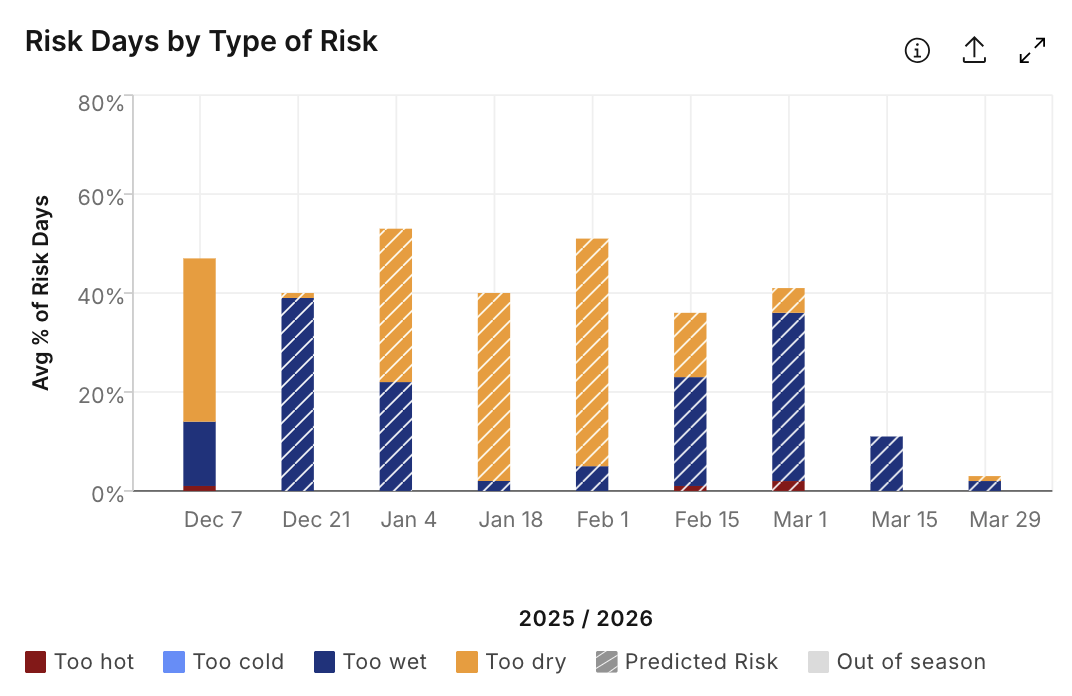
“Coffee is once again a leading indicator of sticky inflation. Our Helios AI models show rainfall in Brazil’s Minas Gerais region running roughly 25% below seasonal norms, compounding the effects of prolonged drought. Add to that the risk of new U.S. tariffs on Colombian imports — at a moment when Colombia supplies nearly 10% of America’s beans — and you get a perfect storm. Retail prices could climb another 12 to 18 percent this quarter alone. That kind of sustained pressure doesn’t just hit café menus — it feeds directly into CPI month after month.”
This blend of climate volatility, geopolitics, and supply shortages makes coffee one of the most inflation-linked commodities heading into 2026.
Soy — The Multi-Chain Amplifier With the Highest La Niña Exposure
Soy is entering the riskiest part of its cycle. South America, which supplies over 53% of global soybeans, is already experiencing early indicators of stress. In Brazil, dryness slowed planting in Mato Grosso, leaving progress 12–13 percentage points behind historical norms. Southern Brazil saw rainfall deficits of 20–25%, and Argentina has cut its planting area estimate by 400,000 hectares due to moisture shortages.
Because soy touches so many value chains — vegetable oils, animal feed, plant-based proteins, processed foods, and biodiesel — small production shifts create disproportionate market impacts. Even a 3–5% decline in Brazilian yields can trigger 10–15% global price reactions. This is already beginning to surface: the vegetable oil price sub-index rose 2.7% in October, despite the overall FAO index declining. With La Niña expected to persist into early 2026, soy remains one of the most climate-exposed commodities in the world.
December Is the Window for Action, Not Observation
Cocoa is trending downward but remains historically expensive. Coffee is volatile and structurally undersupplied. Soy is entering a critical climate-sensitive development window. Yet none of these risks are fully reflected in current pricing. December provides a narrow but strategically important moment when early climate signals are visible, but markets have not yet repriced the risk.
For procurement leaders, the priority is to turn this quiet period into a competitive advantage by evaluating exposure to West Africa, Brazil, Vietnam, Ecuador, and Argentina; reviewing coverage on cocoa, coffee, and soy derivatives; and monitoring La Niña’s progression closely. These commodities may not carry the largest volumes in a portfolio, but they consistently carry the highest volatility — and December often determines how the first half of the year unfolds.
For teams planning beyond today’s indices, book a demo to see how Helios Horizon delivers forward-looking commodity and climate intelligence.


.png)

Personalized commodity intelligence for the teams that feed the world.
