
What does the wheat market look like heading into Sourdough September?
Sourdough September gets home bakers back into their starters, but the wheat behind that flour has already been through most of a growing season by the time September rolls…

August 31, 2026
5 min read
Sourdough September gets home bakers back into their starters, but the wheat behind that flour has already been through most of a growing season by the time September rolls around. Helios Horizon tracks climate risk and export pricing across the wheat world. This look stays with four regions procurement teams are most likely to be sourcing from directly: the EU, Russia, the US and Canada, through Q4 2026 and Q1 2027. As of late August 2026, everything from here forward is Helios' forecast rather than observed data.
How did the 2026 wheat harvest actually turn out?
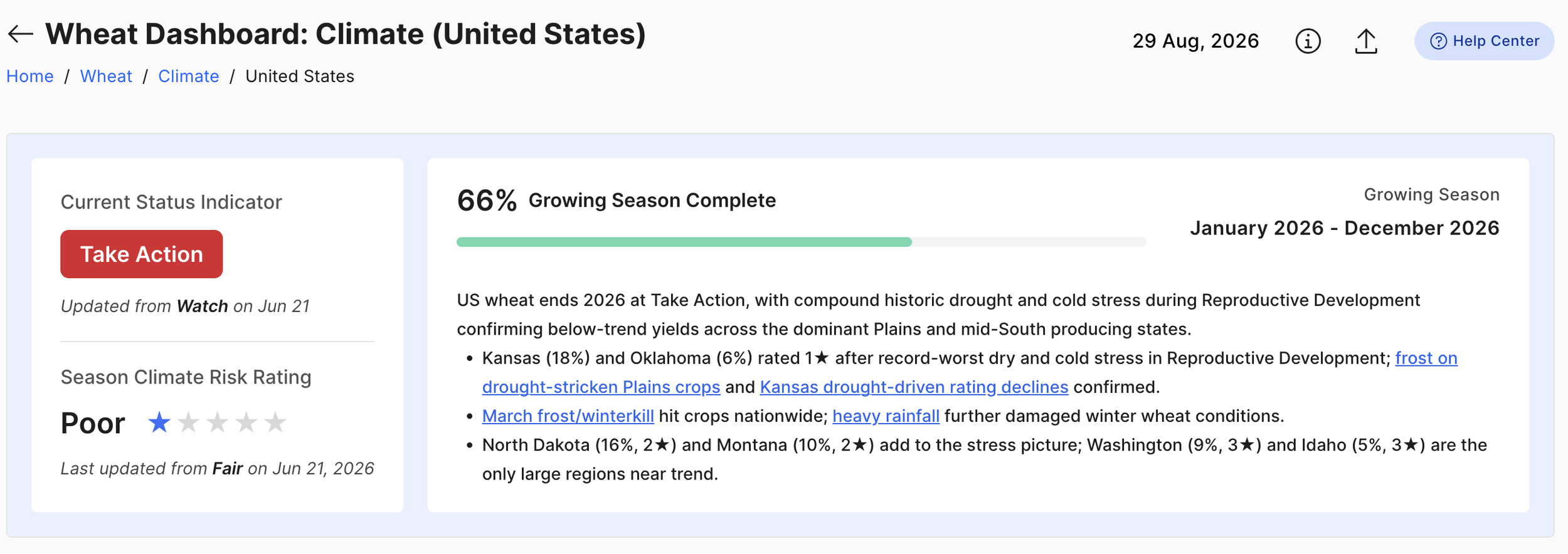
Unevenly. The US closed the season at Poor, one star, with the status raised to Take Action in June. Kansas and Oklahoma both landed at one star after the worst dry and cold stress on record during Reproductive Development, and a March frost and winterkill event hit crops nationwide, with heavy rainfall adding further damage. North Dakota and Montana came in at two stars. Only Washington and Idaho finished near trend, at three stars.
The EU closed at Fair, two stars, an improvement on the Poor rating it carried in May, though the status itself was raised to Take Action in July. France, the bloc's largest producer at 27% of EU output, closed at two stars after heat stress across every observed day of Grain Fill and Reproductive Development, with poor-quality wheat piling up and procurement agencies fielding requests for waivers on quality norms. Germany and Poland both carry Take Action flags despite three-star climate ratings of their own. Romania and Bulgaria are favorable but too small to move the aggregate.


Canada split down the middle: Saskatchewan, its top producer at 46% of national output, finished near trend at three stars, while Alberta closed at two stars, below trend. Russia's Krasnodar Krai, its largest producing region, came through with a clean harvest and a three-star rating.
Which regions carry the most risk heading into Q4 2026 and Q1 2027?
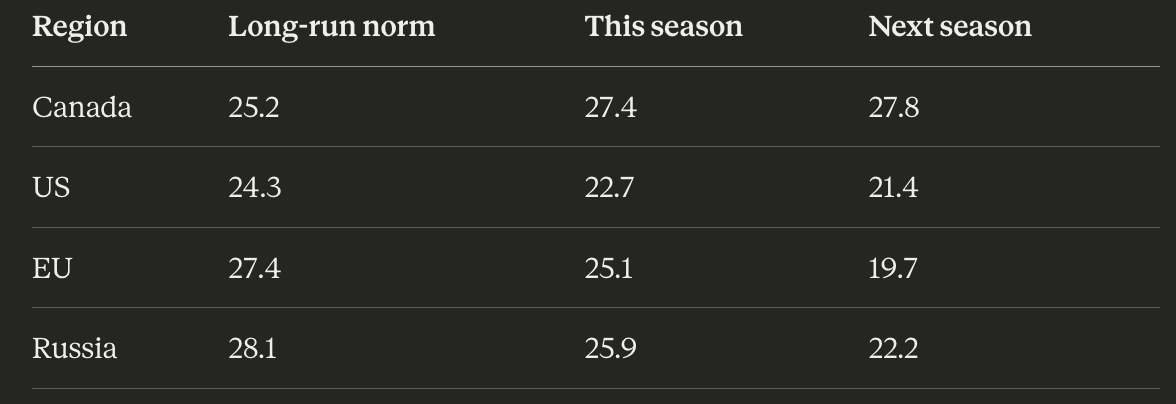
All four sit in the "just as risky as normal" band on WAPR, the share of the growing season spent in weather that damages the crop, but they're moving in different directions.
Canada is the outlier, already running above its own norm and climbing further next season. The US, EU and Russia are all easing, with the EU showing the sharpest drop heading into next season. Between the two European origins, Russia carries the higher absolute risk in both the current and coming season.
Why is Kansas the region to watch this winter?

Kansas grows 18% of US wheat and carries two separate flags. The first hits during the November planting window: WAPR peaks at 42.8 against a norm of 25.4, driven by heat and wet conditions arriving together. The second, larger flag lands in March, on the 2027 crop's vegetative growth phase. WAPR jumps from 8.0 to 53.9 in the first ten days of the month, then holds High severity every day from the 9th through the 31st, against a norm near 21, roughly two and a half times normal for three straight weeks.
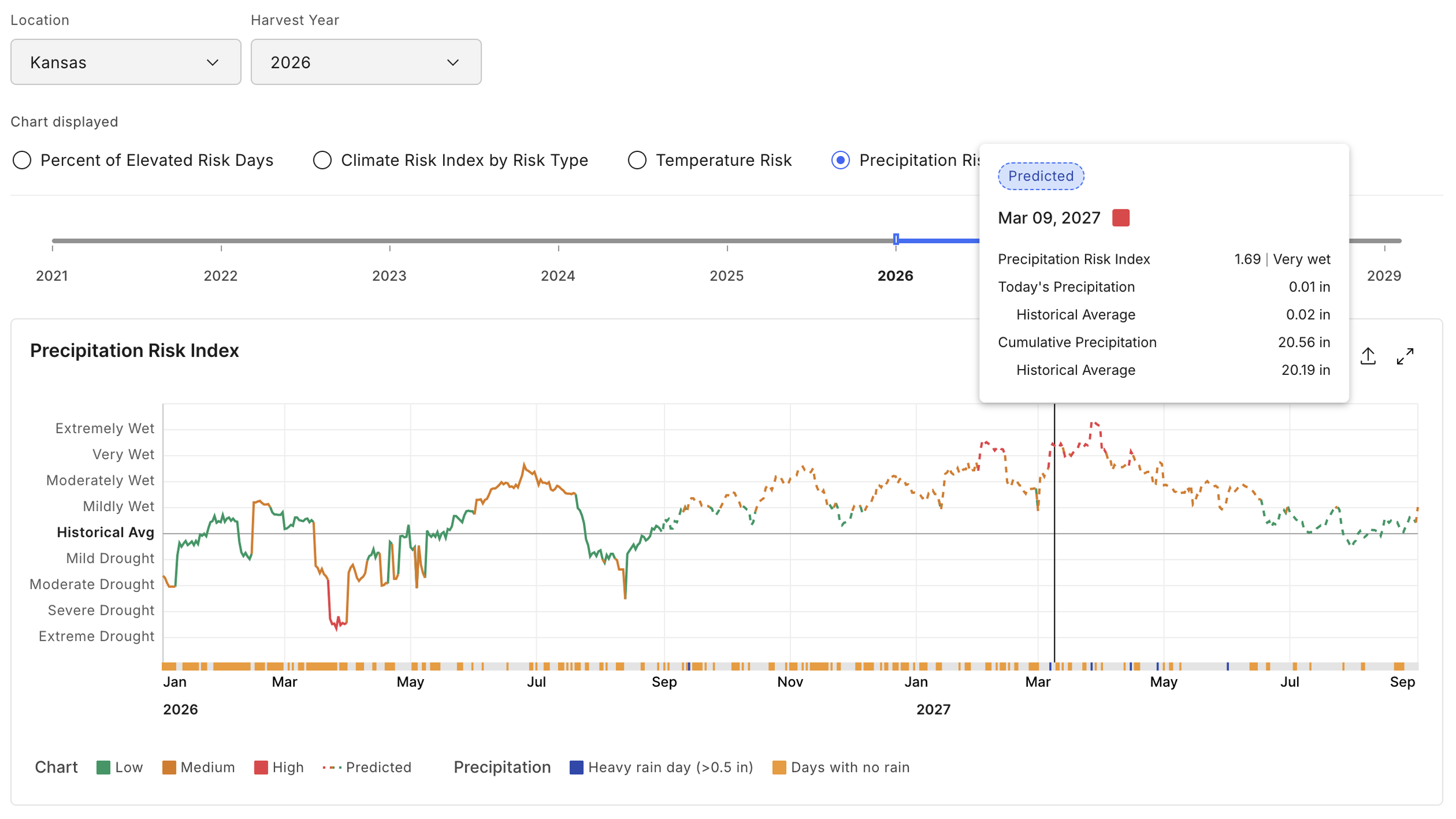
The temperature and rainfall behind that spike are both extreme. Minimums stay below freezing every day from the 4th to the 10th, bottoming at 26.7°F on the 6th, while daytime highs on the 8th reach only 43.8°F against a 57.8°F norm, a cold mass sitting over the crop for the better part of a week rather than a single overnight frost. Rainfall on 7 March hits 0.66 inches against a 0.01-inch norm, well over the half-inch threshold, and season-to-date precipitation reaches 3.56 inches against a 1.43-inch norm, about two and a half times normal. That combination is the reverse of the drought that defined Kansas's 2026 season, and it follows a year that already closed at one star.
Could Russia see a repeat of last year's winterkill?
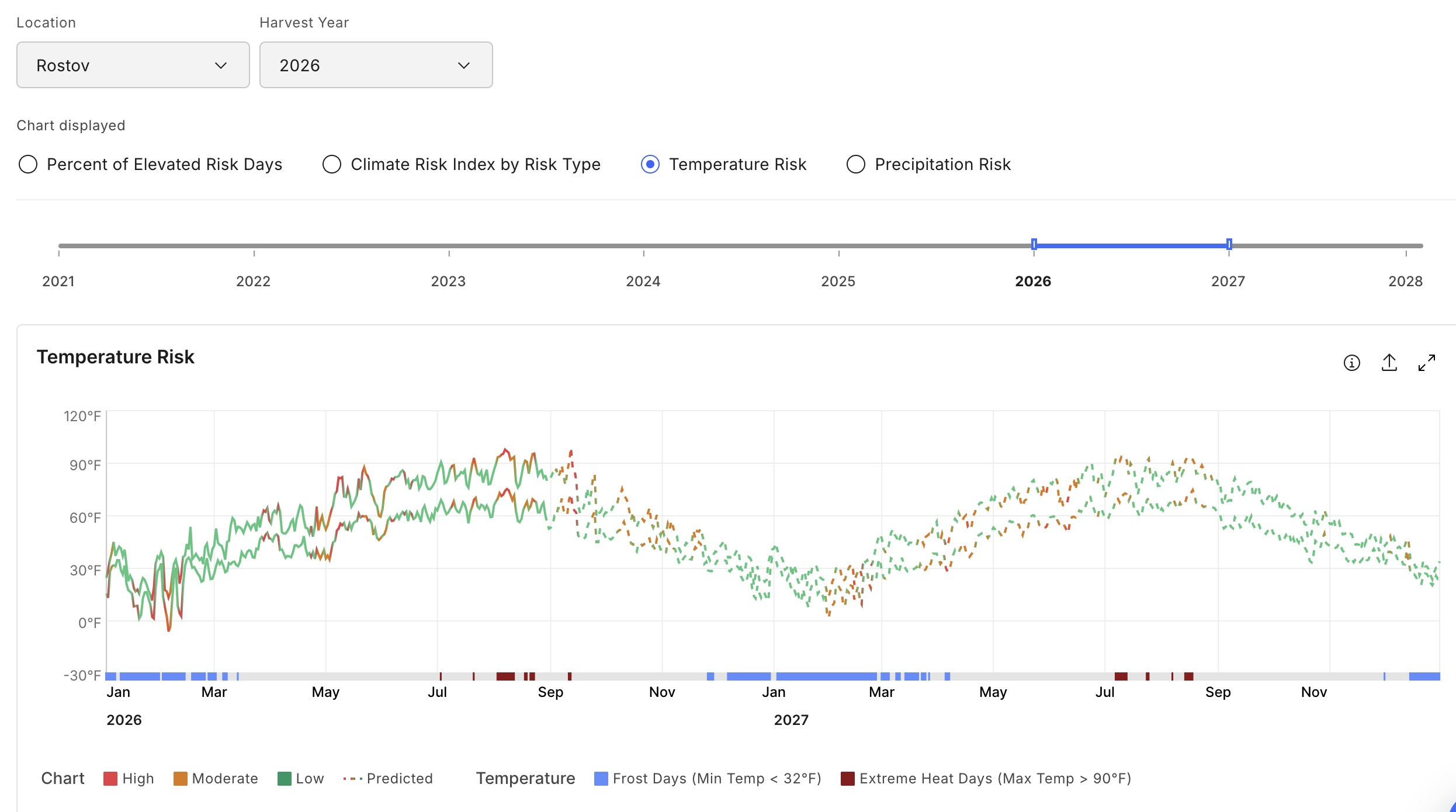
Possibly. Krasnodar Krai, Russia's largest wheat region, shows a clear cold event in mid-January: minimums fall to 13.1°F on the 16th against a 24.1°F norm, with three consecutive days rated High for temperature risk and daytime highs stuck near 24 to 26°F against a 37°F norm. That's the same signature as the January-February 2026 winterkill that damaged Black Sea stands and pushed wheat prices to multi-year highs. Krasnodar came through that season with a clean harvest and a three-star rating, which is exactly why a repeat in January 2027 stands out: it would be hitting the region that held up best last time.

Are the biggest producers in Canada and the EU holding steadier?
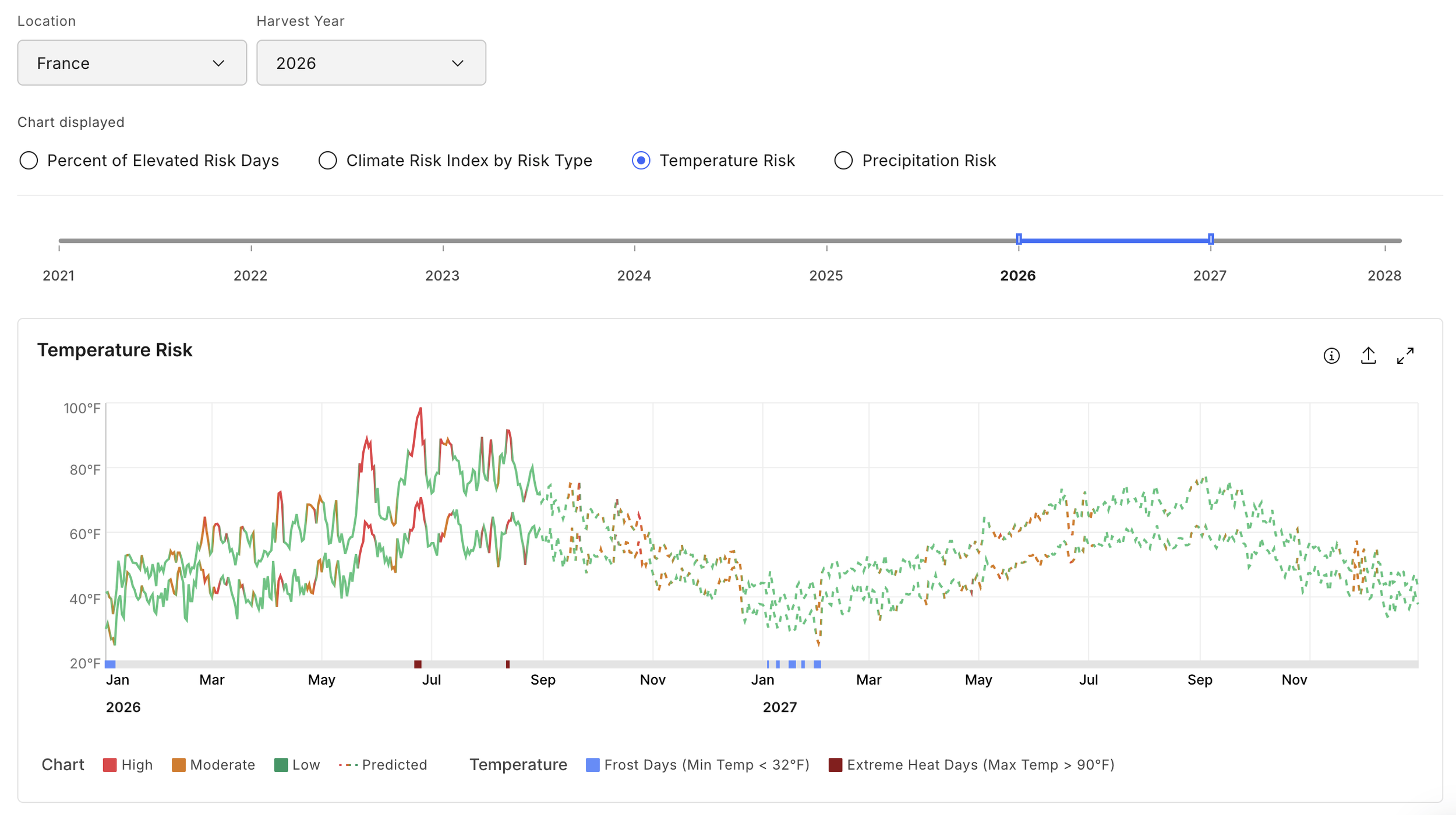
Yes, at least through the fourth quarter. Saskatchewan and Alberta, Canada's two largest wheat regions, run at or below their long-run norms from October through December, with only a moderate cold bump in late January, peaking near 14.9 to 15 on WAPR against a norm around 10, that clears by mid-February. France and Germany, the EU's two largest producers, are calmer still. Both sit at or below their December norms across every risk type Helios tracks: heat, drought, cold and excess rainfall.
Is any of this priced into the wheat market yet?
Not much, and what's priced is quiet. Helios' all-origins wheat average was $271.95 a tonne on 24 August, down from $286.96 a month earlier. Russian export wheat sits at $229.75/t, a seasonal low, with a forecast of $228.20 in a month, dipping to $226.19 by late November, then recovering to $232.61 by February, a trough ahead of the usual December pickup as export stocks move into winter storage. French wheat, the firmest of the origins Helios prices in detail, sits at $268.45/t with a forecast flat at $248 to $250 across one, three and six months, a departure from the usual autumn firming as grain moves into storage. German wheat is at $256.04/t, forecast at $239 to $242 through the same window.
The bigger story is the gap between origins rather than any move over time. French wheat is trading roughly $40 a tonne over Russian, and neither forecast path shows much movement, at least not the kind the climate data above would suggest is building. Helios also prices US and Canadian origins, though specific forecast figures for those two aren't part of this look.
How much should procurement teams trust these forecasts?
It depends on the grade. Helios' one-month wheat forecast has been right 86.4% of the time historically across all origins and varieties. It does better on some of the grades this piece touches: 95.8% on Australian Standard White 1, 92.2% on milling wheat, 87.0% on hard red winter. It's weaker on two grades relevant here, 66.4% on Wheat 12.5% Protein and 70.0% on Hard Red Spring 11%. Russia's Black Sea business trades heavily in 12.5% protein wheat, so the Russian price path above is worth reading as directional rather than precise, with more weight on the current print than the forecast when pricing that grade specifically.
Sourdough starters don't check WAPR scores before they rise. But the flour behind them does, and this winter's two clearest signals, a cold and saturated March in Kansas and a cold snap due back in Krasnodar, are both still ahead of us.


.png)

Personalized commodity intelligence for the teams that feed the world.
