
What we heard at the American Food Manufacturing Summit about AI, scale and supply chain risk
Takeaways from AFMS 2026, with Schreiber Foods and Ingredion, on scaling AI in food manufacturing and building supply chains that see risk coming.

November 10, 2026
3 min read
What was on food manufacturers' minds at AFMS 2026?
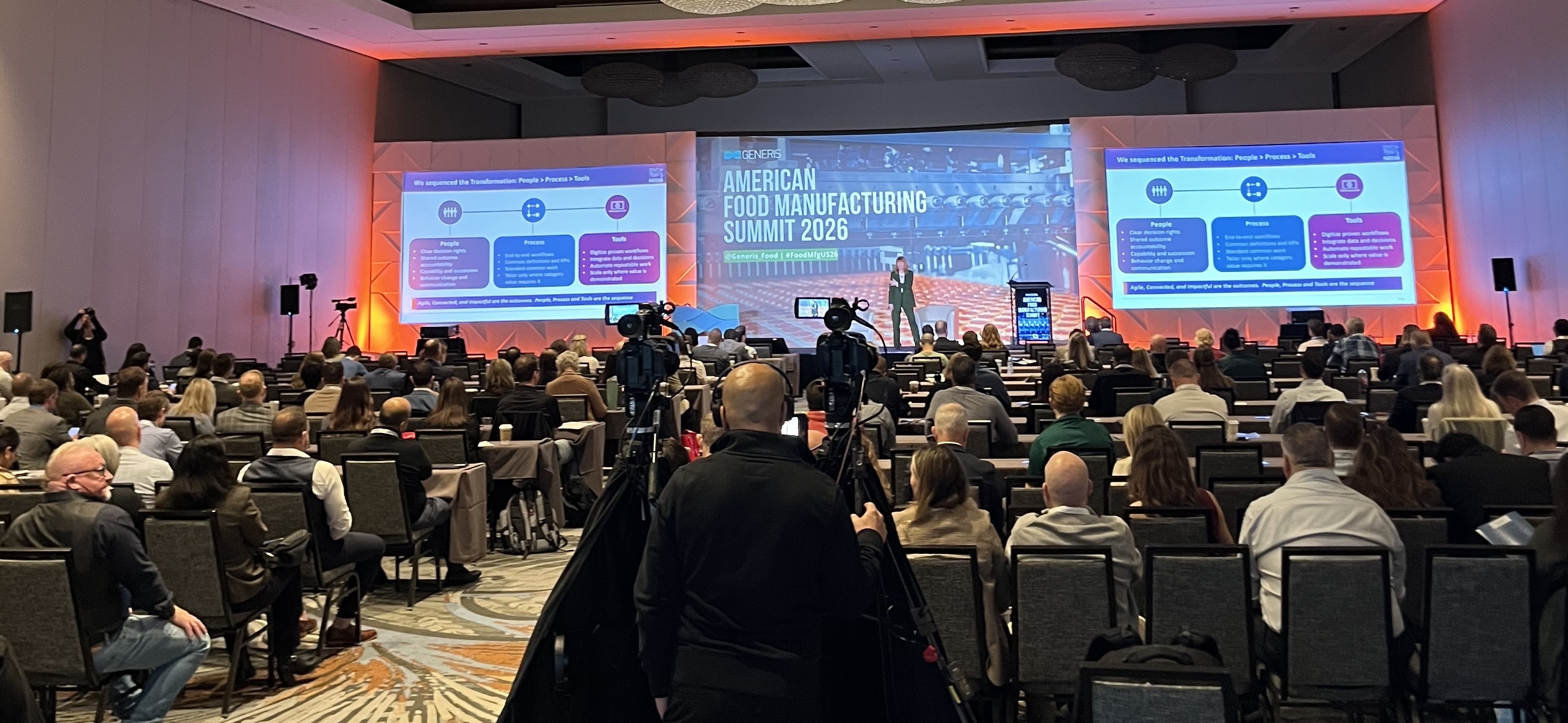
Our team spent two days on the floor at the American Food Manufacturing Summit (AFMS) in Schaumburg, just outside Chicago, meeting operations, quality, supply chain and technology leaders from across food and beverage. The agenda ran across five streams, from process optimization and food safety to digital transformation, supply chain and talent. Yet most of the conversations came back to one theme: how to use AI and technology to get ahead of supply chain volatility.
None of the ideas were new on their own. What has changed is that the question is no longer whether to use AI, but how to put it to work across the whole operation, from the plant floor to demand planning and execution, and how to stop reacting to disruption and start seeing it coming. Sessions from Schreiber Foods and Ingredion captured both especially well, and together they point to a gap the industry is only starting to close.
How are manufacturers using AI from the plant floor to planning?
AI was everywhere on the program, from agentic supply chain workflows to computer vision on the plant floor. What set the most useful sessions apart was less the technology than the plumbing underneath it. Speakers kept returning to clean data foundations, systems that talk to each other, and tools frontline teams actually want to use.
Schreiber Foods made that case most concretely. Sriraj Kantamneni, the company's EVP and chief innovation and digital officer, described how a 75-year-old, employee-owned dairy manufacturer tries to move like a startup where speed creates an edge, while leaning on its scale everywhere else. Its homegrown warehouse, production and quality platform, the Hive, now runs across Schreiber's own sites and is sold to other mid-sized food manufacturers. Because frontline workers use the Hive rather than the ERP underneath it, the company can modernize back-end systems without disrupting about 70% of its workforce.

"It's pretty exciting for a seventy-five-year-old dairy company to be thinking of ourselves as a technology company." Sriraj Kantamneni, Schreiber Foods
The same discipline applies to cleaning up what already exists. Schreiber cut nearly 30% of its roughly 21,000 ERP customizations in a year, keeping custom work only where it sets the business apart. And rather than investing heavily in startups, it increasingly acts as an early customer, running tools like Voxel's computer vision for forklift safety and OpenEnvoy's payables automation in live operations. For a manufacturer, that is a fast way to learn what works. For a startup, a real workflow is often worth more than a check.
Can supply chains learn to see disruption coming?
Putting AI to work inside the operation was only half the conversation. The other half was about everything outside it. Both supply chain keynotes framed resilience as a question of foresight rather than recovery. On day one, McCormick's chief supply chain officer, Josh Chou, focused on regionally balanced supply networks and on strengthening agricultural and ingredient resilience through diversified sourcing.
On day two, Ingredion's Eric Seip, SVP of global operations and chief supply chain officer, picked up the thread with a keynote on moving from digital transformation to predictive supply chain intelligence. The idea is to use AI, analytics and end-to-end visibility to anticipate disruptions and strengthen supplier partnerships before problems land, rather than after. Seip was candid that this work is still in the early innings, with fertilizer supply out of Ukraine, flooding in Thailand and an earthquake in Colombia among the disruptions his team has been managing this year.

"If you're like my company, you're not happy with your demand forecast accuracy. And it is arguably the most important metric that we drive." Eric Seip, Ingredion
The timing makes sense. After years of weather shocks, trade swings and volatile input costs, visibility into your own operations has become table stakes. The harder problem is seeing upstream, into the regions, crops and markets your ingredients come from. Smaller sessions picked up the same thread, including a roundtable on regulatory and commodity challenges led by Westrock Coffee. Schreiber is already acting on it, through an early-customer partnership with a startup focused on market risk.
"It is helping us in the risk management space. So think supply and demand matching, and then a better understanding of market risk and how we can price for our customers." Sriraj Kantamneni, Schreiber Foods
Where does market intelligence fit?
Most of the investment on display at AFMS sits inside the four walls, and the results are real. But a plant can run flawlessly and still lose margin to a drought spotted too late, a crop shortfall in a key sourcing region, or a price swing it couldn't hedge in time. The variables that move food costs most sharply sit outside the plant, which is exactly where predictive supply chains need to look.
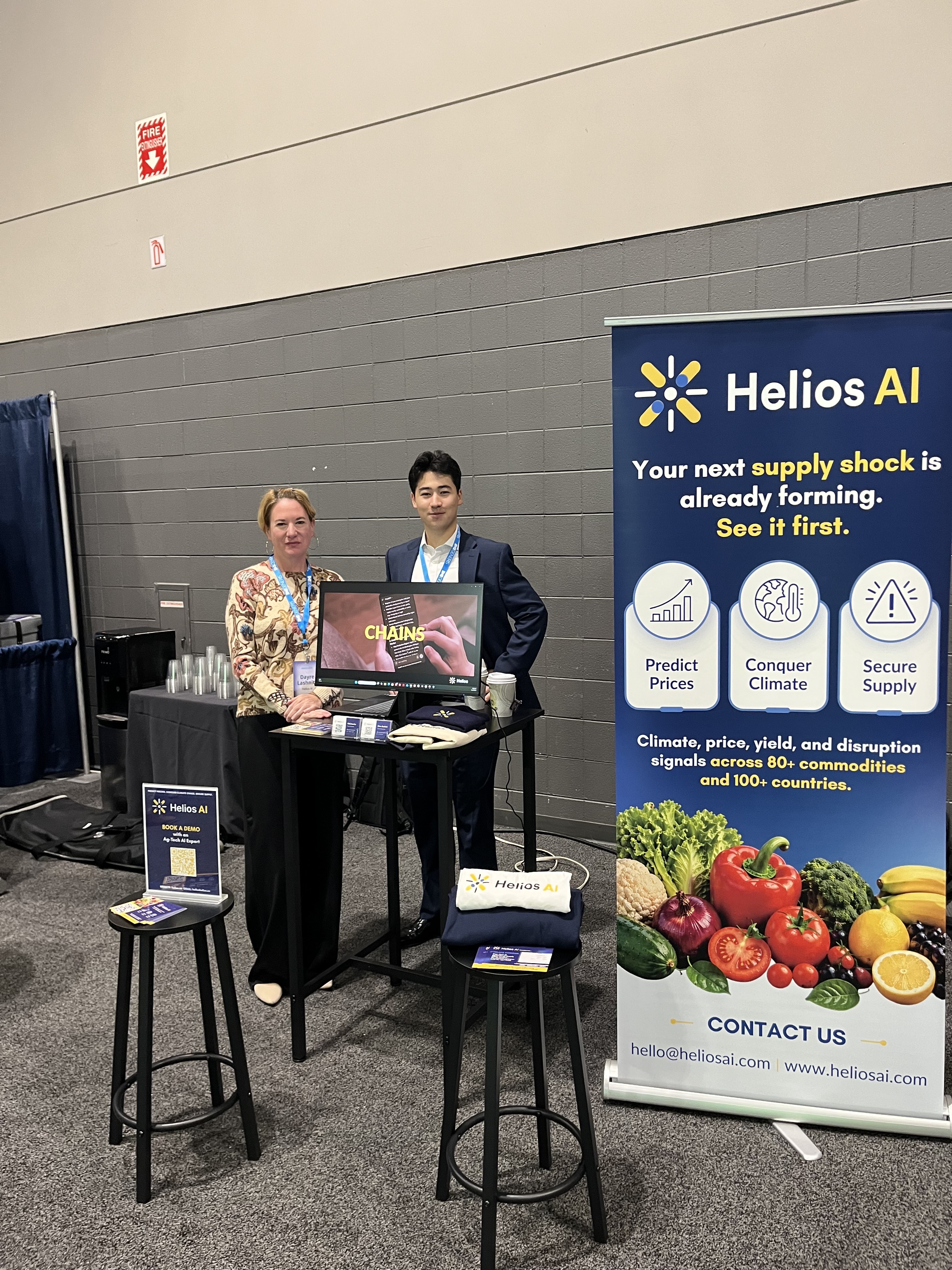
This is the layer Helios AI works in: turning climate, crop and market signals into intelligence procurement and supply chain teams can act on. The lessons from AFMS apply directly. External risk data works best when it is treated as core infrastructure rather than a side report, plugged into the systems teams already use, and tested in live decisions the way Schreiber tests its best partners.
What should food and agriculture leaders take away?
The message from AFMS was not that every manufacturer needs to become a software company. It was that AI starts paying off once the foundations are right: clean data, connected systems, and a willingness to adopt what works. The manufacturers that pull ahead will be the ones that extend the same discipline beyond the plant, to the supply and market risks that decide whether operational gains turn into margin.
That shift from reacting to anticipating is what Helios AI’s Disruption Impact Center is built for. Every event that can move supply, from a drought in a key growing region to a flood on a shipping route, becomes a named disruption with a location, severity and confidence level. Each one is followed from Predicted to Active to Impact Locked. Teams see it all in one place, tuned to the commodities and origins they buy from, so they can act on the first warning instead of the final headline.



Personalized commodity intelligence for the teams that feed the world.
