
What We Learned Hosting a Webinar on AI in Procurement: Benchmarking, Data Foundations, and Faster Sourcing Decisions
Procurement teams face real pressure, and plans often change as new disruptions emerge. In agricultural commodity procurement, volatility and supply risk…

May 13, 2026
4 min read
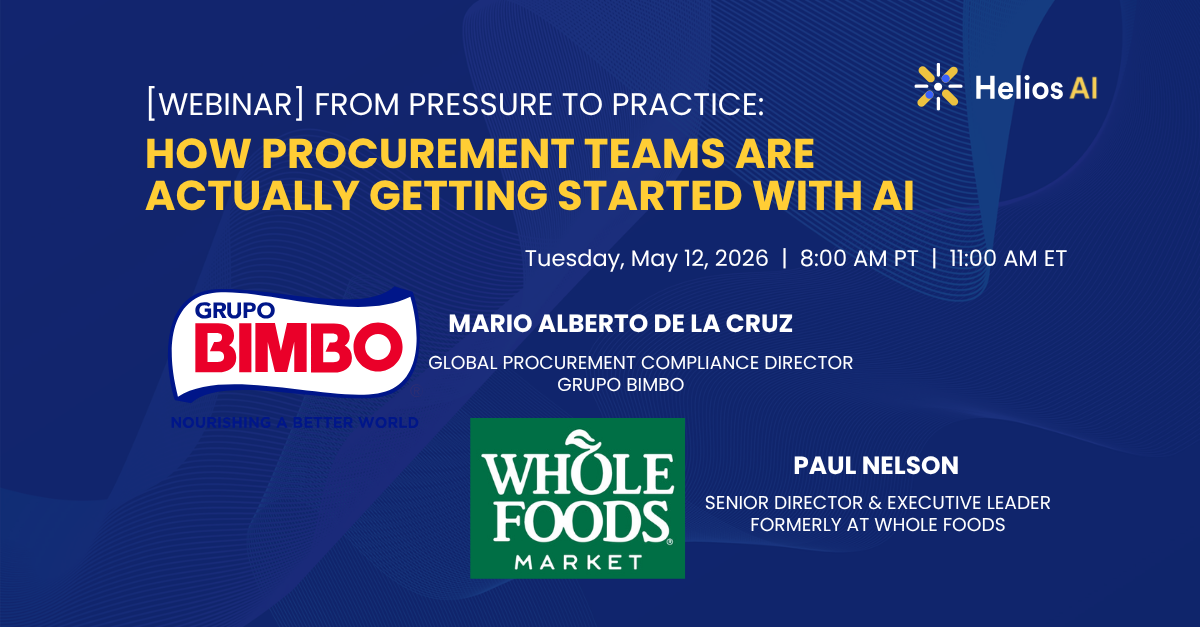
Procurement teams face real pressure, and plans often change as new disruptions emerge. In agricultural commodity procurement, volatility and supply risk can quickly undermine negotiated margins. A recurring challenge is the gap between what procurement needs to manage risk and what's available in technology, data, and talent. In global organizations operating across many countries and business units, data maturity varies significantly, and that directly affects the ability to implement AI successfully.
WATCH REPLAYWhy Are Supplier Conversations Still So Tense?
Supplier relationships can span decades, and cost conversations are often avoided when operations run smoothly. Commodity-based procurement policies change the dynamic by introducing benchmarking against a reference that both sides agree to. As procurement teams build trust in the data they bring to negotiations, tension decreases, and legacy practices begin aligning with newer ways of working.
In many sourcing conversations, multiple benchmarks may be relevant within a single product, including:
Raw materials
Packaging
Transportation and other cost components
This approach also helps onboard newer team members already accustomed to benchmark-driven procurement, reducing the knowledge gap between experienced and junior staff.
How Do You Find the Right Benchmark?
Benchmarking is straightforward for commodities with clear market references, but more complex for specialty crops like blueberries, tomatoes, and onions. Public sources, including USDA data, exchange prices for commodities like soybeans, and regional delivered pricing, can provide a useful starting point.
A practical method starts by working backward with suppliers, asking how they source and price the product. Key questions to ask:
How does your supplier source the product?
How do they price it — FOB, delivered, or formula-based?
Are packaging and transportation costs itemized or bundled?
When the goal is framed as removing volatility risk from the system rather than removing supplier margin, suppliers become more willing to share information.
Where Does AI Actually Fit in Procurement?
AI accelerates work that previously required hours or days, locating the right benchmark, navigating USDA reports, and synthesizing data into usable analysis. It also levels the playing field between tenured employees who "know it in their gut" and newer team members still building context, reducing dependence on individual memory while improving consistency across the team.
What's the First Step Before You Can Use AI Effectively?
A major barrier is that information sits in silos, often stored locally rather than in shared environments. Early AI value comes from unlocking that siloed information and making it searchable across the team. The next stage is interpretation, but the first step is making sure the organization can surface what it already knows.
As experienced employees retire or move on, capturing and distributing their knowledge becomes increasingly important for continuity in sourcing decisions.
Can AI Help with Early Risk Detection?
Procurement teams don't always know where suppliers are sourcing from, including the specific farms or regions involved. In some organizations, origin disclosure is required; in others, it isn't asked for until a problem emerges.
When origin visibility is established, earlier detection enables:
Alternative sourcing plans developed months in advance
Adjustments to promotional plans before supply gaps emerge
Reduced risk of incorrect shelf pricing
Stronger trust at retail
Suppliers may delay sharing bad news while attempting to fix issues internally, which is exactly why getting ahead of disruptions matters.
Formula-Based Pricing: From Manual Work to Dynamic Databases
AI enables procurement to consolidate component costs across many sourcing desks into a dynamic, searchable database, making it possible to compare similar components across suppliers and have more informed conversations when a cost appears out of line.
The hardest situations arise with legacy suppliers where procurement receives only a single delivered price, without clarity on:
FOB cost
Tariffs
Transportation components
Building the cost model blueprint early is critical, especially when structuring RFPs to request component costs explicitly. Previously, assembling this view required significant time and coordination across IT and procurement; AI can reduce that effort dramatically.
What Does Successful AI Implementation Actually Require?
Successful implementation depends on data quality. In large global organizations, multiple ERPs and varying data maturity across business units create real challenges. Duplicate suppliers and duplicated spend can distort spend visibility, and initial dashboards may reflect errors that procurement teams recognize immediately.
A key recommendation: work closely with procurement teams in each business unit to validate and clean data before feeding AI systems. This requires significant time and effort but is necessary for reliable outcomes.
What's Overhyped About AI in Procurement?
AI doesn't solve everything immediately. The two biggest risks:
Underestimating the learning curve — teams need dedicated time to learn how to use AI effectively, ask better questions, and iterate quickly
Deploying too broadly, too fast — without starting small, testing scenarios, and confirming value before scaling
A disciplined rollout starts with a single category or business unit, validates outcomes, and expands from there.
The Bottom Line for Procurement Leaders
Governance, clean data, and compressed timelines are the defining challenges. A governance model is essential, covering data, business units, IT collaboration, and cross-functional coordination. AI also modifies procurement organizational structures, requiring preparation.
The practical path forward:
Start small and validate data before scaling
Build confidence through clean, repeatable processes
Accept that mistakes will happen and ensure decisions can be revisited
Expand adoption as trust and capability grow
AI saves time, but it also raises expectations for faster turnaround from procurement teams and suppliers alike. The teams that win will be the ones that build that foundation deliberately.
WATCH FULL WEBINAR

.png)

Personalized commodity intelligence for the teams that feed the world.
