
What's Really in Your Ice Cream This Summer: A Climate Risk Read on the Key Ingredients
Ice cream season is peaking, and so is the climate risk sitting inside the carton. We ran ice cream's core flavor ingredients through Helios Horizon:…

July 20, 2026
8 min read

Ice cream season is peaking, and so is the climate risk sitting inside the carton.
We ran ice cream's core flavor ingredients through Helios Horizon: strawberries, sugarcane, cocoa, coffee, cherries, raspberries, blueberries, blackberries, and mangoes. The picture for Q3 and Q4 2026 is uneven. Some ingredients are stabilizing. Others are heading into the riskiest stretch of their season just as El Niño conditions take hold across the equatorial Pacific, confirmed by the Japan Meteorological Agency in June, with NOAA now putting the odds of a "Super El Niño" at 67%.
Here is what the data says, ingredient by ingredient.
Strawberries: a 39% price move in 30 days
Strawberry is the most exposed flavor in the freezer aisle right now.
The average US wholesale price sits at $3.86 per kg as of mid-July. Helios forecasts $5.37 within one month, a 39.2% jump, climbing to $5.57 at six months and peaking near $5.51 per kg through November and December. That trajectory breaks from typical seasonal patterns because supply is constrained on three fronts at once.
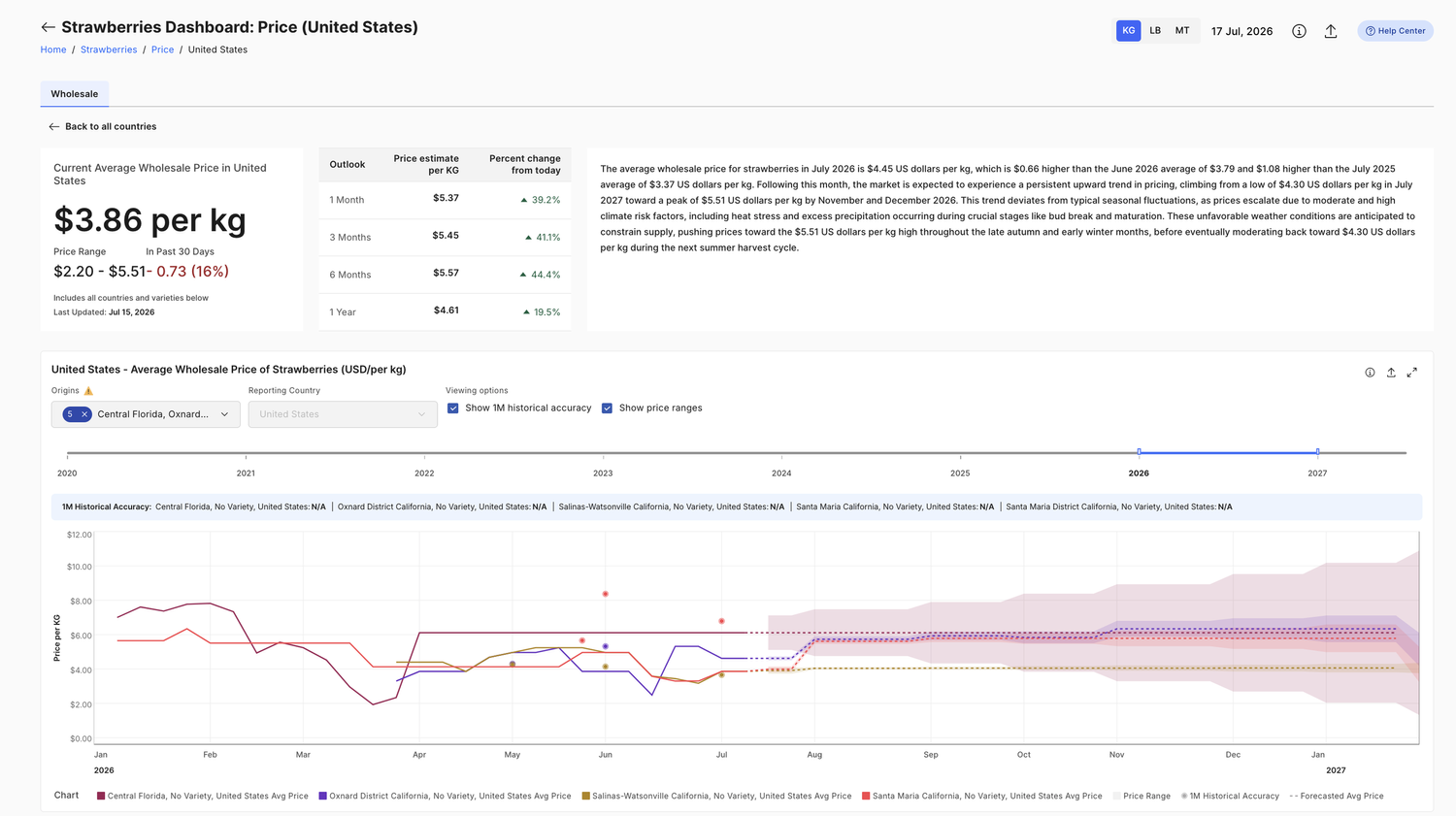
Helios AI Strawberries Price Dashboard, United States, showing $3.86/kg current price and 1/3/6-month forecast table
First, Mexico. We moved Mexico's strawberry outlook to Warning on July 12. Michoacán, which grows 60% of national output, and Baja California (18%) are both rated 2 stars, with Baja California elevated to Take Action earlier in the season on record heat stress. Forecasts suggest wet stress in the current harvest window may reach record levels.
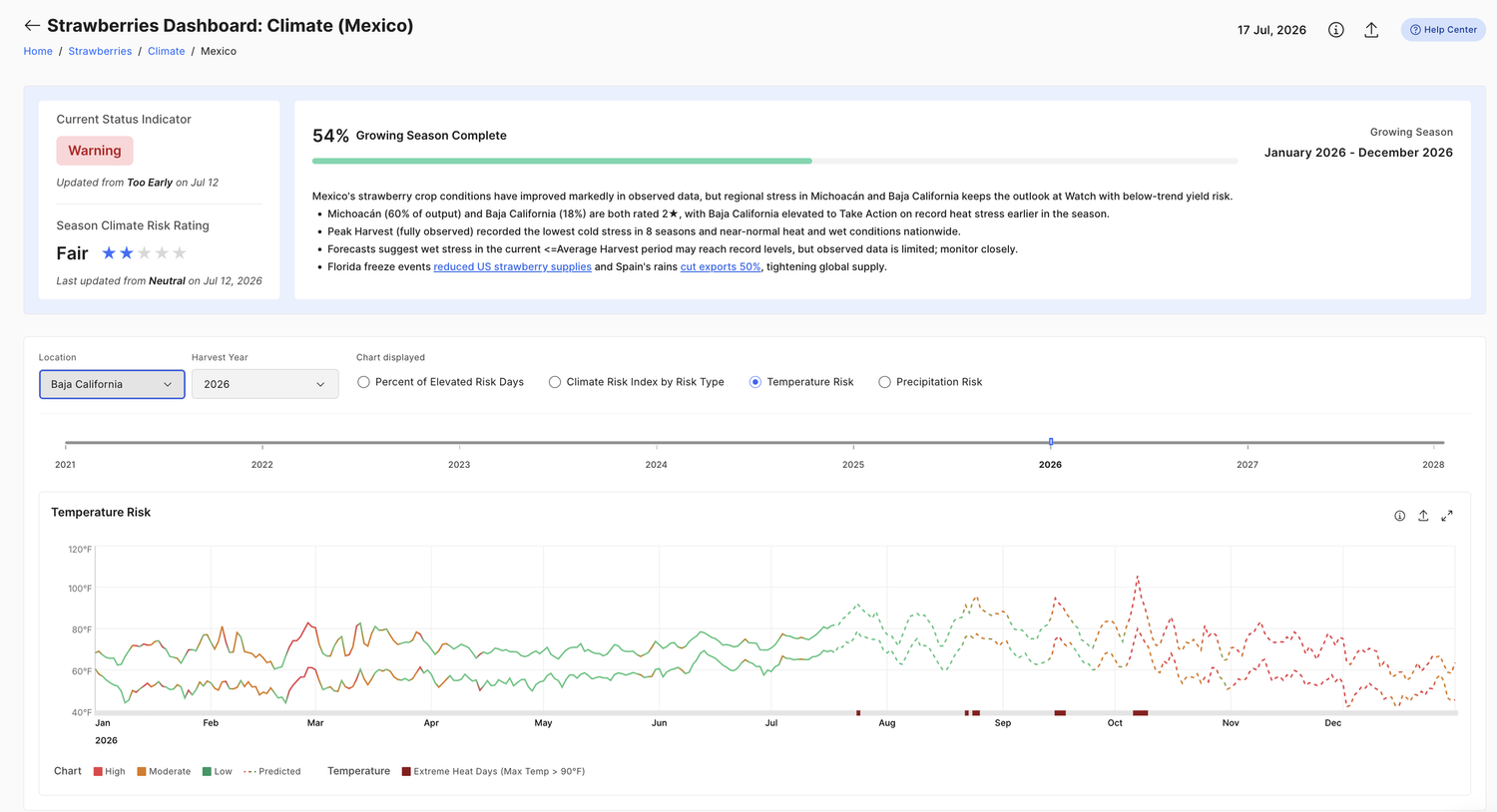
Helios AI Strawberries Climate Dashboard, Mexico, Warning status and Baja California temperature risk chart
Second, Spain. Andalucía produces 97% of Spanish strawberries, and heavy January and February rainfall cut exports by a reported 50%, the season's defining disruption. Harvest wet stress ranked in the 88th historical percentile, and Helios projects a below-trend yield outcome, tracking similar to 2023's minus 5.4% against trend. Industry data backs the platform read: Freshuelva closed the 2025/26 Huelva campaign at 204,035 tonnes of strawberries, down 3% year over year, citing the train of storm systems early in the year.
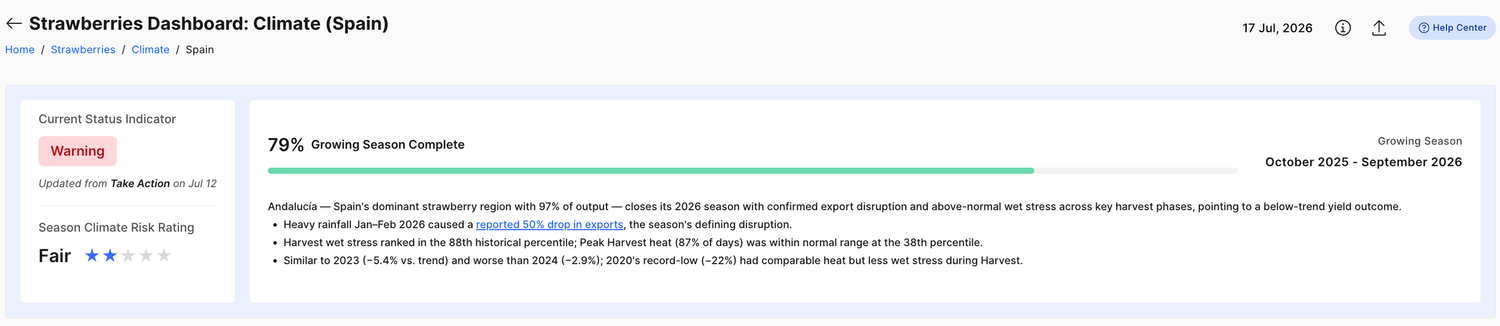
Helios AI Strawberries Climate Dashboard, Spain, 79% season complete with export disruption summary
Third, the US itself. January freeze events in Florida tightened domestic supply during the winter window, and California's spring season opened with extreme March heat. Movement has since recovered, with Central California running well ahead of last year (48,985 units vs. 40,437), but the buffer that normally absorbs import shortfalls is thinner than usual.
For anyone buying fruit preparations, purees, or IQF strawberries, the window to lock coverage below the forecast curve is narrowing.
Sugar: the base ingredient is quietly tightening
Every carton depends on it, and sugar is the calmest soft commodity right now: futures near 14.8 to 15.2 US cents per pound, up about 8% in a month but still down roughly 8% year on year. Brazil's Center-South crush has been strong and most forecasters still project a 2025/26 surplus.
The Helios ratings tell a less comfortable story about where that surplus goes next. Brazil's cane carries a Poor 1-star rating with a Warning flag during peak harvest, hit first by unseasonable cold and now by July excess rainfall. Thailand's Northeastern region, 65% of national output, is at Watch with post-harvest drought at a record 77% of days above threshold, exceeding the 8-season maximum. Pakistan's Weighted Average % Risk sits at 47.4%, driven by extreme heat at 46.4% during vegetative growth, well above the 37.2% ten-year average. US Florida cane took an 11.04% estimated loss from the February freeze, a figure corroborated by USDA WASDE. And India recorded its driest June in over a decade before rains recovered, with an export restriction keeping supply off the world market.
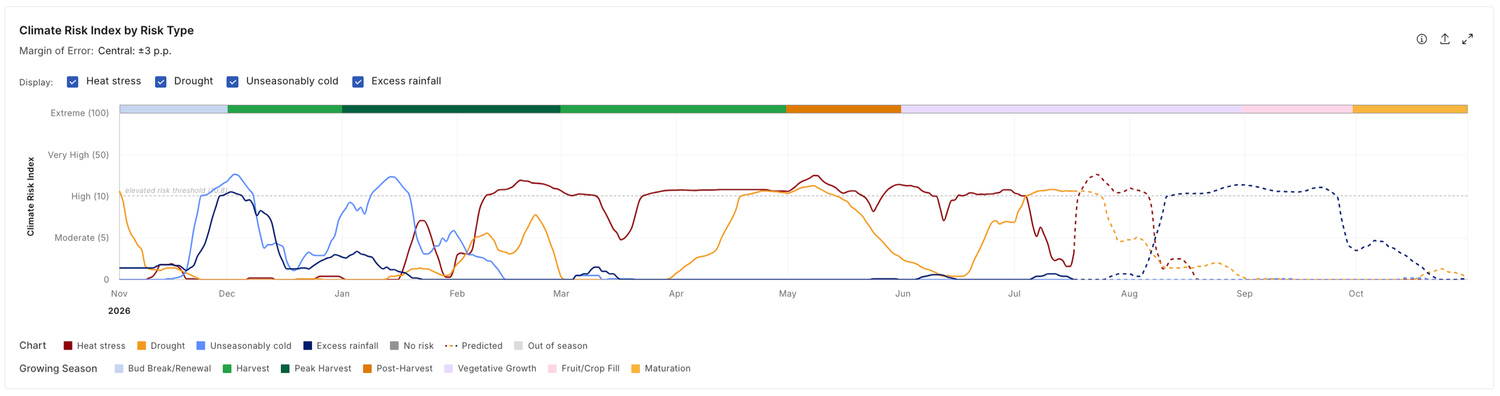
Helios AI Sugar Cane Climate Dashboard, Thailand, Climate Risk Index by Risk Type showing drought and heat stress, following excess rainfall during Q3 2026
This is where El Niño changes the math. Several analysts have shifted their 2026/27 view from surplus toward marginal surplus or slight deficit because El Niño historically cuts yields in India, Brazil, and Thailand at the same time, the three origins that anchor global supply. Translation for buyers: the current surplus is real, but forward pricing has not fully caught up to a deteriorating 2026/27 setup.
Cocoa and coffee: the flavor shelf is volatile
Chocolate and coffee flavors share a supply chain problem: both are concentrated in regions where El Niño historically cuts yields.
Cocoa is a tale of two crops. Supply right now is ample: Ivory Coast port arrivals for 2025/26 ran about 18% ahead of the prior season, Ghana's Weighted Average % Risk sits at just 0.6% versus an 8.7% ten-year average, and European Q1 grindings, the weakest in 17 years, show demand cooling under two years of high prices. Yet New York cocoa traded above $5,300 per tonne in early July, the highest since January, up roughly 39% in four weeks. The market is trading the next crop, not this one. Brazil's cocoa carries a Poor 1-star rating with a Warning flag on heat stress during harvest, and in West Africa, which grows about two-thirds of the world's cocoa, floods have disrupted harvest and transport, disease risk is up, and early surveys show below-average flower and pod formation for the main crop opening October 1. Some analysts see Ivory Coast output falling toward 1.7 to 1.8 million tonnes from about 2.2 million, and StoneX cut its 2026/27 surplus estimate to 149,000 tonnes, citing El Niño risk to West African rainfall. The Helios forward curve saw this coming: in June it priced cocoa at $8.21 per kg twelve months out while nearby prices sat near 2023 lows. Four weeks later, the nearby had already jumped 39% toward it. That gap keeps closing as the October main crop opening approaches.
Coffee carries the sharpest price action of any ingredient in this analysis. Brazil, the largest producer at about 35.66% of global output, holds a Poor 1-star rating during peak harvest on cold stress, with a Take Action flag, and the harvest is running behind at 52% complete versus roughly 60% a year earlier. Arabica traded near $3.15 to $3.20 per pound on July 8, up about 31% in a month, after touching a five-month high near $3.50. The buffer is thin: ICE-certified arabica stocks sit at their lowest since March 2024, which amplifies every weather scare. And the scares are stacking. Cold-front frost fears are live now, and the bigger forward risk is El Niño delaying the September to October flowering rains that set the size of Brazil's 2026/27 crop. Cote d'Ivoire's coffee already shows what that looks like: the platform's most severe rating, Take Action, after every day of the flowering phase recorded drought stress, the worst in 8 seasons of data. The relief valve is real but conditional: forecasters still expect a large 2026/27 Brazilian crop around 70 million bags, which could ease prices if the flowering window cooperates.
Mango: the sorbet flavor running dry
Thailand, the world's largest fresh mango exporter by value at roughly 18% of global trade, moved to Watch on July 12. All three major producing regions, Central (27%), Northern (20%), and Eastern (15%), covering 62% of national output, are rated 2 stars based on observed data.
The dry stress numbers stand out even in a report full of them. Dry stress in the current harvest period hit its worst level in 8 seasons, the 100th percentile, and Peak Harvest dry stress reached the 88th percentile. Heat at Peak Harvest ran above threshold every single day, though that sits at the historical median for this crop and period. The nearest comparable season, 2019, yielded 7.6% below trend.
The Bangkok-area detail shows how deep the water deficit runs: cumulative precipitation is down 43.66% versus the historical average (37.32 inches against 66.25), and heavy rain days are down 62%, just 15 this season against a norm of 40. Today's risk reads 100%, Very High, with maximum risk persisting through the next month.
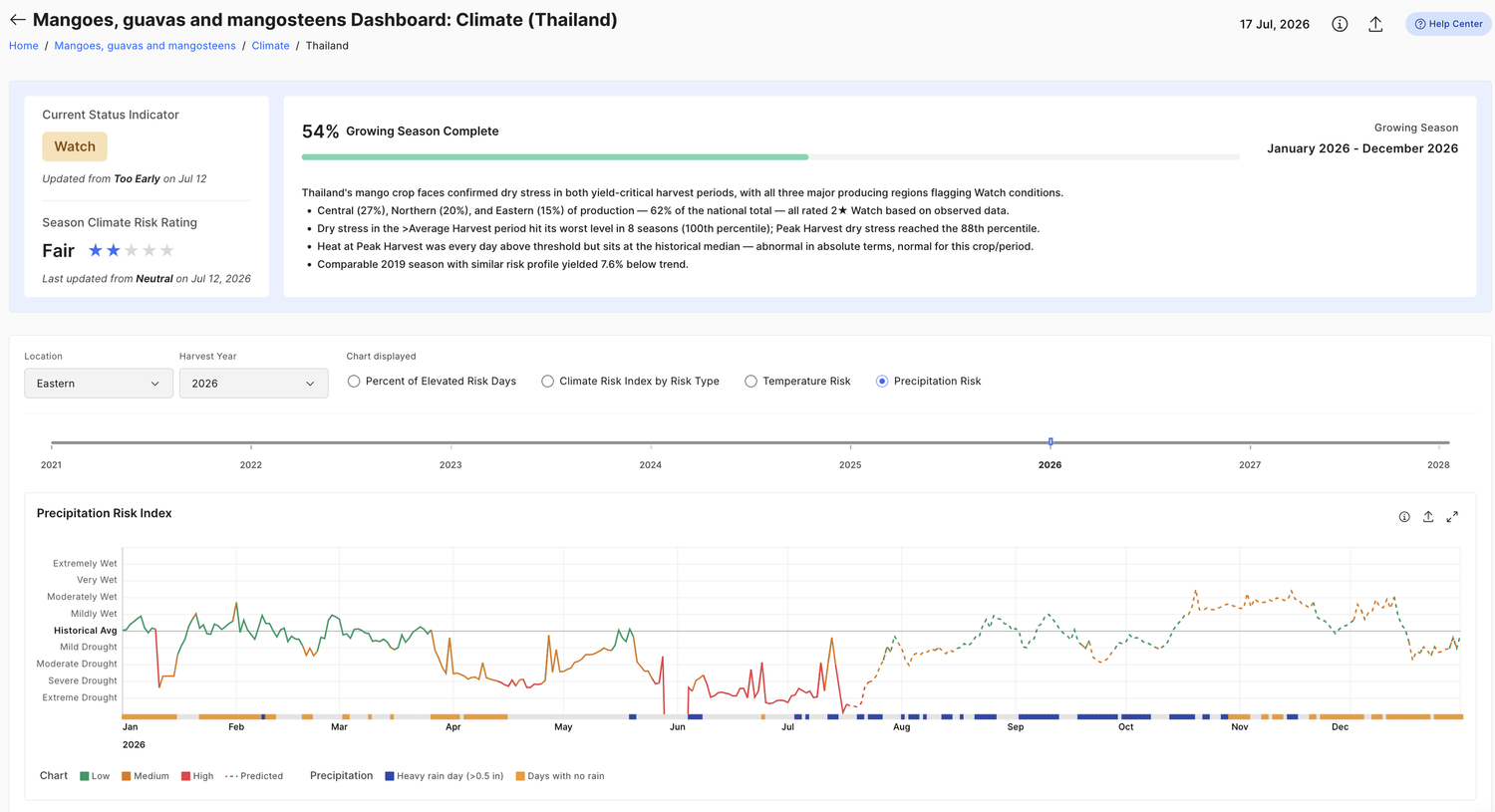
Helios AI Mangoes Climate Dashboard, Thailand, Watch status and Eastern region precipitation risk
Thailand is not alone. Our Q2/Q3 report flagged Egypt's mango crop, another top-ten export origin, at worst-on-record seasonal stress. For anyone buying mango puree or IQF chunks for sorbet and dairy applications, two major origins are stressed in the same season, which limits the usual substitution play.
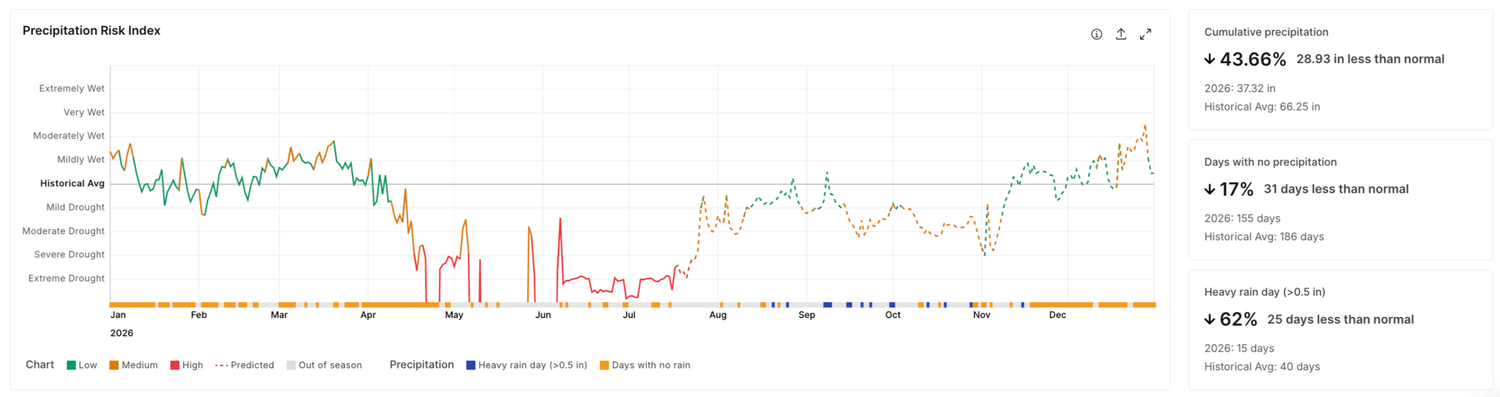
Helios AI location view, Bangkok Thailand, 100% today's risk with cumulative precipitation panel
The rest of the sundae: cherries and berries
Cherries carry the highest projected volatility of any ingredient we analyzed, with Weighted Average % Risk peaking at 39.5 in August on extreme heat. US cherries are in peak harvest now at 25.5% risk, heat-driven, though notably below the 44% historical average for this window.
The berry complex (raspberries, blueberries, blackberries) shows a shared pattern: wet risk climbing through Q3 and peaking in September at a 26.5 average Weighted Average % Risk before a December resurgence driven by cold and dry conditions. The standout single risk is Guatemala's blackberries at 68.4%, almost entirely cold stress. Argentina's blueberries face their riskiest stretch in October, when forecasted excess rainfall coincides with bud break.
What this means if you buy these ingredients
Three takeaways from the data.
Strawberry coverage is the most time-sensitive decision on this list. A 39% forecasted move in 30 days, with Mexico at Warning and Spain closing a disrupted season, leaves little slack from any origin.
Sugar and cocoa reward patience with a deadline. Current surpluses offer favorable forward levels, but both markets flip on West African and Southeast Asian rainfall between August and October. That is the window to build 2027 coverage.
Watch September and October. That is the convergence window: peak wet risk for berries, peak dry risk for sugarcane, West African rainfall deciding the size of the cocoa main crop, and El Nino's make-or-break influence on Brazil's coffee flowering rains.
Helios AI tracks climate risk, price forecasts, and disruption signals across 80+ commodities and 100 countries, with 12-month price forecasts updated as conditions change. If your ingredient list looks like an ice cream label, this is the season to see what the data says about yours.


.png)

Personalized commodity intelligence for the teams that feed the world.
