
When Biofuels Became a “Crucial Asset,” the Feedstock Market Changed Regimes
There is no environmental rationale left in the headline of the most consequential biofuel rule the United States has written in twenty years. The…

May 27, 2026
12 min read
The policy language has already shifted from environmental product to strategic energy infrastructure, and the procurement implications run further than the forward curves suggest.
By João Pedro Rodrigues Morciani, Lead Agricultural Analyst
There is no environmental rationale left in the headline of the most consequential biofuel rule the United States has written in twenty years. The Environmental Protection Agency’s (EPA) final Renewable Fuel Standard (RFS) Set 2 rule, published on 27 March 2026, is titled “EPA Finalizes Historic New Renewable Fuel Standards to Strengthen American Energy Security, Support Rural Economies.” Climate does not appear. The word “asset” does.
That is the regime change in one sentence.
“America’s national security depends on our energy security, and biofuels are a crucial asset that brings more jobs and helps farmers in rural America.”
— Brooke Rollins, US Secretary of Agriculture
When the cabinet secretary responsible for the world’s second-largest soybean crop calls that commodity a national-security asset, the procurement category it sits in has been re-shelved. The question is not whether to recognize the regime change. It is what it implies for everyone else buying the same commodities.
From the old ESG to the new one
For two decades, ESG stood for Environmental, Social, and Governance — a framework that treated biofuels primarily as a climate product. Mandates were justified on lifecycle carbon math. Subsidies were defended on environmental grounds. When feedstock prices spiked, the food-vs-fuel critique had real political traction, and governments backed down. The 2008, 2012, and 2022 mandate reversals all happened inside that frame.
The new ESG — a framing increasingly used in energy markets — replaces those three letters with Economics, Security, and Geopolitics. It has been migrating into the biofuel rulebooks of the three governments that matter most. The EPA’s Set 2 final rule states that the 2026 and 2027 volume requirements “will protect investments made by American corn and soybean growers, oilseed processors, and biodiesel and renewable diesel producers, whose products are critical to our country’s energy security.” In Brazil, President Lula da Silva signed the Combustível do Futuro law in October 2024 with the line “Brazil will lead the world’s largest energy revolution.” In Indonesia, Energy Minister Bahlil Lahadalia framed the B50 mandate in a single sentence that names all three legs of the new framing: “B50 allows us to maximize domestic resources, strengthen rural economies, and secure our national energy future.”
The procurement-relevant point is not the rhetoric. It is that the rhetoric is now binding policy. The US 45Z tax credit, hard-coded into law through 2029 by the July 2025 reconciliation package, disqualifies imported feedstocks. EPA Set 2 halves the Renewable Identification Number (RIN) value of foreign-origin fuel and feedstock from 2028. Indonesia’s B50, launching in July 2026, will absorb roughly 20 billion liters of biodiesel domestically — a sharp year-on-year increase. These are forward-dated commitments to keep specific molecules inside a sovereign-backed bid for the rest of the decade.
Under the old framing, mandates could be walked back when feedstock costs threatened consumer prices. Under the new one, the political cost of reversal climbs sharply, because the reversal now reads as surrendering energy security rather than rebalancing an environmental policy. The framing is what makes the bid durable.
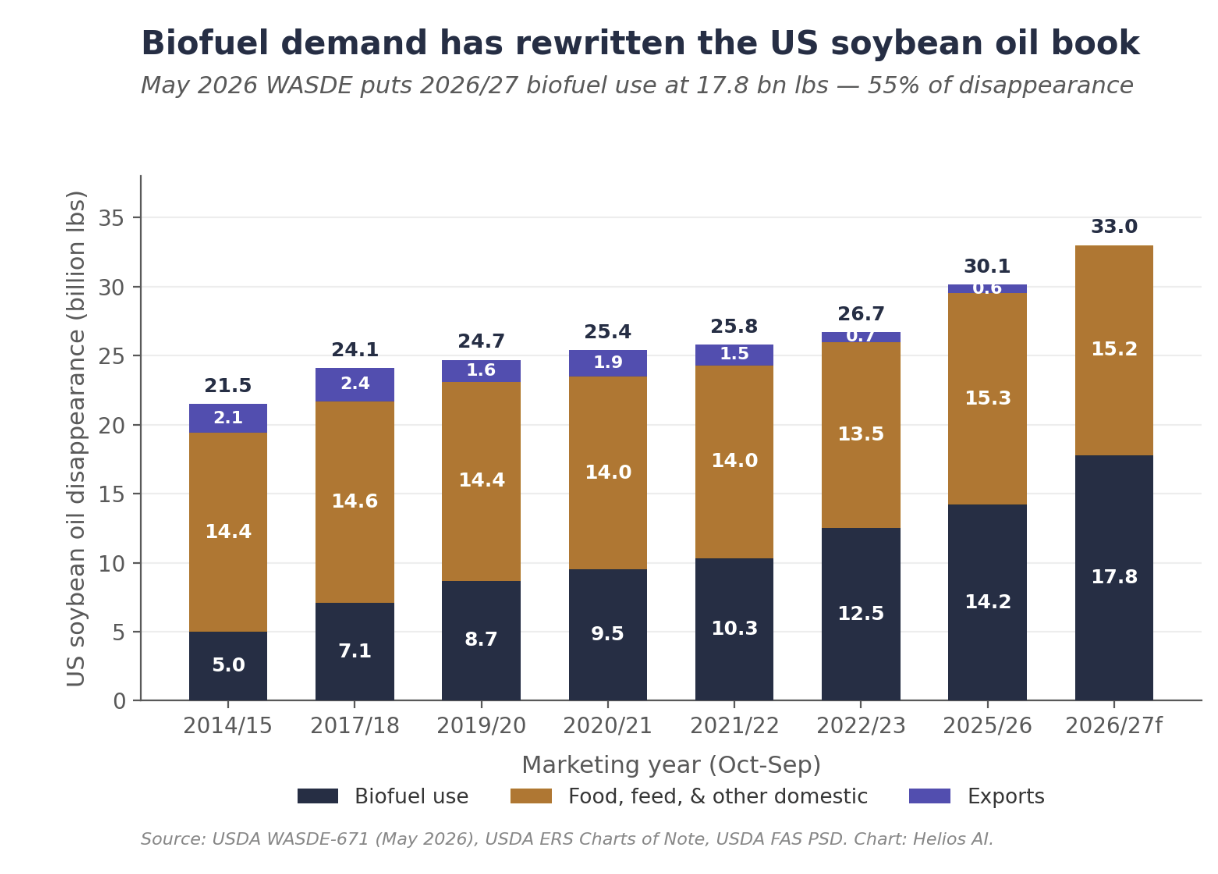
Chart C1: May 2026 WASDE-671 lifts US biofuel use of soybean oil to 17.8 bn lbs in 2026/27, up 25% from 2025/26, with exports falling to near zero | Source: USDA WASDE-671 (May 2026), USDA ERS Charts of Note, USDA FAS PSD | Range: MY 2014/15 to MY 2026/27
Brazil is the proof of concept — and somebody is paying for it
The strategic-asset framing is not theoretical. Brazil has been running the experiment for fifty years, and in the months since the closure of the Strait of Hormuz, the results have become visible. Brazilian pump prices rose roughly 5% in March 2026, against approximately 30% in the United States, as Laura Carvalho — Director of Economic and Climate Prosperity at the Open Society Foundations — documented in Project Syndicate. Brazil’s response to Hormuz was to deepen the bet: in May 2026, the ethanol-in-gasoline blend moved from 30% to 32%, absorbing more sugarcane into the strategic pool.
The mechanism Carvalho identifies is the one that matters for procurement: “fuel refined by the state-run energy major Petrobras has remained dramatically cheaper than imported gasoline equivalents, cushioning consumers from global oil volatility.” The cushion is real. So is the cost. The US Department of Agriculture’s (USDA) April 2026 Oil Crops Outlook reports that Brazil’s 15% biodiesel blend mandate is now absorbing 7.0 million metric tons of soybean oil domestically, holding exports nearly flat. That is 7 million tonnes of oil that the global food and oleochemical book does not get to bid for.
The 1975 Brazilian National Alcohol Program — ProAlcool — delivered roughly $52 billion in avoided oil imports between 1975 and 2002, per the International Energy Agency (IEA). Indonesia’s biodiesel program has saved a comparable order of magnitude in foreign exchange over the last five years. Both governments have receipts. Other governments are reading them. The procurement reader should expect more of this framing, not less.
The bid spreads across the fats-and-oils complex
The most underappreciated feature of the strategic-asset frame is that it does not remain within a single feedstock. EPA Set 2 requires US biodiesel and renewable diesel production to grow by more than 60% above 2025 volumes.
Read the original policy intent, and the sequence is not accidental. The US biofuel credit framework was engineered around environmental, social, and governance logic: California's Low Carbon Fuel Standard (LCFS) and the federal 45Z Clean Fuel Production Credit reward feedstocks with lower lifecycle carbon-intensity (CI) scores. Tallow, UCO, and other waste-derived fats carry materially lower CI scores than virgin soybean oil, so processors maximize credit value by substituting toward them whenever they are physically available. The Energy Information Administration's (EIA) Form 819 data shows the substitution running on schedule — soybean oil's share of US biodiesel feedstock fell from 65.9% in 2020 to 30.7% in early 2025, US tallow consumption for biofuel production has more than tripled in two years, and UCO imports collapsed to a 20-month low once 45Z's domestic-only rule disqualified the imported pool.
But the waste pool is finite by nature. You cannot ranch a national herd to hit a renewable-diesel mandate, and you cannot scale used cooking oil faster than restaurants generate it. The International Energy Agency (IEA) expects biofuels to absorb 80% of global waste and residue oil supplies by 2030 — at which point the waste pool ceases to be a swing supplier and becomes fully subscribed. The mandate keeps growing. The low-CI feedstocks do not.
Once the waste pool is structurally maxed, the only feedstock left with the scale to meet Set 2 is soybean oil — and US policy has been quietly re-engineered to reflect that. The framework now layers an energy-security argument on top of the original ESG argument: domestic crush capacity, domestic acreage, and a feedstock the country actually controls. The CI penalty on soybean oil is being offset by credit-stack design, mandated volumes, and 45Z's domestic-content rule until soybean oil clears at parity with the waste fats it was originally meant to displace. Soybean oil has been promoted. It is no longer the high-CI feedstock the policy was trying to move past. It is the strategic feedstock the policy now depends on.
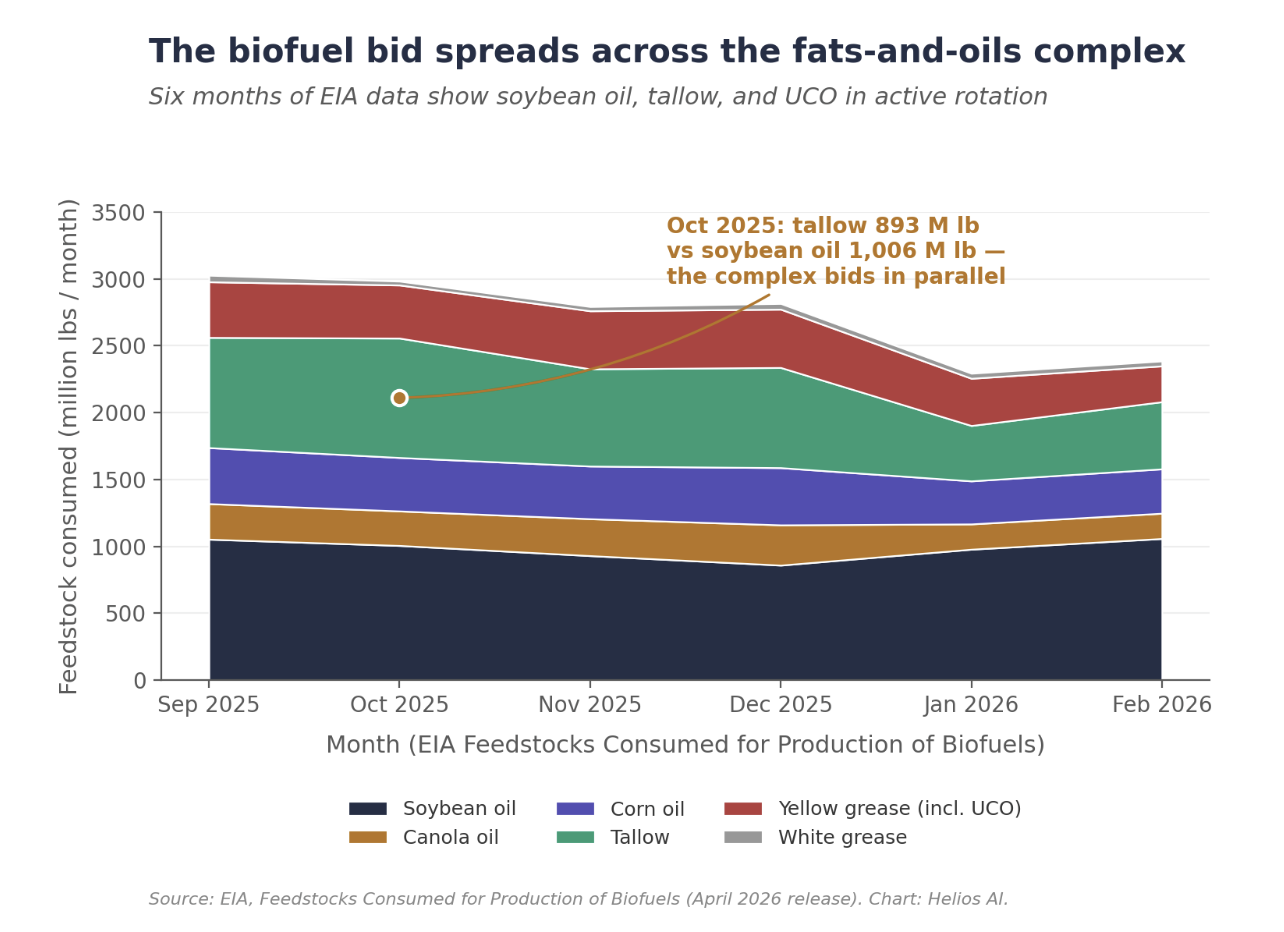
Chart C5: EIA monthly data show soybean oil, tallow, canola, corn oil, and yellow grease/UCO in active rotation as US biofuel feedstocks | Source: EIA, Feedstocks Consumed for Production of Biofuels (April 2026 release) | Range: September 2025 to February 2026
For procurement teams in oleochemicals, animal nutrition, pet food, and food service, the cross-feedstock substitution is the central operational consequence. A hedging strategy built around a single feedstock — even one as central as soybean oil — leaves the buyer exposed to the substitution chain, with the strategic-asset bid now running through the entire complex. USDA’s Economic Research Service is explicit on this point in its May 2026 Oil Crops Outlook: animal-fat and UCO imports are expected to rise into 2026, specifically “to help meet the higher mandate-driven demand.”
The price evidence is already in the curve
Multilateral institutions have stopped describing biofuels as an environmental category. The World Bank's April 2026 Commodity Markets Outlook lists "Global biofuels" alongside Other OPEC+ spare capacity, additional pipelines, and Strategic Petroleum Reserve releases as one of the "potential alternative sources for oil supplied via the Strait of Hormuz." A multilateral institution placing biofuels in the same analytical bucket as the SPR is the new framing turned official.
The CBOT soybean oil futures curve tells the procurement story in sharper relief. Three days after the 28 February closure of the Strait of Hormuz, the July–December 2026 strip settled in the low 60s ¢/lb, with the curve already in mild backwardation. By 1 April, following the EPA's 27 March publication of the final Renewable Fuel Standard Set 2 rule, every contract on the curve had moved roughly four to five cents higher. By 1 May, the curve had moved again — another eight cents or so — alongside an upward revision of the USDA's 2026/27 soybean oil price forecast by seven cents per pound.
The shape of that move is the signature of the regime change. Between 3 March and 26 May, the front and back of the July–December strip rose by approximately the same magnitude, on the order of 11 ¢/lb across the curve. The entire forward curve was re-rated in parallel, not just the prompt month. The market did not price the Hormuz closure as a panic; it priced it as a step-change in the structural level. On top of that level, the curve is also in backwardation, with the near-dated strip trading several cents above the December 2026 contract — the typical pattern when the market expects the prompt to stay tight while the next harvest remains months out. Both signals point the same way: the new level is being treated as durable, and the prompt is being treated as scarce.

The Food and Agriculture Organization’s (FAO) April 2026 Food Price Index hit its highest reading in over three years, with vegetable oil as the primary driver. FAO Chief Economist Máximo Torero named the cause directly: “Vegetable oils, however, are experiencing stronger price increases, driven largely by higher oil prices, which are increasing demand for biofuels and putting additional pressure on vegetable oil markets.” When the United Nations’ chief food economist identifies biofuel demand as the price setter in vegetable oil markets, the institutional consensus has shifted.
Where the new framing still has limits
The frame is durable. It is not infinite. Three real ceilings deserve attention from any procurement team building a multi-year sourcing strategy.
First, even Lula’s “energy revolution” defers when feedstock costs threaten food and fuel inflation. Brazil’s planned B16 implementation in March 2026 became, in the words of Aprobio President Jerônimo Goergen, “very remote.” The strategic-asset frame has a political ceiling at the point where consumer-price pass-through becomes electorally costly.
Second, the sustainable aviation fuel (SAF) experience in Europe is showing what mandate-supply mismatches look like. International Air Transport Association (IATA) Director General Willie Walsh, in December 2025: “If the objective is to increase SAF production to decarbonize aviation, policymakers need to learn from failure.” European airlines paid a multi-billion-dollar premium for SAF in 2025. The new framing can produce significant cost dysfunction when policy outruns physical supply.
Third, the 2022 food-vs-fuel reversal is still in living memory. Argentina, Indonesia, India, and Brazil all reduced or delayed biofuel mandates when feedstock prices spiked. The threshold is higher under the strategic-asset frame, but it exists.
These three limits are operational, not directional. They define where procurement teams can find short-term relief windows inside a structurally tightening bid. They do not reverse the regime change.
What this means for the procurement reader
The most useful posture for a feedstock buyer in mid-2026 is to treat the strategic asset as reframing the way credit teams treat a sovereign rating change: as a regime shift that re-prices the curve for everyone holding the underlying paper, even those whose own positions have not moved. The biofuel bid is now policy-backed across the three largest jurisdictions in the global feedstock market. It is hard-coded into US tax law through 2029. It is widening across the fats-and-oils complex, not narrowing. And it sits underneath the highest FAO Food Price Index reading in three years.
Between 3 March and 26 May, the CBOT curve repriced the structural level of soybean oil by roughly 11¢/lb across the July–December 2026 strip. That is the market accepting the new regime, not panicking about it.
What the curve has not yet priced is the bid's durability beyond the actively quoted near-strip. The 45Z tax credit runs to 2029. Indonesia’s B50 launches in July 2026 and is structurally permanent. Brazil’s biodiesel blend is on its way to B20. None of those policy commitments are inside the curve the market currently trades. The procurement teams that read the parallel shift as a one-time level adjustment will set their 2027–2029 coverage on the assumption that today’s deferred contracts are fair value. The teams that read the new ESG — Economics, Security, Geopolitics — as durable will hedge further out the curve than the listed contracts go, in physical and over-the-counter markets that price the back of the strip more honestly. The next two WASDE releases and the EPA’s 2028 RVO rulemaking are the events that will discriminate between those two readings.
Frequently Asked Questions
What is the new ESG framing in biofuel policy?
The new ESG — Economics, Security, and Geopolitics — replaces the older Environmental, Social, and Governance framing of biofuels as primarily a climate product. It is reflected in the title of the US EPA’s final RFS Set 2 rule of 27 March 2026, which centers on energy security and rural economies and omits any reference to climate. Brazil’s Combustível do Futuro law and Indonesia’s B50 mandate are explicit in the same direction, framing biofuels as national-security infrastructure.
How is the biofuel bid spreading beyond soybean oil?
EIA Form 819 data show soybean oil’s share of US biodiesel feedstock falling from 65.9% in 2020 to 30.7% in early 2025, as tallow, UCO, and canola were drawn in. US tallow consumption for biofuel production has more than tripled over the past two years. The IEA expects biofuels to absorb 27% of global vegetable oil production and 80% of global waste-and-residue oil supplies by 2030, indicating that the substitution chain runs through the entire fats-and-oils complex.
What is the CBOT soybean oil futures curve telling procurement teams in 2026?
Between 3 March and 26 May 2026, the CBOT soybean oil curve repriced upward by roughly 11¢/lb across the July–December 2026 strip. The front month moved from 62.93 to 74.29¢/lb, and the December 2026 contract moved from 60.46 to 69.70 by a similar amount. That parallel shift is the market accepting a higher structural level, not panicking about a one-month spike. The May 26 curve also sits in 4.6¢/lb backwardation, reflecting near-term physical tightness. What the curve does not price is durability beyond December 2026 — the limit of the actively quoted near-strip — even though 45Z runs through 2029 and Indonesia’s B50 launches in mid-2026. Procurement teams that read the new ESG framing as durable need to hedge further out than the listed strip.
What are the limits of the strategic-asset framing for biofuels?
Three limits are operationally relevant. First, the framing defers when feedstock costs threaten food and fuel inflation — Brazil’s B16 implementation in March 2026 became “very remote," in the words of Aprobio President Jerônimo Goergen. Second, mandate-supply mismatches can produce significant cost dysfunction, as European SAF buyers experienced in 2025. Third, the 2022 food-vs-fuel reversal is recent enough that the political threshold for further rollback, while higher, still exists.
Why does this matter for category management and hedging teams?
The biofuel bid is now policy-backed across the three largest feedstock jurisdictions and is widening across the fats-and-oils complex rather than narrowing. A hedging strategy built around a single feedstock leaves the buyer exposed to the substitution chain running through the complex. USDA’s May 2026 Oil Crops Outlook expects animal-fat and UCO imports to rise into 2026 to meet higher mandate-driven demand. The procurement-relevant question is no longer whether the bid will persist but where the short-term relief windows sit inside a structurally tightening market.



.png)

Personalized commodity intelligence for the teams that feed the world.
