
World Food Day 2026: why record harvests didn't end hunger
This Friday, October 16, the FAO will mark World Food Day in Rome, as it has every year since 1981. The 2026 theme, shared with the World Food Forum, is "Innovate today. Nourish tomorrow." It is a good theme. It is also easy to read the wrong way.
October 13, 2026
3 min read
What does "Innovate today. Nourish tomorrow." actually ask of us?
This Friday, October 16, the FAO will mark World Food Day in Rome, as it has every year since 1981. The 2026 theme, shared with the World Food Forum, is "Innovate today. Nourish tomorrow." It is a good theme. It is also easy to read the wrong way.
The comfortable reading is that innovation means producing more: better seed, better inputs, more yield per hectare, more food in the world. That reading has a problem. The world already did that. Last year's cereal harvest was the largest on record, and acute hunger rose anyway. Both facts are true at the same time, and the gap between them is where the theme gets interesting.
If more food did not nourish tomorrow, the innovation that will have to be about something else. Our view is that it is about seeing exposure before the shock arrives, and planning on the forecast rather than waiting for the famine declaration. That is what we built the Hunger Exposure Index to do, and World Food Day is a reasonable moment to explain why.
Why did a record cereal crop coincide with rising hunger?
Because availability was never the binding constraint. Roughly 266 million people were in acute food insecurity while the world's granaries were fuller than they had ever been. A country does not go hungry because there is no grain to buy. It goes hungry because it cannot pay for the grain, cannot afford the fertilizer to grow its own, or has no second route when the first one closes.
That is a different problem from the one most food innovation is pointed at, and it has four moving parts. The first is climate risk to the cropping calendar: whether the rains and the heat land in the weeks that decide a harvest. The second is fertilizer and energy exposure, because a country that cannot afford inputs this season plants less next season. The third is foreign exchange: can it buy on the world market when its own crop fails. The fourth is cereal import dependence, which decides how much of the food on the table was never grown at home in the first place.
None of these buffers refills on its own. A reserve spent this year is thinner next year. And none of them shows up in a global production number, which is why record harvests and record hunger can share a headline without either being wrong.
Which countries cannot buy their way out of the next shock?
The Hunger Exposure Index scores 47 countries from 0 to 100 on exactly those four buffers. Most of the inputs are public and verifiable, from USDA, FAO, IMF, IPC and FEWS NET. What Helios adds is the crop-level climate read: not a national rainfall average, but what the season is doing to the specific crops a country depends on, in the weeks that matter. A score near 70 or above marks critical exposure, and at launch about 130 million people lived in the six countries past that line.
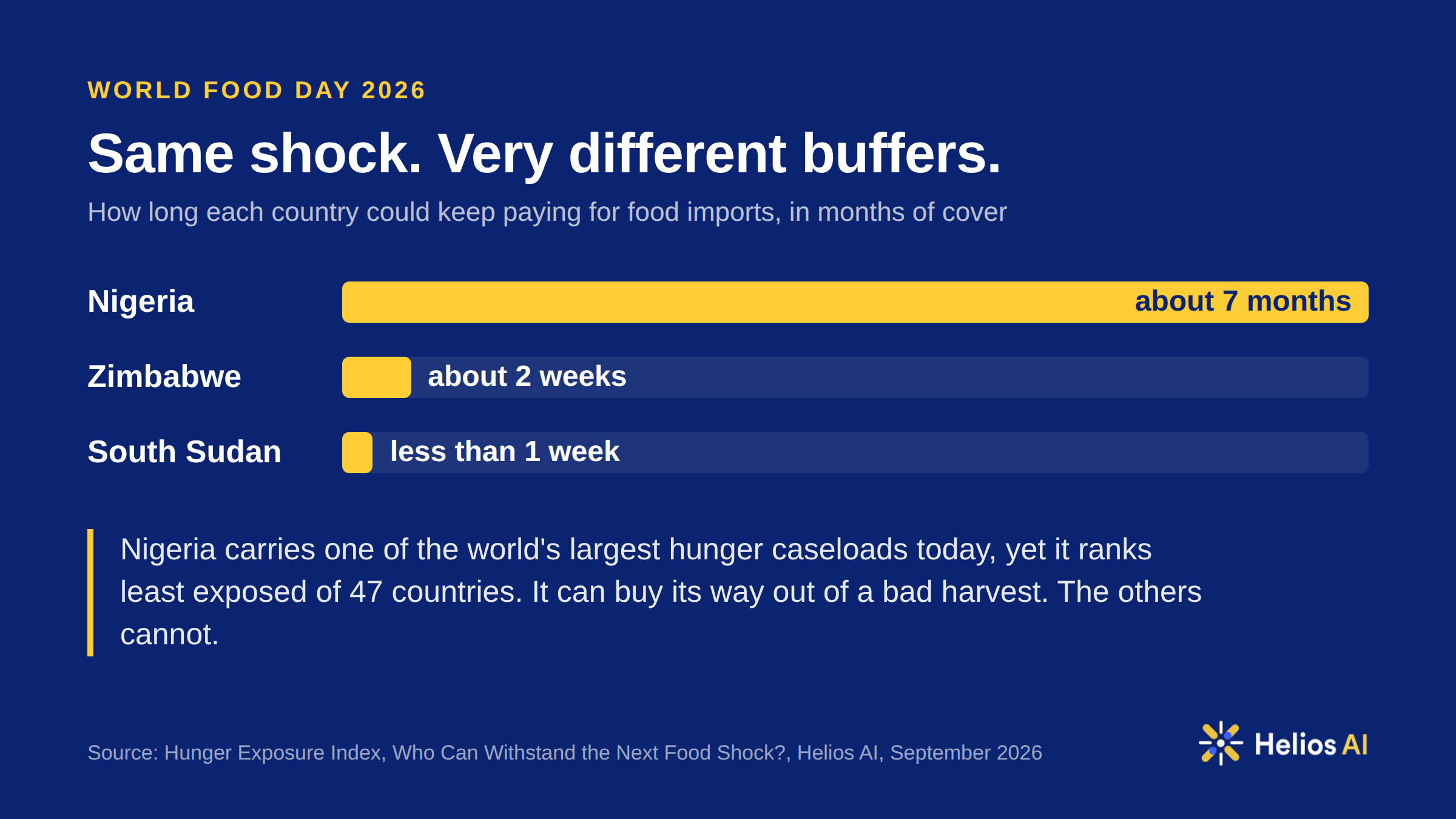
The number that makes the index legible is import cover, the number of months a country could keep paying for its food imports if everything else stopped. Nigeria has about seven months. Zimbabwe has about two weeks. South Sudan has less than one week.
Nigeria is the case that surprises people. It carries one of the world's largest hunger caseloads today, and it still ranks 47th of 47 on exposure, the least exposed country in the index. That is not a contradiction. Today's hunger and tomorrow's exposure are different measurements. Nigeria can buy its way out of a bad harvest. South Sudan cannot. The index exists to tell those two situations apart before a shock makes the difference obvious.
The full 47-country table is published with every value, free and ungated, in the report Who Can Withstand the Next Food Shock?
Why does October matter for the 2027 harvest?
Because the shock is a forecast, and the window to act on it is closing now. A strong El Niño is developing in the equatorial Pacific. Most of the 2026 crop was decided before its peak, which is why this year's harvests look fine on paper. The 2027 harvest is the one that grows through the aftermath: disrupted rains across parts of Africa and Asia, and fertilizer that is still hard to afford in the countries that need it most.
For the countries at the exposed end of the index, the pre-positioning window closes around October. Grain bought and shipped now arrives before the lean season. Grain bought after a harvest fails arrives into a market that has already repriced, with a currency that has already weakened. That is the whole difference between a shortfall and a crisis, and it is decided in the months when nothing looks wrong yet.
World Food Day lands inside that window. The attention it brings to hunger is real, but the useful question this year is not how many people are hungry today. It is which countries will not be able to respond when the 2027 shortfall lands, and whether anyone moves while there is still time to.
What would acting on a forecast look like?
It would look like treating exposure as a planning input rather than a post-mortem. Humanitarian funding still mostly follows the famine declaration, which by definition arrives after the point where money buys the most. A forecast that says South Sudan has less than a week of import cover and an El Niño harvest ahead is actionable in October. The same information in March of next year is a budget line.
It would also look like procurement teams and humanitarian planners reading the same evidence. A CPG buyer watching maize in East Africa and a WFP country office watching the same maize are looking at the same crop and the same rains. Today they read it in different systems, on different timelines, and discover the problem at roughly the same moment: too late. The innovation worth the name is a shared, forward-looking view of where the system breaks, and the discipline to move on it before it does.
The world is not short of food. It is short of foresight that anyone acts on. That is what nourishing tomorrow requires, and it is what we will keep building toward.
.png)

Personalized commodity intelligence for the teams that feed the world.
