
One Shock, Two Crises: What We Presented at International Grains Council Conference 2026
The International Grains Council conference in London brought together grain traders, procurement leaders, and agri-food executives from across the globe.…

June 23, 2026
3 min read


The International Grains Council conference in London brought together grain traders, procurement leaders, and agri-food executives from across the globe. We were there, and what we heard in that room confirmed something we've been tracking in the data for months: the assumptions buyers have been running on are quietly breaking down.
Why does the same shock create two different crises?
Francisco Martin-Rayo opened his panel with a sentence: "The wheat market is not one market.”
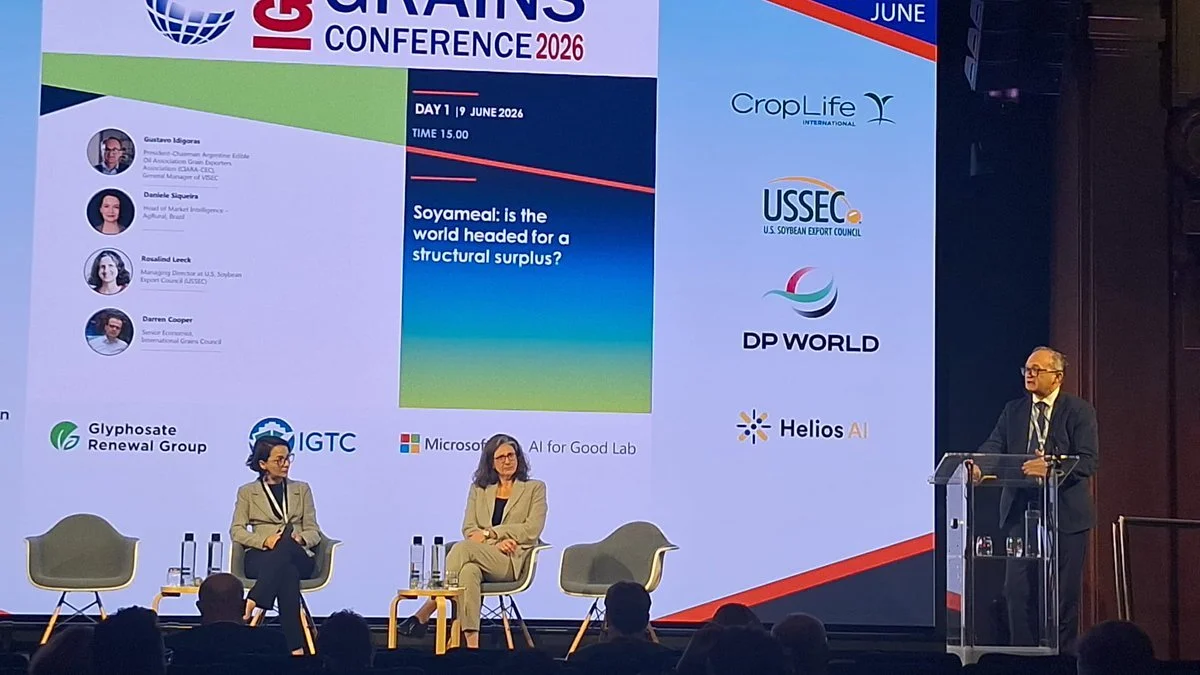
The May WASDE had just confirmed shrinking global buffers: production is down, carryout is drawing for a second consecutive year, and the smallest US crop since 1972. Most of the room was already tracking that. What Francisco argued was the part the headline number obscures: the same shock hits producers and importers on completely different clocks through completely different mechanisms.
On the producer side, the fertilizer disruption: urea is sitting roughly 80% above February levels; Hormuz concentration risk is still unresolved and doesn't hit Russia and Kazakhstan the same way it hits Australia, the US, or France. The first group is net urea exporters. The shock strengthens their position. The second group is net urea importers. It raises the cost of next year's crop. Same price environment. Opposite outcome.
On the importer side, the asymmetry runs along currency lines. Egypt and Indonesia, the two largest wheat-importing nations, don't pay in dollars. Chicago gave back its post-WASDE spike on good weather and soft demand, and prices fell below $6 per bushel. But emerging market currencies weakened at the same time, erasing much of that relief at the point of delivery. As our analyst Joao Morciani put it, cheaper wheat on the board doesn't produce a cheaper bill at the port.
The practical message for the procurement professionals in the room: origin diversification strategies built on spot price comparisons alone are missing half the picture.
DOWNLOAD IGC SLIDESWhat the hallway conversations confirmed
The data point is one thing. What reinforced it was the texture of conversations throughout the day.
Buyers are increasingly aware that the tools they've relied on: annual supplier contracts, static origin strategies, and backward-looking price benchmarks were built for a more stable environment. The volatility of the past three years hasn't been absorbed as a temporary disruption. It's being re-categorized as the new operating condition.
Several themes surfaced repeatedly: the need for earlier signals on production risk, not just price; the difficulty of translating climate forecasts into procurement decisions; and a growing recognition that the gap between what futures markets show and what companies actually pay once currency, freight, and input cost dynamics are layered in is wider than most internal models account for.
This maps closely to what we heard at the Cambridge Forum on Future Food Supply Chains earlier this year, where the conversation had already shifted from sustainability framing to operational language: supply chain resilience, procurement risk, and input cost exposure. Climate risk has left the ESG report. It's showing up in sourcing decisions.
What happens when the weather clock runs too?
El Niño hasn't run yet. NOAA recently upgraded its intensity forecast: a very strong event now sits at 63% probability this winter, with the same producer regions that are already carrying elevated fertilizer costs sitting in the firing line: Australia, US Hard Red Winter, and Southern Brazil.
The compounding risk isn't hypothetical. It's a known set of overlapping exposures arriving on different timelines. The fertilizer clock has already run. The weather clock is about to. Next Tuesday, we're hosting a live webinar, “Before El Niño Strikes: Which Agricultural Commodities Are Most Exposed in H2 2026?” where we will walk through exactly which commodities carry the highest compounded exposure as the season shifts. If you're making sourcing decisions for the second half of the year, this is the session to be in.
RSVP TO THE WEBINARWhat IGC made clear is that the question is no longer whether these risks are real. It's whether procurement and trading teams have the visibility to act before the market reprices them.
The teams that will be best positioned aren't the ones watching spot prices. They're the ones reading the full transmission chain, origin by origin, currency by currency, season by season.

.png)

Personalized commodity intelligence for the teams that feed the world.
