
Record Harvests. Record Hunger. Who Can Withstand the Next Food Shock?
Helios AI launches the Hunger Exposure Index, backed by a $3 million strategic investment from W23 Global and five of the world's leading grocery retailers.

September 16, 2026
3 min read
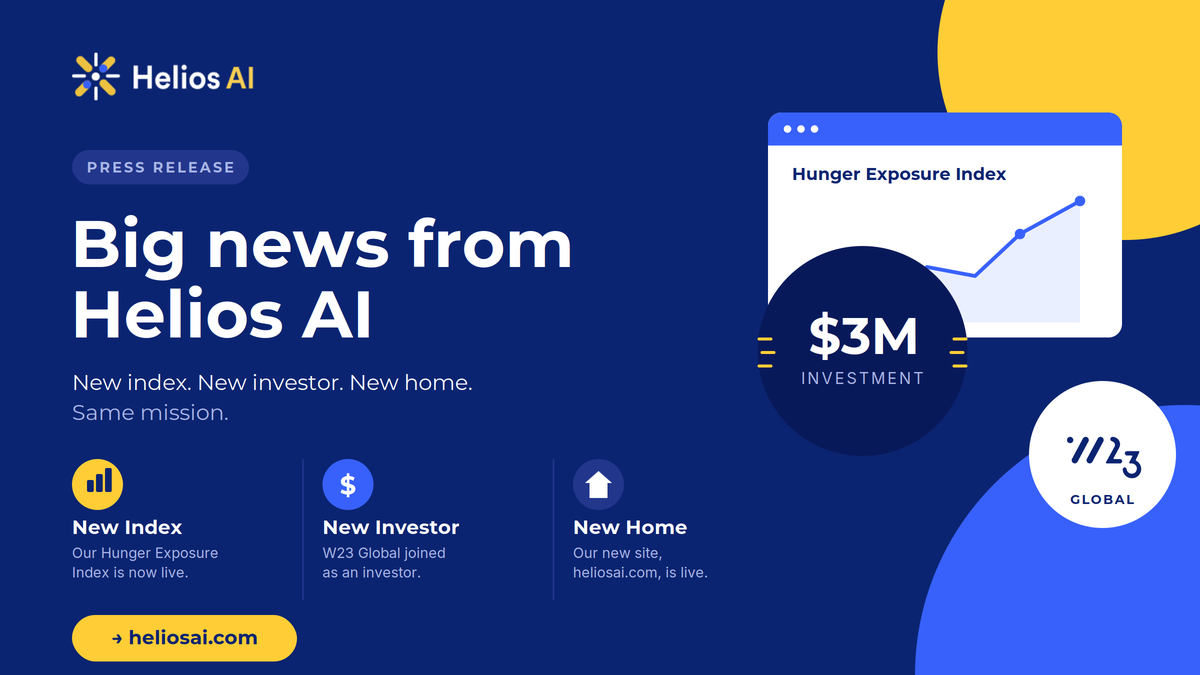
Helios AI launches the Hunger Exposure Index, backed by a $3 million strategic investment from W23 Global and five of the world's leading grocery retailers.
Over the last twelve months, the world grew its largest cereal harvest on record. In those same twelve months, acute hunger reached a new high of more than 266 million people. Both numbers are real. The distance between them is the story.
Availability was never the constraint. A failed harvest is survivable when a country can buy the difference on the open market. It becomes a catastrophe when it cannot.
"A failed harvest is survivable if a country can buy the difference on the global market, but it becomes catastrophic when it can't," says Francisco Martin-Rayo, co-founder and CEO of Helios AI.
That is the whole thesis, and the buffer it points to can be measured months before any shock lands.
The market that sees disruption first is backing the foresight
Today Helios AI is announcing a $3 million strategic investment from W23 Global, the venture fund backed by five of the world's leading grocery retailers: Tesco, Ahold Delhaize, Woolworths Group, Shoprite Group and Empire Company. These are the businesses that feel supply and price shocks before almost anyone else, and they are putting capital behind seeing those shocks earlier.
"Helios' predictive commodity intelligence enables retailers to act before supply and price risk reaches the market," said Ingrid Maes, CEO and CIO of W23 Global. "As climate risk, geopolitical disruption and shifting trade flows make commodity availability and pricing increasingly difficult to predict, earlier visibility into emerging risks helps retailers secure supply, manage cost pressures and ultimately protect availability and prices for customers."
The investment expands the same predictive intelligence behind the report we are publishing today.
What the Hunger Exposure Index measures
The Hunger Exposure Index scores what happens to a country when the next shock arrives, rather than counting how many people are hungry today. Those are different questions, and they produce different answers. The index runs 47 countries through four weighted inputs: climate risk to the cropping calendar, fertilizer and energy routing, the foreign exchange constraint, and import dependence weighed against how severe hunger already is. The variable that matters most is import cover, the number of months a country's reserves can pay for the food it does not grow. Below roughly six weeks, a lost harvest cannot be bought back at any price.
Nigeria makes the case. It carries one of the largest hunger caseloads in the world and lands last on the index, the least exposed of the 47, because it holds about seven months of import cover and exports fertilizer rather than importing it. Zimbabwe holds about two weeks. Score "how many are hungry now" and "who cannot absorb what comes next" as the same number, and you send help to the wrong countries.
See where every country lands. Explore the interactive Hunger Exposure Index map and download the full research report, Who Can Withstand the Next Food Shock?
Explore the Index
Download the Report
Earlier this year the closure of the Strait of Hormuz looked like the start of a global food crisis. We said so. So did most of the market. Six months on, it has not reached prices the way anyone braced for. Record South American and United States crops arrived in exactly the window that needed them, grown and fertilized before the disruption hit. The catch is that almost none of it is repeatable. Stockpiles do not refill themselves. A record harvest is one harvest.
A strong El Niño is now developing on top of a system that has already spent its slack. Most of what the world eats in 2026 is already grown or standing in the field. The crops carrying the real risk are the ones planted from late 2026 and harvested through 2027, facing the aftermath of the event and this year's fertilizer squeeze in the same season. Exposure, unlike the weather itself, is knowable now. The window to pre-position closes around October.
The reach extends well past retail. Helios AI is also welcoming Helga Flores Trejo as Senior Advisor to the CEO, carrying the work into governments and humanitarian organizations, where the exposure this index measures is often the line between a hard year and a famine.
"Climate change and the geopolitical realignment are propelling food security to the forefront of national security concerns. As volatility becomes the new normal, predictive intelligence, not just reactive measures, is what this moment demands," said Helga Trejo. "The forecasting models Helios AI has built, mapping climate risk, commodity price shocks, and supply chain disruption at the district level, are exactly the kind of applied AI this challenge requires, and I am eager to help scale that capability."
Most of what 2027 will cost is still being decided right now, in planting choices being made this season, in fertilizer applied or skipped, in reserves built or left empty. There is still time to change the number. The index is where that work starts.
Read the full analysis
The Hunger Exposure Index ranks all 47 scored countries and sets out our dated calls for 2027, each with a public revisit date.
Explore the Interactive Index
Download the report
Go deeper, live
The FAO & IFPRI join Helios AI on a live webinar to dive deeper into the Hunger Exposure Index.
Save your seat
Covered in the press

.png)

Personalized commodity intelligence for the teams that feed the world.
