
The Bloom Sets the Price Weeks Before the Harvest Does
The blueberry price outlook looks calm: US spot prices are easing into peak harvest. Yet the climate-risk signal that historically leads a price move by…

July 23, 2026
10 min read
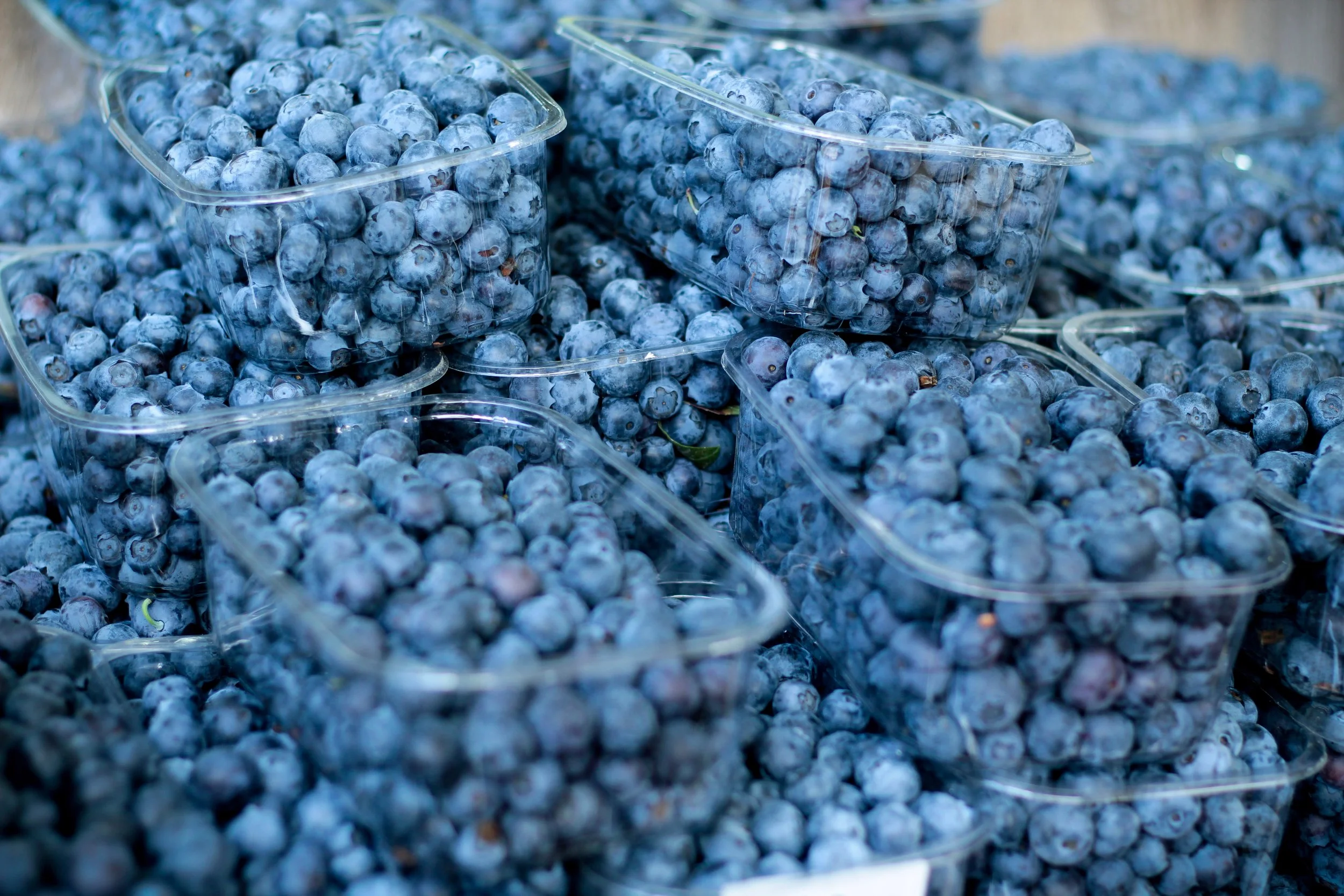
The blueberry price outlook looks calm: US spot prices are easing into peak harvest. Yet the climate-risk signal that historically leads a price move by weeks is already flashing Warning across Peru and three US states — and reading that gap is the whole game.
João Pedro Rodrigues Morciani · Senior Analyst, Helios AI
The blueberry tape is quiet right now, and that is exactly what makes it interesting. As Oregon and Washington ramp and California, Georgia, Florida and Mexico all ship, US spot prices are easing into domestic peak harvest: flats of 12-by-6-ounce cups have been running mostly US$15.95 to US$17.95 and softening as supply builds (FreshPlaza, July 20, 2026). Our own shipping-point read agrees. US aggregate wholesale sat at USD 2.29/lb on July 13, 2026, from U.S. Department of Agriculture (USDA) data via Helios, and the global cross-source average was USD 2.77/lb — just 4.4% above its five-year norm. A buyer scanning spot today sees calm.
Our climate-risk ratings do not. In the July 19, 2026 run, Peru's Ica and Lambayeque regions both carry a 1.0-star Warning, and three US states — New Jersey, Michigan and Oregon — are rated Warning in the middle of their harvest. That is the tension. Blueberry prices do not move when the harvest disappoints. They move weeks earlier, when the bloom does. The spot tape is the last thing to know.
Blueberry prices lead the harvest because the crop is set before it is picked.
The mechanism is agronomy, not sentiment. A blueberry crop is fixed long before it reaches a terminal market, and chill gates everything. The plant needs a stretch of winter cold to flower properly — northern highbush varieties want 800 to 1,000-plus "chill hours" below 7 °C, with southern highbush and rabbiteye types needing far fewer, per University of Georgia Extension. Flower buds set in late summer and fall, and enough winter chill lets them break the following spring. Deny that chill, in the words of the same extension guidance, and you get "poor bud break, erratic flowering, and drastically reduced yield." That is why a warm winter is a blueberry problem specifically, not a generic weather headline — and it is exactly what an El Niño delivers to Peru's coast, which is where the 2023 season turned.
That sequence builds a lag into the price. Bud break, bloom and fruit set happen weeks to months before fruit arrives at wholesale. A climate anomaly in that window fixes the volume envelope early; the price only prints when the thinned volume shows up. The gap is what we call the bloom-to-price lag. As with coffee, whose climate premium we traced session by session, the field data records the damage first and the market reprices it later — only in blueberries there is no futures market to anticipate it, so the lag plays out against a physical shipping-point print.
Peru 2023 is the dated proof.
One season shows the mechanism closing in real numbers. Peru is the world's largest fresh-blueberry exporter and the marginal supplier into the September-to-November global window, so a Peruvian bloom-window anomaly transmits straight to the world wholesale price. In the austral autumn and winter of 2023, an El Niño-driven warm, wet coastal anomaly denied the crop its chill. Our climate-risk wet-stress score for La Libertad, Peru's largest blueberry region, first escalated to 72 the week of June 25, 2023, eased, then re-escalated to a peak of 75 by September 3. Lambayeque had shown the coastal-flood signature even earlier, a monthly wet score of 88 back in April. Heat and dry scores stayed near zero throughout: this was chill denied by warmth and humidity, precisely the setup that suppresses flowering.
The price followed, on a clock you can count. Peru's US import wholesale held near its historical norm through the shoulder, roughly USD 3.10 to 3.30/lb (USDA, Imported–Shipping Point, US market, via Helios). Then it broke the week of September 25 to USD 5.62/lb, up 116% versus five-year history, peaked at USD 5.66/lb (+177%) through early October and early November, and stayed elevated near USD 4.59/lb (+40 to +50%) into January 2024. The global cross-source wholesale average tells the same story independently, jumping from USD 2.69/lb in early September to USD 5.62/lb by early October (+117%). That is a terminal-market lag of about three weeks from the peak reading on September 3 to the price break on September 25 — and up to roughly thirteen weeks from the first escalation in late June.
The outcome corroborated the read. Full-season Peru exports fell about 24% year over year in 2023/24, and the industry named the mechanism plainly: a warm winter denied chill, and the dominant Ventura variety aborted flowering in favor of vegetative growth (FreshPlaza; International Blueberry Organization). "Higher prices helped cushion the losses," the trade reported. The climate signal had priced the shortfall a full quarter before the accounts closed.
The rule: read the escalation, not the harvest.
Treat a bloom-window rating escalation as the coverage-decision date. The rule that falls out of Peru 2023 is simple: when a lead origin's per-region climate-risk rating escalates during its bloom or fruit-set window, that is your signal — weeks before the wholesale market reprices. Act on the first escalation and you buy the maximum lead time at the cost of some false positives; wait for the sustained peak and you trade lead time for confidence. Call the usable window 4 to 12 weeks, and treat it as a mechanism with error bars, not a law. One worked example is one data point.
And name what would falsify it. The lag can be muted. Peru is planting into record acreage and extending its production windows, so more plants and a longer season can offset lower per-plant yield and blunt the price move even when the bloom is stressed. The signal is also regional, not blanket — a feature, because it makes exposure hedgeable origin by origin. In the same July 19, 2026 run, Peru's tropical Piura region sits at 3.0-star All Good, a clean control showing the Warning is specific to the chill-dependent coastal regions, not the whole country. If the stressed regions still ship volume, or a well-timed weather shift restores flowering, the price move fails to arrive. That is the honest boundary on the read.
The signal is flashing now.
The live setup rhymes with 2023. A warm winter is exactly what this El Niño threatens. NOAA's Climate Prediction Center has an El Niño Advisory in effect and, as of July 9, 2026, puts an 81% chance on a very strong event in October through December — the window Peru's crop depends on. On the ground, our July 19 run already rates Peru's Ica at 1.0-star Warning on record heat: 65% of harvest-period days ran above threshold, the 100th percentile and far past the prior eight-season high near 15%. Lambayeque is also at 1.0-star Warning, on its worst dry season and second-worst heat on record for the phase. La Libertad, the 2023 protagonist, sits at 2.0-star Watch.
Helios AI climate-risk ratings, Blueberries — run July 19, 2026
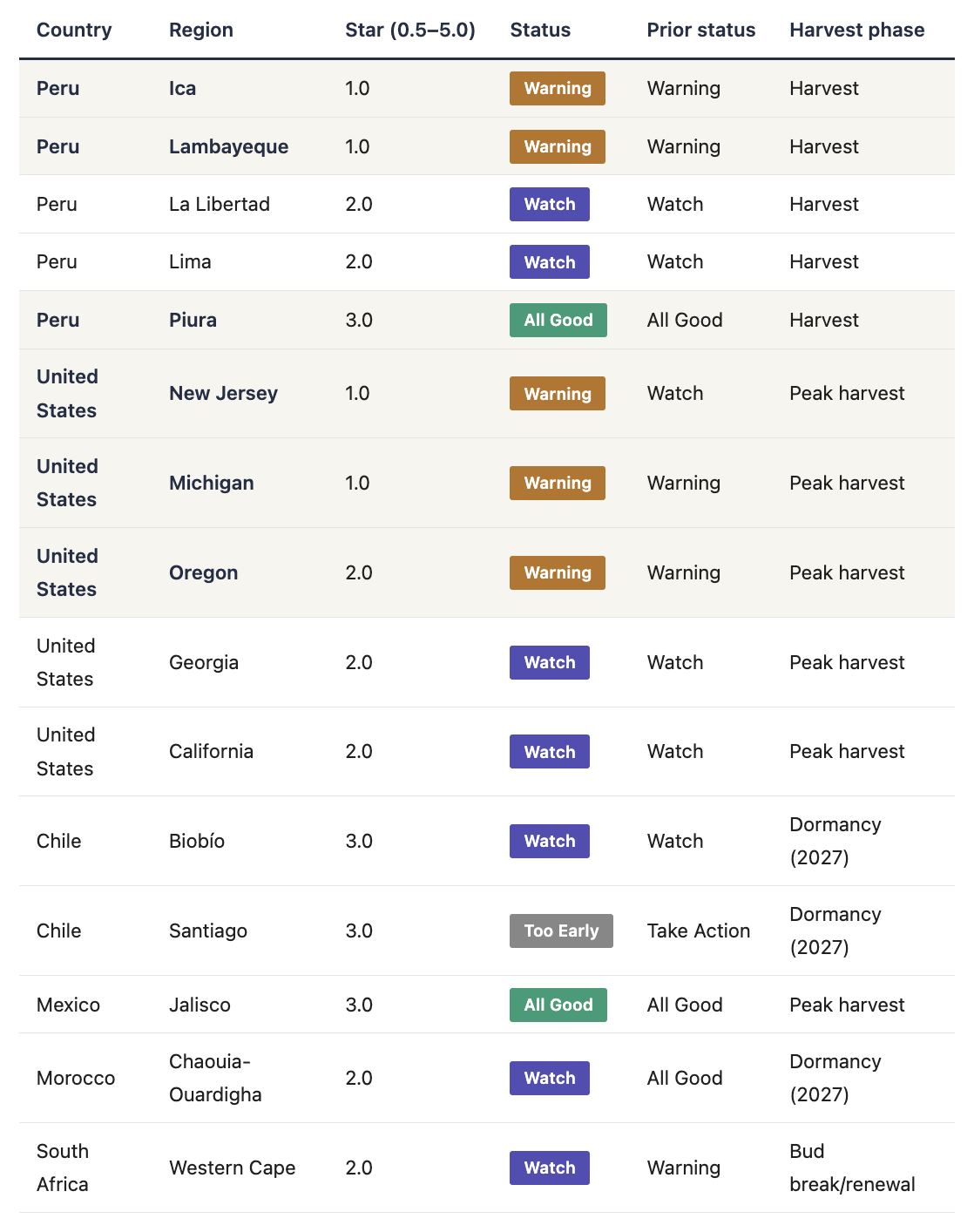
Chart 1 (C1): Helios AI per-region climate-risk ratings, Blueberries, run July 19, 2026. Star 0.5–5.0 (higher = lower risk); status = climate-risk status indicator. Highlighted rows: Peru's Ica and Lambayeque at Warning against Piura's All Good control, and the three US peak-harvest Warnings (New Jersey — freshly upgraded from Watch — Michigan and Oregon).
Peru's own growers have shifted to reading the bloom. ProArándanos, the Peruvian blueberry growers' association, projected roughly 56,000 tonnes over the following ten weeks (+40% year over year) on June 9, 2026, then warned that temperatures had "started warming up" and could "affect flowering and fruit development during the seasonal peak" — and switched from a full-season estimate to short-term ones, calling the longer view "not yet sufficiently reliable." That is a rare public admission that the bloom-window read is now the operative forecast.
“If El Niño significantly disrupts that supply, we anticipate a market response similar to what we experienced during the 2023-2024 season.”
- Kasey Cronquist, President, North American Blueberry Council
The domestic tail is flashing too, against a soft tape. In the US peak harvest, New Jersey has just been upgraded from Watch to Warning on a reproductive-development drought that hit 80.6% of days — the 100th percentile, worst in eight seasons against a historical median of zero — which "directly threatened fruit set." Michigan is a 1.0-star Warning on record cold during fruit fill, and Oregon a 2.0-star Warning on harvest heat. Yet Michigan's shipping-point wholesale printed USD 1.71/lb on July 13 and South New Jersey USD 2.00/lb on July 6 — at or just above their historical norms. The signal is loud; the price is asleep. That gap is the lead time, live.
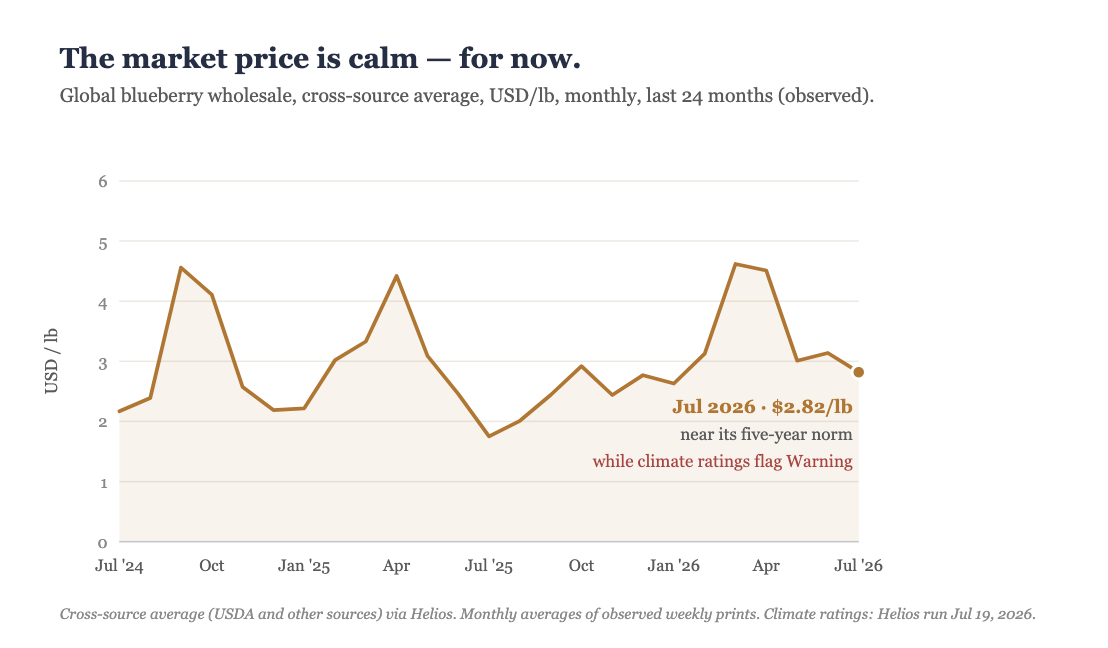
Chart 2 (C2): Global blueberry wholesale, cross-source average (USDA and other sources) via Helios commodity_prices_weekly, USD per lb, monthly, last 24 months (observed). At USD 2.82/lb in July 2026 the market sits near its five-year norm, even as Helios AI climate-risk ratings flag Warning across Peru and three US states (run July 19, 2026) — the calm tape against a flashing forward signal.
The Bottom Line.
A quiet spot market is not the same as a quiet crop. The Peru 2023 loop shows the mechanism paying out: a climate-risk escalation that peaked in early September preceded a +116% price break three weeks later and a move that held for a quarter, exactly the kind of response the trade is now bracing to repeat. Today the same instrument is at Warning across Peru's coastal core and the US harvest belt while the tape sits near its five-year norm. The buyer's decision is not to forecast the size of this El Niño — no one can price that yet — but to choose whether to position while the outcome is still wide or after the market has narrowed it. This is the specialty-crop leg of our El Niño procurement playbook, and the same forward, climate-integrated method runs next in the mango price map. The bloom has already voted. The price just hasn't counted the ballots.
Frequently Asked Questions
What is the blueberry price outlook for 2026?
As of mid-July 2026, US spot prices are easing into domestic peak harvest — the global cross-source wholesale average was USD 2.77/lb on July 13, 2026, just +4.4% above its five-year history (USDA via Helios). The forward risk sits in the September-to-February Southern-Hemisphere window: our climate-risk ratings have Peru's Ica and Lambayeque at Warning on record heat and drought (run July 19, 2026), which historically leads a price move rather than following one. The honest framing is a soft tape now with a flashing forward signal, not a confirmed spike.
Why do blueberry prices move before the harvest?
Because the crop is fixed before it is picked. Chill accumulation and bloom set the fruit weeks to months before volume reaches a terminal market, so a climate anomaly in the bloom or fruit-set window determines the volume envelope early. The price only reprints when the thinned volume arrives at wholesale — so the climate signal necessarily leads the price.
What is the bloom-to-price lag, and how long is it?
It is the gap between a bloom-window climate-risk escalation and the wholesale price move it precedes. In Peru's 2023/24 case, the Helios climate-risk signal peaked on September 3, 2023 and the US import price broke the week of September 25, 2023 (+116% versus five-year history) — about a three-week terminal lag, with up to roughly thirteen weeks from the first escalation in late June. We frame the usable window as 4 to 12 weeks, depending on whether you act on the first escalation or wait for confirmation.
Which countries drive blueberry prices through the year?
Northern Hemisphere supply — the US and Mexico — runs roughly May through August or September. Southern Hemisphere export supply — Peru, Chile, South Africa — runs roughly September through February, with Peru dominating the September-to-November global window as the world's largest fresh-blueberry exporter. Because Peru is the marginal supplier into that window, a Peruvian bloom-window anomaly transmits to the global wholesale price.
How does El Niño or a climate anomaly affect blueberry supply?
A warm coastal winter can deny the crop the chill hours it needs, causing poor bud break and, in Peru's dominant Ventura variety, flower abortion in favor of vegetative growth. NOAA CPC has an El Niño Advisory in effect (July 9, 2026), with a 97% chance the event persists into early spring 2027 and an 81% chance of a very strong event in October–December — the setup that reproduces the 2023 chill-denial event. Peru's 2023/24 exports fell about 24% year over year under that pattern.
How can a procurement team use an early climate signal to time blueberry coverage?
Treat a bloom-window rating escalation for a lead origin as the coverage-decision date, not the harvest report. Acting on the first escalation buys maximum lead time with more false positives; waiting for a sustained peak trades lead time for confidence. Because the signal is regional — Peru's Piura sat at All Good while Ica and Lambayeque were at Warning in the July 19, 2026 run — exposure can be hedged origin by origin rather than treated as a single country bet.


.png)

Personalized commodity intelligence for the teams that feed the world.
