
The Hazard Changed. The Headline Didn't.
Mexico's avocado crop went on Watch on 2 August for a drought that has since receded, and what a Q4 buyer now carries sits in two dated windows of excess rain, in October and in…

September 3, 2026
14 min read

Mexico's avocado crop went on Watch on 2 August for a drought that has since receded, and what a Q4 buyer now carries sits in two dated windows of excess rain, in October and in November, arriving through the channel that actually prices this market: weekly shippable volume and fruit size, not the size of the crop.
By João Pedro Rodrigues Morciani · Helios AI
The Drought Ended Before This Piece Was Written.
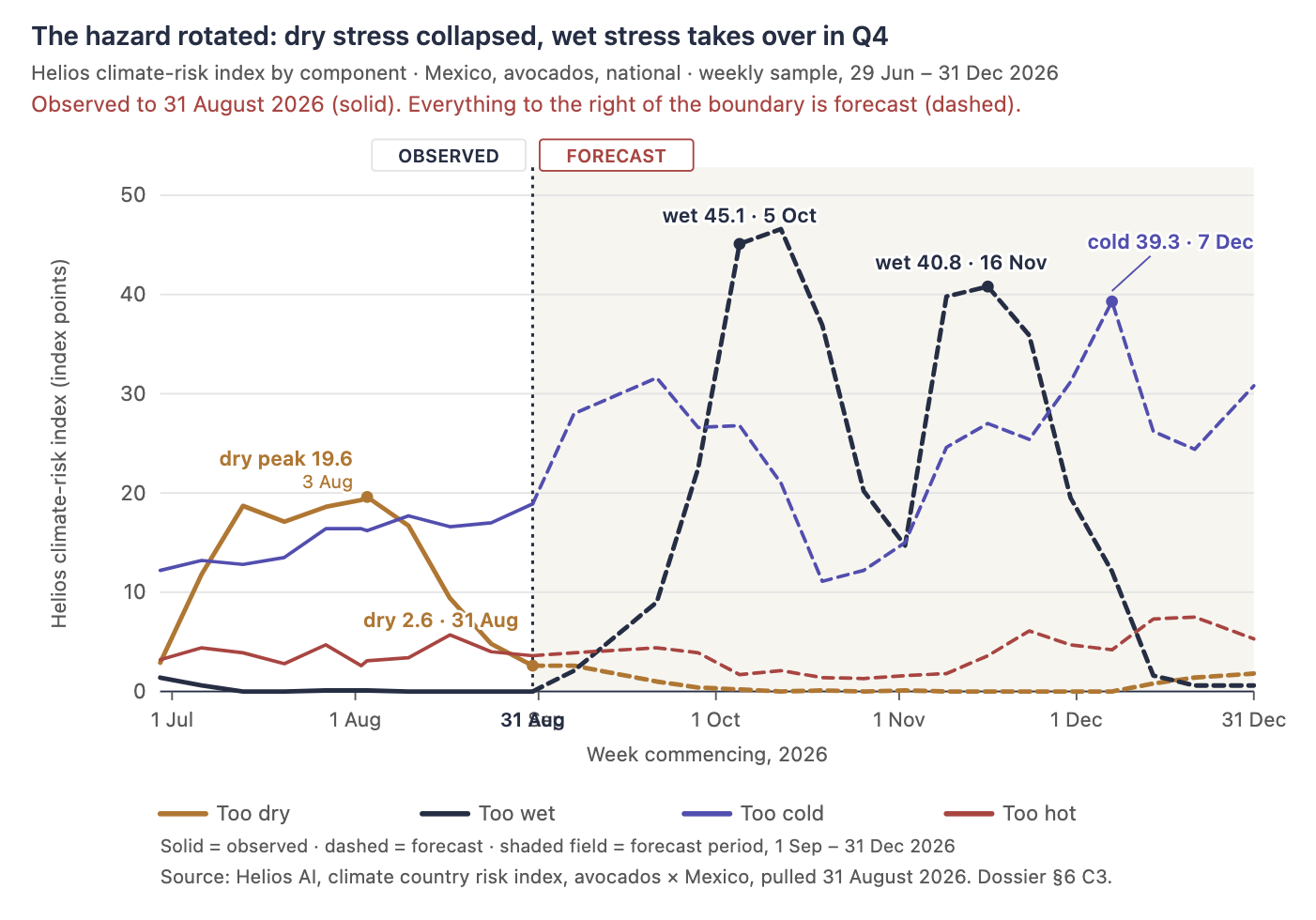
We put Mexican avocado on Watch on 2 August, and the hazard behind that call is already gone. The dry-stress component of our national climate-risk index peaked at 19.6 index points on 3 August and reads 2.6 on 31 August. In Michoacán, nearly three-quarters of the crop we track, it fell 90% over the same four weeks, and our forecast for the rest of the season carries no dry days at all.
Mexico's own water agency measured the same episode on instruments that share nothing with ours. CONAGUA put Michoacán's moderate-drought footprint at 10.2% of state area in mid-July, the year's peak, easing to 5.4% by its 15 August edition, with nothing at all in severe drought or worse. On the edition of 31 May 2024 that most extreme category held 59.3% of the state. Two systems, one episode, the same calendar.
The story a buyer is being told has not caught up. Michoacán drought and Super Bowl scarcity is a narrative that recurs in trade and consumer coverage most Januaries, and it is running again now against a hazard that has already passed.
a yield, a production figure or a harvest outcome. It is a climate-stress reading on a season 66% complete, and no rating here is an outcome.
We Can Say Michoacán Was Dry in July. We Cannot Say It Is Dry Now.
There is a version of this article that keeps the drought alive another month, and our own error bar is why we are not writing it. Michoacán reads 5.0 index points above its historical average today, against a published margin of error of ±7.81 points for that region, and our severity flag there never left Low, including on 2 August. July's dry stress was real and measurable. Today's is not something our numbers can carry.
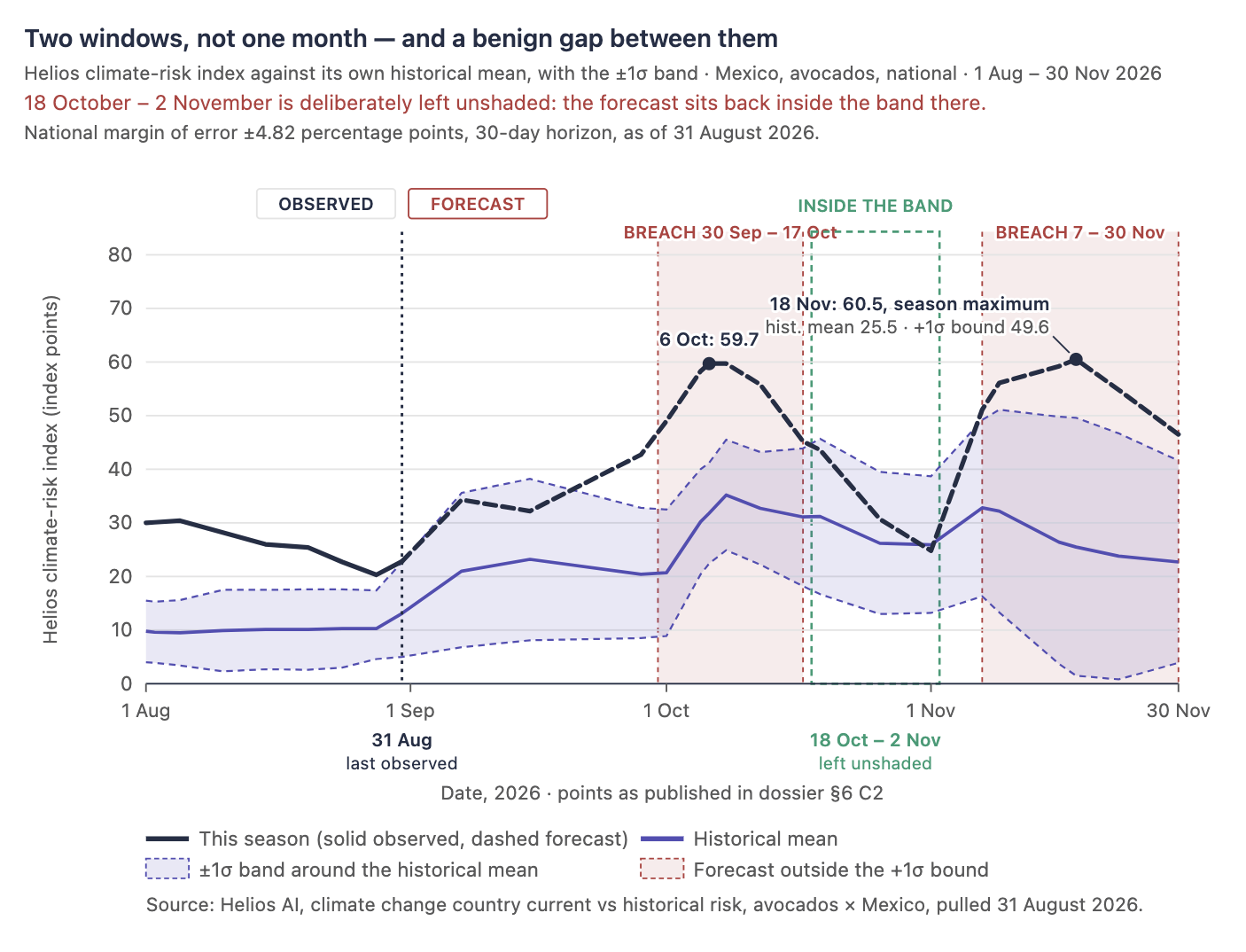
Which invites a fair question: why trust the forecast when the observation sits inside the band? Because they are not the same size. The November gap is roughly seven times the national margin of error of ±4.82 points; the reading we are declining to claim anything about is two-thirds of a wider one.
Two Windows, Not One Month.
What a Q4 buyer actually carries is not a drought. It is rain, twice, on dates we can name. Our forecast leaves its normal band, one standard deviation either side of its own historical mean, from about 30 September to 17 October, peaking on the 6th. It leaves again from about 7 to 30 November, peaking on the 18th at 60.5 index points against a historical mean of 25.5, the season maximum. Excess rain drives both, with the dry component at zero throughout.
Between 18 October and 2 November our own forecast sits back inside the band, and we would rather print that than round it away. A piece that told you October and November were risky, full stop, would be misreading its own chart. The quiet fortnight is the part that makes the two loud ones testable.
Both windows sit inside the interval where a climate signal is worth acting on. Our August basis research put that interval at four to twelve weeks. Early October is five weeks out and mid-November eleven, which is the whole reason this runs now rather than in November.
a price, a yield or a production figure. The breach windows are approximate at their edges, which is why they are written as "about", and the shading follows the dated points in the table below rather than a smoothed envelope.
What Excess Rain Does to a Harvest, and Where It Reaches a Price.
Both windows land in Peak Harvest, where rain stops being a growing-season variable and becomes a picking problem. Roughly 65% of Michoacán's orchards are rain-fed, per USDA's Foreign Agricultural Service, and wet ground decides whether crews and trucks reach a block in a given week. The same rain carries a quality cost. UC's Statewide Integrated Pest Management Program, published agronomy rather than a Helios output, puts it plainly: anthracnose "becomes a postharvest problem after the grove has been excessively wet for extended periods," and its instruction to growers is to "harvest only during dry conditions." Fruit picked wet arrives with more rot behind it, and that shows up at the retail end of the chain, not at the orchard.
This market prices weekly shippable volume, not annual tonnage, and it proved that four months ago. In May 2026 Mexican movement into the United States fell from 65.1 million pounds to 48.6 million in two weeks. USDA two-layer carton prices went from $25.61 to $37.82 over the same fortnight, a 48% move, as reported on 2 June 2026. Our own weekly series, Mexican Hass on an imported shipping-point basis, ran $2.82 per kilogram on 27 April to $4.56 on 25 May, up 62%. Westfalia Fruit declared force majeure and Mission Produce's senior director of sales, Galen Johnson, told FreshFruitPortal on 28 May that "available supply is no longer sufficient to meet US demand." None of that required the crop to be short.
And the fruit-size channel does not settle in the quarter it is created. USDA's Avocado Annual for Mexico records the lag in one sentence: "Early 2025 saw prices spike due to shortages, coming off from a hot winter in 2024." Second-half weather damages calibre and the bill lands the following Q1. For anyone covering Q1 2027, that is the exposure these two windows sit in front of.
The season's other anomaly works on the same thing the rain does. Across the season to 31 August, 88.5% of national days registered cold stress, against zero in each of 2021 through 2024. CONAGUA reached it independently: in a July when most Mexican states came in warmer than their own history, only two were classified cooler at the minimum-temperature end, and Michoacán was one. The precision matters, because it is easy to overwrite. Michoacán did not have a cold July in absolute terms; it ran cool against a nationally hot one and against its own historical distribution. Cold slows sizing, and it is forecast across the same Peak Harvest the rain is disrupting.
The honest counterweight is that the size channel is narrower this year than last. Rabobank's 2026 avocado update, as reported rather than read at source, has the price ratio between the smallest and largest fruit compressing from about 1:3 in 2025 to roughly 5:6 in 2026. If big fruit is barely worth more than small fruit, a sizing shock has less price to transmit. That is the strongest argument against this piece, and a buyer should hold it alongside the rest.
The Crop Is Flat, and August's Price Had Another Cause.
Nothing here is a supply call, and the arithmetic is the reason. Our supply module puts Mexican production for calendar 2026 at 2,784,390 tonnes, USDA's Foreign Agricultural Service forecasts 2,800,000 in its 12 March 2026 Avocado Annual, and SIAP, Mexico's agri-food information service, published a definitive 2025 actual of 2,792,481. Three numbers inside 0.6% of each other. "Record" is not available either: SIAP's series peaks in 2023, and the "record 2.8 million tonnes" circulating in trade coverage is an artefact of a lower base year.
A rating is a risk state during a season. It is not a harvest. Every region in our tracked set, carrying 95.2% of national production, is forecast above historical-average yield by our own supply model, including both rated Warning. The caveat belongs with it: that table applies one national baseline to every region, so it cannot resolve regional differences at all.
There is also a reason not to read August's price as a climate signal. Our escalation landed on 2 August. On the 5th the United States suspended its agricultural personnel's activities in Michoacán over a security threat, halting the phytosanitary verification exports depend on; inspections resumed through the second half of the month. It is the month's largest dated supply event, and it is not weather.

that 2026 is a record. It is not the highest bar in its own series, and neither 2026 figure is an actual.
What Would Prove This Wrong.
The first test arrives in six weeks. If the observed index stays inside its upper bound through 17 October, the October half of this call has failed and the November half stands unsupported until it verifies alone. If the breach comes but the wet component is not what drives it, the mechanism named here is wrong even where the index is right. And if CONAGUA's September editions put Michoacán back near last year's 94.6% unaffected, July's episode carried no Q4 consequence at all.
The Bottom Line.
A buyer covering Q4 does not need a view on a drought that ended in the first week of August. Two dates carry what is left: the fortnight around 6 October, and the week around 18 November. Between them, our own forecast puts the crop back inside its normal band. What those dates threaten is not the size of the crop. It is how much fruit moves in a given week, at what calibre, with how much rot behind it, and that is a Q1 2027 problem being set now.
No 2026/27 Mexican crop forecast exists anywhere. Not from USDA, not from APEAM, the Mexican growers' and exporters' association, not from SIAP. Anything said today about Q4 2026 and Q1 2027 is said into a vacuum, and the honest version of that is a dated climate read with its error bar beside it.
Frequently Asked Questions
What does the avocado prices 2026 forecast look like for Q4?
We do not publish a price forecast in this piece, and the reason is a house rule rather than a gap: our forward statement is a climate statement, and price is the consequence a reader argues toward with their own basis. What we can give you is an observed print with its basis. Mexican Hass in our own weekly series, on an imported shipping-point basis, reported in the United States, averaged $3.12 per kilogram on the observation week ending 24 August 2026, against $3.96 per kilogram on the same basis a year earlier, a fall of 21.1%. The forward part of the argument is the two forecast breaches: roughly 30 September to 17 October, and roughly 7 to 30 November 2026, driven by excess rainfall. The channel it reaches a buyer through is weekly shippable volume and fruit size rather than annual tonnage, which is the mechanism the body of this piece sets out.
Is the Michoacán avocado harvest 2026 short?
No, and none of the available evidence says it is. Our own supply module puts calendar-2026 Mexican production at 2,784,390 tonnes on a 1 August estimate; USDA's Foreign Agricultural Service forecasts 2,800,000 tonnes in report MX2026-0019 of 12 March 2026; SIAP's definitive 2025 actual was 2,792,481 tonnes. Those three sit within 0.6% of each other. Every one of the eight regions we track, carrying 95.2% of national production between them, is forecast above historical-average yield by that same supply model. A Watch rating describes a risk state during the season. It is not a harvest outcome, and this piece makes no shortfall claim.
What actually drives Mexico avocado supply Q4 2026?
Two dated windows of excess rain, and a cold-stress reading that has no analogue in our record. Our forecast has the national index breaching its +1σ band from about 30 September to 17 October, peaking at 59.7 points on 6 and 8 October, then again from about 7 to 30 November, peaking at 60.5 on 18 November against a historical mean of 25.5. Between 18 October and 2 November the forecast is back inside the band. One structural point a US buyer should hold alongside that: only Michoacán and Jalisco are approved to export Mexican avocados to the United States, per USDA's Foreign Agricultural Service, so risk readings for other producing states do not reach a US programme.
Was there a drought in Michoacán in 2026?
In July, modestly, and it has receded. CONAGUA's monitor put Michoacán's D1 area at 10.2% in mid-July 2026, the year's peak, easing to 5.4% by 15 August, with zero percent of the state in D2 or worse. Our own dry-stress component peaked at 19.6 index points nationally on 3 August and reads 2.6 on 31 August. The indicator pointing the other way is storage: Michoacán's 24 dams averaged 71.10% in a figure attributed to CONAGUA's state delegate on 21 August 2026, above the 68% reported a year earlier. Water scarcity in Michoacán is not something we can evidence today.
Why did Mexican avocado exports stop in August 2026?
Security, not weather. On 5 August 2026 the United States suspended its agricultural personnel's activities in Michoacán over a threat to US interests, which halted phytosanitary verification and with it avocado exports from the state; inspections resumed progressively through the second half of August. Our climate escalation landed on 2 August, three days earlier and on a different cause. Any August price move in Mexican avocado has at least two explanations, and the larger one is not climatic.
What would prove this analysis wrong?
Three things, all of them observable. If the index stays inside its +1σ upper bound through 17 October 2026, the October call has failed. If it breaches on cold or heat rather than on the wet component, the named mechanism is wrong even where the index is right. And if CONAGUA's September editions return Michoacán to something like last year's 94.6% unaffected, the July episode carried no Q4 consequence. One boundary condition is worth stating with those: our climate season for Mexican avocado is calendar 2026 and reads 66% complete, while the fruit a Q4 2026 or Q1 2027 buyer is covering belongs to the 2026-27 trade season now beginning. Season completeness in our product is not season completeness in the trade's.


.png)

Personalized commodity intelligence for the teams that feed the world.
