
Vegetable Oils at the Center: Energy Shock, Supply Resilience, and Policy
The CBOT soybean oil front-month contract opened 2026 at 48 cents per pound. By June it had touched 79 cents — a roughly 65% move in five months. The USDA…

June 25, 2026
9 min read

Joao Morciani · Senior Analyst, Helios AI
Act One: The Inversion
The CBOT soybean oil front-month contract opened 2026 at 48 cents per pound. By June, it had touched 79 cents — a roughly 65% move in five months. The USDA WASDE now forecasts the 2026/27 marketing-year average at 70 cents per pound — up 7 cents from a year earlier — a number that lands in a footnote but marks a structural repricing a decade in the making.
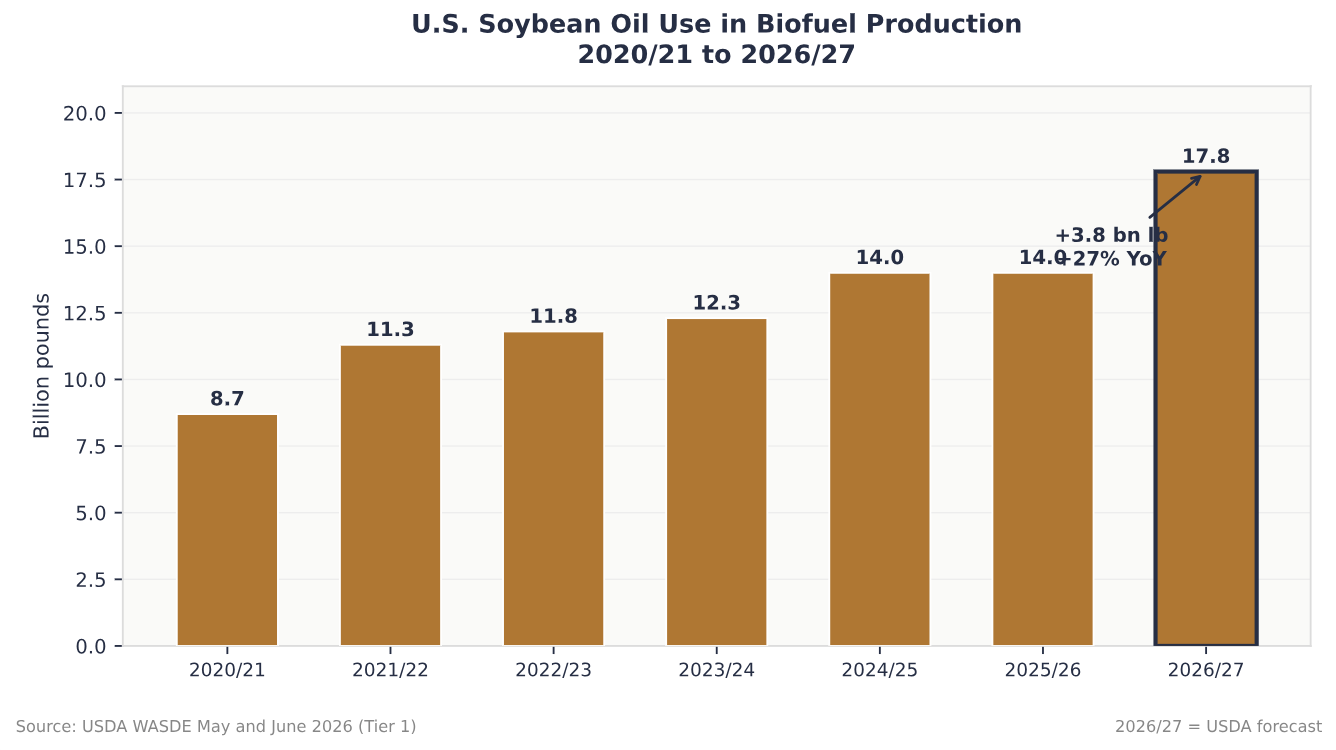
The standard reading of that chart is a biofuel demand story. That reading is incomplete. The fuller version:
Food demand still accounts for the largest share of vegetable oil consumption — but it no longer sets the price. Demand growth has changed hands. Food consumption grows slowly, with population and income; biofuel consumption grows in policy-driven steps, and that is where the marginal barrel now comes from.
That distinction inverts forty years of intuition. From the 1970s to the early 2020s, vegetable oils were priced on the food-demand stack, crush economics, protein extraction, and oil yield, and biofuel use was the modest policy-driven increment on top. Food demand set the clearing price.
That is no longer true at the margin. In the 2026/27 USDA forecast, U.S. soybean oil consumption in biofuel production reaches 17.8 billion pounds — up 3.8 billion pounds, or 27%, from the prior year. That single-year increment is not a marginal bid from blenders chasing economics; it is the arithmetic consequence of four simultaneously operative policy floors: the U.S. Treasury 45Z Clean Fuel Production Credit, the EU ReFuelEU Aviation mandate, Brazil's Future Fuel Law, and Indonesia's B40 biodiesel program.
When four independent mandates mature in the same two-year window, the demand they create is structural, not cyclical — and because policy sets it rather than appetite, it can jump at the stroke of a regulator's pen, far more exposed to sudden shifts than the slow demographic growth of the food stack.
The biofuels-as-industrial-policy reframe we developed last month established the regime change. The task here is to make it tradable: where the price is set, who sets it, and what moves it in discrete jumps rather than along a smooth curve.
Act Two: Supply Resilience and the Four-Oil Complex
A structural demand floor matters only if supply cannot expand to meet it. The data suggest it cannot — not on the timeline the mandates require.
The FAO Vegetable Oil Price Index rose 5.9% in April 2026 to its highest reading since July 2022. Palm, soy, sunflower, and rapeseed oils all contributed. FAO's Food Outlook identifies a structural deficit of approximately 3 million tonnes in 2025/26, with carry-over inventories declining for a third consecutive season.
The index is not signaling a weather event or a trade disruption — it is signaling that the global vegetable oil supply-demand balance has shifted in a way the food stack alone cannot explain.

The four-oil complex, soybean oil, palm, sunflower, and rapeseed, does not behave as one market. University of Illinois farmdoc researchers documented in December 2025 what practitioners had seen for months: the historical soybean oil–palm oil price correlation has been structurally broken since 2020. Pre-2020, soybean oil carried a stable, slight premium to palm; the spread reached 113% in September 2022. Then, in late 2024, came an unprecedented reversal: palm oil futures exceeded soybean oil prices for the first time since the 1990s.
There is no longer a single global vegetable oil market signal — and that fracture is precisely what makes the four-mandate simultaneity dangerous.
And the growth is not evenly distributed. The IEA's Renewables 2024 forecast places nearly two-thirds of global biofuel demand growth through 2030 in emerging economies, primarily India, Brazil, and Indonesia. That geography is the crux of the feedstock problem: the emerging-market mandates lean on the carbon-intensive oils the food stack also wants (Indonesia on palm, Brazil on soybean oil), while advanced economies ration low-CI wastes and residues like used cooking oil and tallow under GHG-intensity standards. The exception is the United States, where removing indirect land use change from 45Z scoring deliberately pulled domestic soybean oil back into the low-CI tent.
The result is a world bidding for the same vegetable oils from two directions at once — emerging-market volume mandates and advanced-economy carbon arithmetic — with no single feedstock able to clear both.
Each mandate pulls on a different oil. The U.S. 45Z credit repriced soybean oil specifically: cutting its carbon intensity to 27 made it worth a credit of roughly 49 cents per gallon (subject to final Treasury rulemaking), and its share of U.S. biofuel feedstock, down from 65.9% in 2020 to roughly 33% by early 2025, is now projected to recover to 41% by 2027. Bunge (which absorbed Viterra's Rosario-corridor crush in July 2025) and ADM sit at that inflection; Neste, targeting 6.8 million tonnes per year of renewable-fuel capacity by the end of 2026, needs volumes no single oil can satisfy alone.
Indonesia's B40 mandate, confirmed at 15.6 billion liters for 2025, pulls on palm oil. GAPKI warned in January 2026 that under limited supply, absorbing more CPO at home cuts exports — and Malaysia's April 2026 MPOB data showed it in motion: production up 18% month-on-month, yet exports down 14% while biodiesel exports jumped 193%. Wilmar sits at the center of that tension. The B50 aspiration — roughly 3 million additional tonnes of palm oil per the CIMB Securities estimate — remains a 2026 scenario; B40 is the base case for the full year, with B45 or B50 possible in the second half pending road tests.
Sunflower and rapeseed serve Europe's stack. Ukraine supplies roughly 92% of EU sunflower oil imports, and its 2025 harvest fell from 13 to about 10.5 million tonnes. Meanwhile, the EU burns these oils at scale — Transport & Environment estimates 58% of EU rapeseed oil now goes into vehicles. The 2025/26 rapeseed crop (18.9 million tonnes, up nearly 12%) is already spoken for by a ReFuelEU SAF mandate ramping from 2% to 6% by 2030 and 20% by 2035. Darling Ingredients' expanding European UCO network signals where the residual pressure is landing.
The structural point: four mandates pull on four oils, and with the substitution correlation broken, a squeeze in one no longer relieves the others. What absorbs the pressure is the Rotterdam soybean oil basis — the oil the mandates most want and the one the U.S.-Argentina-Brazil corridor most directly controls. The BOGO spread (soybean oil versus Rotterdam gasoil) widened as gasoil fell and soybean oil held — a sign the mandate-driven demand floor is sticky in a way energy-price weakness cannot dissolve.
The ENSO pathways beneath this supply picture are the subject of our El Niño Watch webinar on June 30; I won't preempt that discussion here. The point for pricing is narrow: a moderate-to-strong El Niño would stress the Argentine and Brazilian crop estimates underpinning the forecast — not deterministically, but as a scenario with material probability. Climate is not the primary driver of today's price; it is the tail risk that turns a tight balance into a crisis.
Act Three: The Policy Threshold and the Argentina Pivot
Brazil offers the clearest illustration of why "a step function, not a curve," is the right analytical frame for this market.
The Future Fuel Law (Lei 14.993, October 2024) raises Brazil's biodiesel blend by one percentage point each March, targeting B20 by 2030. Brazil reached B15 in August 2025 — six months late, due to inflation concerns. That delay is not a failure of the thesis; it is evidence of it. The market did not get a smooth revision to mandate demand; it got a binary event — the step either happens, or it does not. More than 70% of Brazilian biodiesel feedstock is soybean oil, and the ANP prices compliance off CBOT soyoil futures and the BRL/USD rate. When the B16 step scheduled for March 2026 was confirmed delayed — potentially until April 2027, pending MME feasibility studies — the market had to re-price, not a smoother ramp, but the absence of a specific policy trigger.
The step function argument is not undermined by the B16 delay — it is confirmed by it. You cannot have a step function without the risk that the step does not come.
The Future Fuel Law does more than ratchet the blend; it opens Brazil's first programmatic move into advanced biofuels — and that is where feedstock demand compounds. A sustainable aviation fuel mandate (ProBioQAV) begins in January 2027 at a 1% emissions cut, rising toward 10% by 2037, and a national green-diesel program (PNDV) layers a renewable-diesel requirement of at least 3% on top. Both pull on the same soybean oil the biodiesel mandate already claims, stacking a second and third demand floor onto a single feedstock. The implication is larger than domestic balance: at Brazilian crush economics, Brazil is positioned to export this volume, not just consume it — Acelen Renewables alone has financed roughly US$1.5 billion for a Bahia biorefinery targeting about one billion liters a year of SAF and renewable diesel from 2029, aimed at undercutting European and North American supply.
Brazil is the rare producer that can satisfy a domestic mandate and arbitrage a foreign one at once — which turns its policy calendar into a global feedstock variable, not a domestic one.
Indonesia faces the same mechanics: the 2026 quota is essentially flat with 2025 at 15.646 million kiloliters, and the B50 step, when it comes, adds roughly 3 million tons of palm demand to an already short market.
Argentina is where the step function has its most direct mechanical expression. It is the world's largest soybean oil exporter, with a Rosario corridor of 344 crushing facilities and 67 million tons of nameplate capacity, roughly 80% in Santa Fe. The 2025/26 crop is pegged near 48 million tonnes by both the USDA FAS attaché and the Bolsa de Cereales, against a crush of 42 to 43 million tonnes.
The Milei government's export-duty (DEX) schedule for soybean byproducts, soybean oil included, moved in three discrete steps: from 31% at inauguration in December 2023 to 24.5% in mid-2025 to 22.5% in December 2025. The next reduction is a monthly step of 0.25 to 0.5 percentage points beginning January 2027, contingent on the ruling coalition retaining the presidency.

The central bank hit its 2026 IMF dollar-buying target of US$10 billion in six months — US$8.1 billion of it from grains and oilseeds. The timing of Argentine farmers' selling is not weather-driven; it is a financial calculation against a policy calendar that moves in discrete steps.
The Rotterdam soybean oil basis is, in part, a function of Argentine fiscal arithmetic: when the DEX step comes, how much foreign exchange it frees for BCRA, and whether the IMF programme's crawling-peg corridors make bean sales in January 2027 more or less attractive than in December 2026.
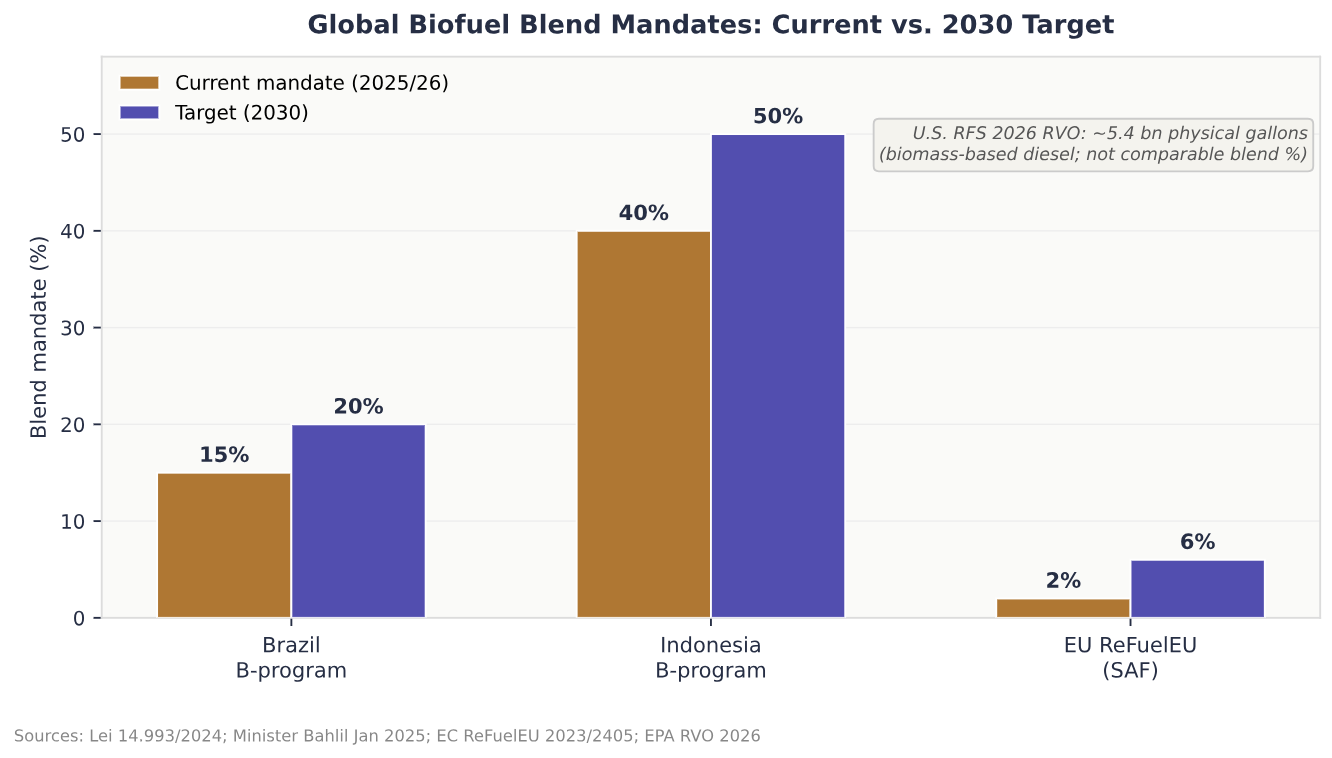
The convergence point is the Rotterdam soybean oil basis. Four mandates want soybean oil; Argentina produces it, and the DEX schedule and BCRA corridor decide when, and at what FX rate, it flows. That is the step function: not weather, not a smooth curve, but a sequence of binary policy events governed by legislative calendars, feasibility studies, and elections.
The "which mandate clears first" question is not metaphorical — it is the spread trade. The trader who knows whether the 45Z final rulemaking, B16 passage, or B50 announcement arrives first has the position.
Closing: Three Clocks, One Spread
Which threshold clears first, the 45Z rulemaking, the Argentine DEX/FX clock, or the conditional B16 and B50 increments, is the question that decides the spread. The Rosario crush corridor's response to each is where the tradable edge lies.
Our CEO described a moment when fertilizers became a strategic input. The vegetable oil complex is where the energy clock, fertilizer clock, and climate clock now converge into a single tradable spread — priced not on weather, but on which policy mandate clears first.



.png)

Personalized commodity intelligence for the teams that feed the world.
