
What Happens When Coffee Farmers Get AI-Powered Climate Intelligence: Lessons from COSA, Ethos, & Progreso in Rwanda and Uganda
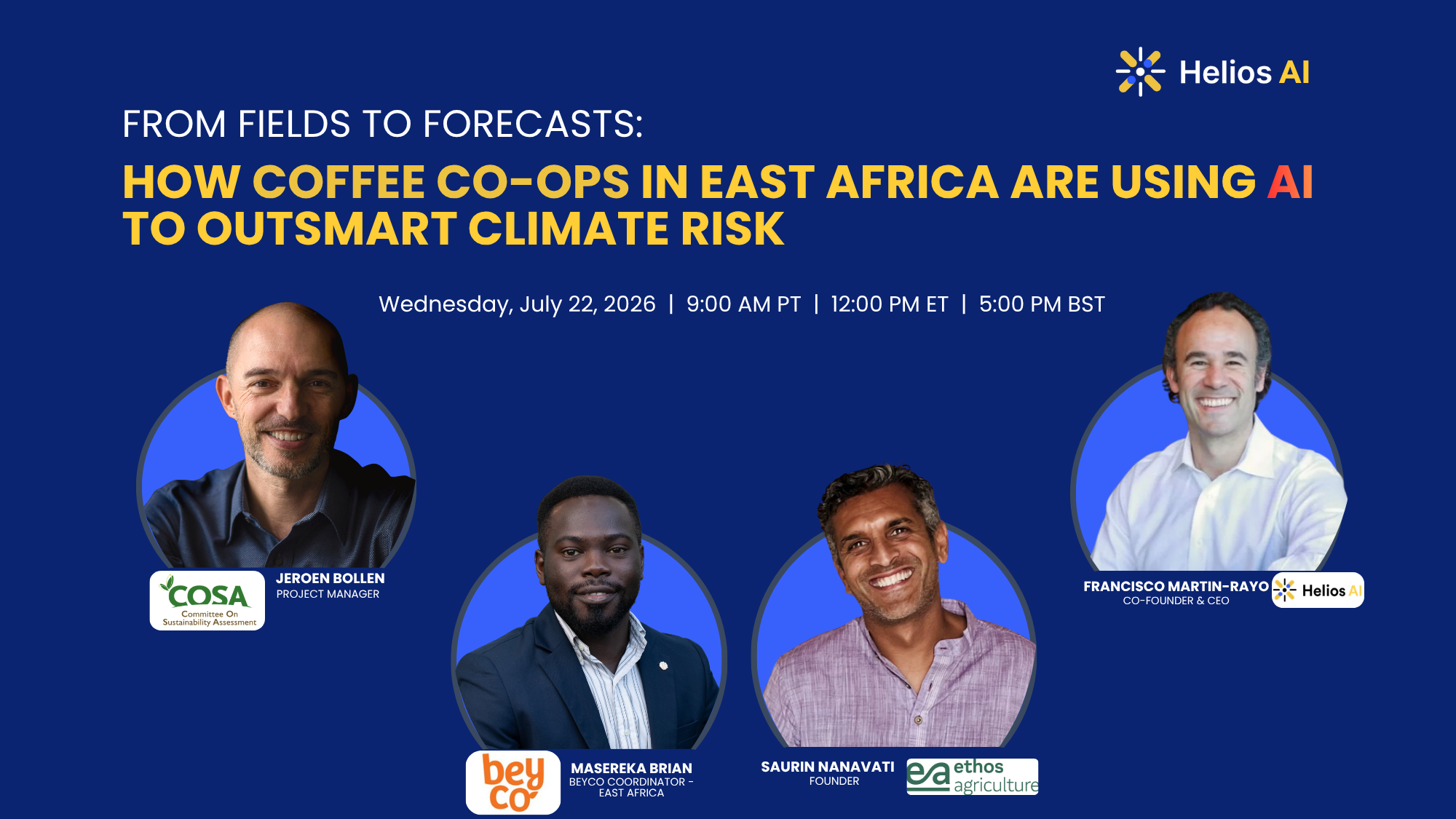
Last week, Helios AI and Committee on Sustainability Assessment COSA hosted a live fireside chat with Ethos Agriculture and Progreso Foundation to share…
July 27, 2026
6 min read
Coffee farming in Rwanda and Uganda has always run on generational knowledge. Farmers know that in July or August it rains. In October, the sun comes out. This is when to plant. This is when not to plant. For generations, that knowledge was enough.
Climate change broke it. Abrupt rains arrive mid-season. Dry spells land where they never used to. And a smallholder farmer with roughly 40 harvests in a lifetime cannot afford to bet on signals that no longer hold.
Last week, Helios AI and Committee on Sustainability Assessment COSA hosted a live fireside chat with Ethos Agriculture and Progreso Foundation to share results from a Gates Foundation-funded pilot bringing AI-powered climate intelligence to coffee cooperatives in Rwanda and Uganda. Here is what we learned.
WATCH THE REPLAYWhat Is a Smallholder Coffee Farmer, and Why Does Climate Data Matter So Much to Them?
A smallholder farmer depends mostly on their own and their family's labor, farming plots as small as a few acres. They are members of cooperatives — producer organizations that aggregate their crops, negotiate contracts, coordinate logistics, and provide market access to buyers they could never reach alone.
What makes climate intelligence so consequential for these farmers is that coffee is rarely the only crop on the land. Most smallholders also grow food crops alongside their coffee to sustain their households. A dry spell does not just threaten the harvest they sell. It threatens the beans and soy they eat. When conditions turn without warning, farmers are forced into impossible choices: harvest coffee prematurely, or sell it while it is still in the garden just to make ends meet.
"So it's very crucial what we get in terms of real information, accurate data from Helios AI, the risk about certain crops, even not only coffee, because these coffee farmers do a lot of things and it helps the cooperatives and the farmers to get a stable income, but to also look at their livelihoods."
- Masereka Brian, Founder of Bagheni Coffee Estate and Beyco Coordinator at Progreso Foundation
How Have Coffee Cooperatives Historically Made Planting and Harvest Decisions?
Until recently, the answer was seasonal intuition, general weather forecasts, and what worked last year. Cooperatives programmed on a week-to-week basis, but the information rarely made it all the way to individual farmers. Most were left to follow what they did in previous seasons or copy what their neighbors were doing.
The problem was not just the lack of data. It was the lack of the right kind of data. A general weather forecast tells a cooperative manager that rain is coming. It does not tell them whether that rain will damage a drying batch, delay a transport route through dirt roads on a mountainside, or shift a harvest window with a contract deadline already in play. Crop-specific, location-specific risk is a fundamentally different signal, and it is the one that changes decisions.
"For too long, data has been extracted from farmers without giving anything meaningful back. With Helios AI, we're testing tools that make climate data accessible and practical, helping co-ops anticipate risk in real time."
- Jeroen Bollen, Senior Advisor & Project Lead at COSA
How Does AI-Powered Climate Intelligence Actually Work for a Coffee Cooperative?
The Helios AI platform covers 80+ commodities across 100+ countries, down to the 2.3 kilometer level. The world is divided into 14 million hexagons, each with 10 years of historical weather data and forward-looking climate risk signals updated every 24 hours. The output is not a generic forecast. It is crop-specific climate risk: what conditions mean for coffee, in this specific location, at this point in the growing season.
But data alone does not change decisions. The critical innovation in this pilot was how Ethos Agriculture translated that signal into something cooperatives could actually act on. Saurin Nanavati, Founder of Ethos Agriculture, created a coffee calendar: a planning tool that broke each month into four weeks and mapped cooperative activities against the climate outlook — planting, drying, transport, and export. Every month, cooperatives presented their calendars in a group session, creating peer-to-peer learning across the program.
"Getting one specific week wrong at the beginning of planting can affect your whole season's production. That's why this matters, it's about making the right decision at the right time."
- Saurin Nanavati, Founder, Ethos Agriculture
How Did Cooperatives Go From Skeptical to Trusting a New Data Source?
Adoption did not come from training sessions or presentations. It came from a prediction that held.
When cooperative managers first started using the platform, many were skeptical. They had relied on the same seasonal signals for decades, and there was understandable caution about betting a harvest on a new tool. What changed things was not persuasion — it was accuracy. Once a forecasted dry spell or rain event materialized exactly as the platform said it would, the question shifted from "should we trust this?" to "what does it say this week?"
At Abateraninkunga ba Sholi Cooperative, the signal moved from managers to farmers directly. In our partnership announcement, Sustainability Manager Gustave Nikomeze described the impact:
"The platform helps us know the right time for agricultural practices according to weather conditions. Our members now receive early warning information to cope with unfavorable climate."
- Gustave Nikomeze, Sustainability Manager
What Was the Biggest Surprise of the Pilot?
Every speaker had a version of the same answer: the speed of adoption, once trust was established.
Most assumptions about working with smallholder farmers in low-connectivity, low-literacy environments put adoption timelines in years. The pilot suggested something different. The cooperatives that engaged early began adapting the coffee calendar to their own conditions, sharing it with extension officers, and building it into their farmer training programs, without being asked to.
"When the dry spell came exactly as predicted, my parents stopped relying on what they had always known and started asking every week: what does the forecast say? Farmers adopt this faster than you think, as long as the signal is accurate."
- Masereka Brian, Founder of Bagheni Coffee Estate and Beyco Coordinator at Progreso Foundation
What Are the Real Barriers to Scaling This Beyond a Pilot?
The pilot surfaced three honest constraints. Language is the first: most farmers in East Africa do not read text messages sent in English, and information sent as a written alert rarely gets the same attention as a voice message or a phone call. Cost is the second: access to a platform needs to be priced in a way that is proportional to how often cooperatives use it and the value it delivers. The third is the human infrastructure required to help cooperatives interpret and act on the data — the monthly sessions that made this pilot work were resource-intensive, and scaling that model requires reducing the support layer without losing the impact.
None of these are permanent barriers, but they are real ones. The path forward is not just a better platform. It is integrating climate intelligence into the tools and workflows cooperatives already use.
What Does the Future of Climate Intelligence for Smallholder Farmers Look Like?
The platform is one delivery mechanism. But the vision is wider. Francisco Martin-Rayo, CEO and Co-Founder of Helios AI, closed the session with where it may go next:
WATCH FULL SESSION"Maybe in the future it's not the platform. Maybe it's WhatsApp. Maybe it's a voice note. The technology exists today: a farmer sends a picture of their crop, and you respond with an audio message. That's the next pilot."

.png)

Personalized commodity intelligence for the teams that feed the world.
